Stalin’s Soviet Union · CHAPTER 4 ·
Stalin’s Five-Year Plans
Chapter 4 of The Soviet Union under Stalin, 1924–1953: “The Five-Year Plans”
From 1928 Gosplan’s Five-Year Plans set output targets for every industry as political commands and poured resources into steel, coal, machinery and electricity. Stalin argued in 1931 that the USSR had ten years to catch up, and new plants such as Magnitogorsk, which lit its first blast furnace in 1932, moved industry east.
Chapter 4 is included with every paid plan. WW2 is free in full, and chapter 1 of every atlas is free. A free account opens 3 more chapters a day. Starter, at $9 a month, opens all 21 with no daily limit — see the plans.
Free printable Stalin’s Soviet Union study guide, sent by email ↓
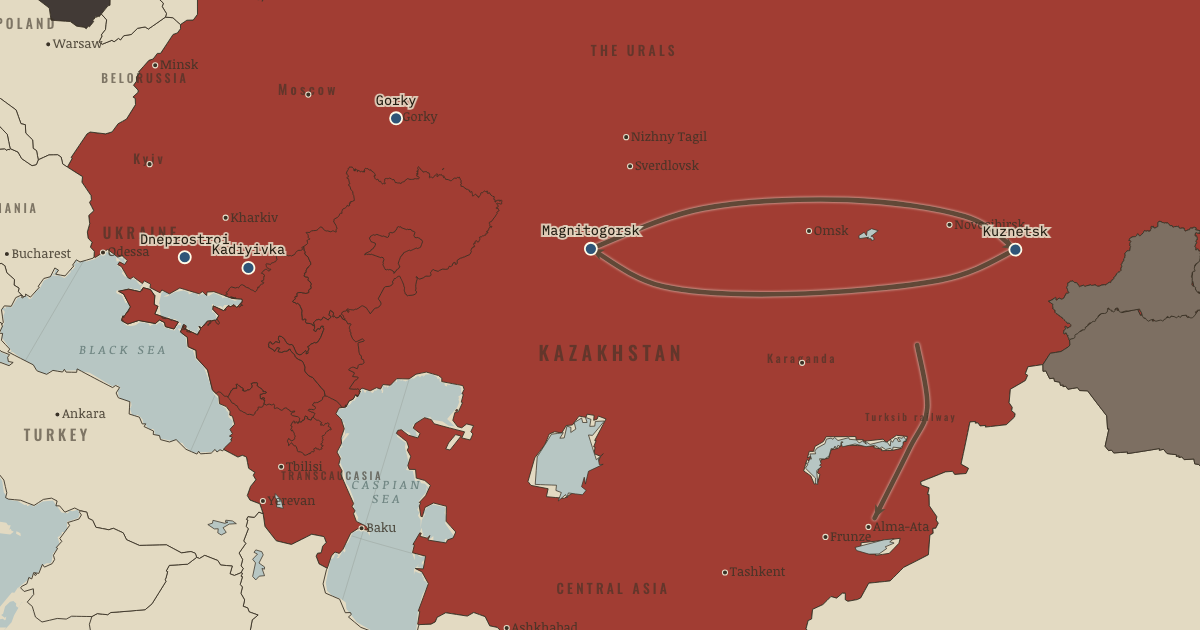
The map above is the world of The Soviet Union, August 1935 — The Second Five-Year Plan: steel, coal and camps.
Every state on the map that year: The world in 1938 · Europe in 1938.
Part of IB History: The Soviet Union under Stalin →
SHORT EXPLANATION
In February 1931 Stalin told the Soviet Union that it was “fifty or a hundred years behind” the advanced countries. It had ten years to catch up, he said, “or they crush us”. Industrial growth was presented as a condition of survival, and the First Five-Year Plan of 1928–32 put steel, coal, machinery and electricity ahead of other needs.
Gosplan, the State Planning Commission, set output targets for every industry. Like a company’s five-year budget, the plan specified production; unlike an ordinary budget, its targets were political commands, and a shortfall could be treated as sabotage. Leaders raised those targets repeatedly as they competed to show ambition. The premise was that orders from above could make a planned economy grow faster than a market.
Official figures show steel rising from about 4 million tonnes in 1928 to 18 million in 1940, and coal from 35 to 166 million. Western recalculations are lower, but still show some of the century’s fastest growth. The map marks Magnitogorsk and Kuznetsk, joined by the Urals–Kuznetsk ore and coal shuttle, the Dnieper dam, the Gorky car plant and Turksib railway linking Siberia to Central Asia. Millions of peasants became workers and unemployment vanished.
The builders paid for those gains. Real wages, measured by what pay could buy, fell sharply in the early 1930s. Food and housing were scarce, waste was immense, and prisoners and deportees built much of the new industry. The factories would help win a war; their construction imposed a heavy price on the people who worked in them.
The full story
Gosplan’s First Five-Year Plan resembled a company’s budget in one respect: it assigned factories amounts to produce. But its targets had the force of law. In 1929 the leadership chose the most ambitious draft for 1928–32, called the “optimal variant”, and then raised its demands further. The overriding purpose was speed, even when the cost was high.
The target for pig iron—the crude iron used to make steel—shows what this meant in practice. For 1932 it rose from 10 million tonnes to 17 million; actual output was about 6 million. Managers faced punishment for missing orders, especially after mining engineers were accused of “wrecking”, or deliberate sabotage, at the Shakhty trial of 1928. They hoarded materials, inflated reports and pressed workers harder. In January 1933 the government nevertheless declared the plan fulfilled in four years and three months. Most targets had been missed, but heavy industry had grown quickly, and that growth was the achievement the regime chose to celebrate while consumers went short.
The map shows the new industrial centers in the east. Magnitogorsk, in the southern Urals, was modeled on the steelworks at Gary, Indiana; its first blast furnace was lit in early 1932. Kuznetsk in western Siberia followed months later. Each supplied something the other needed: trains carried Magnitogorsk iron ore east and Kuznetsk basin coal west. The arrows trace this Urals–Kuznetsk Combine, a shuttle of about 2,000 kilometres each way.
Other projects connected distant regions and drew on foreign expertise. Turksib, completed in 1930, linked Siberian grain to Central Asian cotton. Foreign firms, many American, designed the Stalingrad tractor works and Gorky car factory, while American engineers helped build the Dnieper hydroelectric dam, opened in 1932. The remote eastern sites were expensive to build, but their distance from the borders put industry beyond invaders’ reach. A decade later that location helped decide the war.
The plans changed workers’ daily lives as well as the landscape. As food went to export and rationing returned, real wages—the goods pay could buy—fell steeply between 1928 and 1932. Workers left jobs in such numbers that managers competed for them with bonuses and housing. The state used coercion too: labour books introduced in 1938 recorded employment and tied a worker to a job, much like a work permit held by an employer. Harsh discipline laws followed in 1940.
Rewards and pressure met in the Stakhanovite movement. In August 1935 the miner Alexei Stakhanov cut 102 tonnes of coal in one shift at Kadiyivka, about fourteen times the norm, the output expected of a miner much like a sales target. Record-breakers gained pay and prestige, but their records helped raise expectations for everyone else. Meanwhile prisoners in the political police’s expanding economy dug canals, mined gold and built railways. The industrial power created by the plans drew on both free and unfree labour, and treated both as resources to be spent.
FULL EXPLANATION
How fast did the economy really grow?
Soviet statistics claimed industrial growth of more than 15 percent a year in the 1930s. Naum Jasny and Abram Bergson spent years testing such claims by recalculating output at consistent prices. Bergson estimated national income growth of about 5 to 6 percent a year in 1928–40: fast internationally, though much lower than the official picture. Inflated prices for new products and falling quality as quantity rose helped produce the gap. Growth also leaves a further question: what happened to living standards? Robert C. Allen’s Farm to Factory (2003) argues that the industrial “big push” improved them over the decade as a whole when education, health and urban jobs are counted. R. W. Davies and Mark Harrison emphasize the collapse of consumption in 1930–33 and waste from unfinished projects. The evidence supports rapid growth of heavy industry and military power alongside low consumption and large hidden losses.
Stakhanovism: reward and pressure
Stakhanov’s extraordinary shift was organized as an event. Lewis Siegelbaum’s Stakhanovism and the Politics of Productivity (1988) describes how the mine’s party organizer selected him, assigned helpers to prop the roof and remove coal, and invited a reporter for 30–31 August 1935. Within weeks industries had their own record-breakers, who received higher pay, apartments, holidays and medals. Stalin told their November 1935 conference that “life has become better, comrades; life has become more joyous”. For ordinary workers, the records had another consequence. They helped justify higher output norms in 1936, so pay fell unless workers produced more. Some Stakhanovites were assaulted by fellow workers; managers unable to reorganize production around the records faced accusations of sabotage. Siegelbaum shows real advancement for some and resentment among many. The movement faded after 1937 as the Terror turned attention from records to enemies.
The police economy
The political police became one of the country’s largest construction organizations, as archival research since 1991 by Oleg Khlevniuk and others has shown. Its prisoners dug the White Sea and Moscow–Volga canals, built the Baikal–Amur railway, mined gold in Kolyma and coal in Vorkuta, and felled timber across the north. By 1940 the NKVD’s economic directorates held a significant share of national capital investment and produced most Soviet gold and much of its timber and nickel. Whether this was efficient remains disputed. Paul Gregory and others find prisoner labour costly once guards, transport and high mortality are counted; Gulag officials themselves complained of low productivity. The system offered planners another advantage: prisoners could be sent where free workers would not go. It allowed the state to colonize the north and east by command, whatever the cost per tonne.
Key places on the map
On this day
Why it happened
Fear of war drove the pace. The Bolsheviks expected capitalist powers to attack the first socialist state, and the war scare of 1927 made preparation urgent. Steel and machinery could supply tanks, aircraft and artillery, so heavy industry took priority over consumer goods and defence plants received scarce materials first. Stalin’s February 1931 warning gave the country ten years to catch up and justified the sacrifices demanded; the deadline proved almost exactly right.
Ideology demanded a socialist economy. For Marxists, a socialist society required large-scale industry and an industrial working class. NEP had left the economy dominated by peasants and small traders. Planning promised both a different society and an alternative to the market’s booms and slumps. After 1929 many Western observers found this attractive: the Great Depression brought soaring unemployment in the West while Soviet factories were hiring.
Collectivisation released grain and labour. Industrial towns needed food, and foreign machinery had to be paid for. Control of the harvest gave the state grain for both purposes, even during famine; exports reached about 5 million tonnes in 1931 and paid for imported machine tools. Collectivization also sent millions of peasants into industry. Some fled the farms as migrants; deported “kulaks” were sent to sites such as Magnitogorsk. The two revolutions of 1929 were designed to work together, each depending on the other’s violence.
Political competition inflated the targets. After the Right’s defeat, a warning that a target was unrealistic could be dangerous. Raising it demonstrated loyalty: the 1932 pig-iron target went from 10 to 17 million tonnes. The slogan “there are no fortresses Bolsheviks cannot storm” made caution sound like cowardice. Planners and managers had incentives to promise more than they could deliver, building waste and falsified reports into the system.
THE TURNING POINT
Magnitogorsk, February 1932. Three years before the first blast furnace was lit at Magnitogorsk in February 1932, its site had been empty steppe. The furnace showed that a heavy industrial base could be built in the east. With Kuznetsk it formed a second metallurgical center beyond the reach of a European army. In 1941 German forces overran Ukraine’s old industrial regions, while the Urals and Siberia produced much of the steel for Soviet tanks. The plans’ most expensive decision became their most important.
What it changed
The industrial base for victory in 1941–45. When the western industrial regions were lost in 1941, factories in the Urals and Siberia supplied the Red Army through the war. The experience of building and moving whole plants also helped make the 1941 evacuation possible. Even historians severely critical of Stalinism regard the industrial base as the plans’ decisive result, though they debate whether a less brutal path could have reached the same end.
A society of new workers and new managers. Industrialization made millions of peasants into urban workers and opened careers to young people from peasant and working-class families. Trained as engineers and managers, these vydvizhentsy (“promoted ones”) owed their rise to the regime and formed the core of its support. Two members of the generation, Leonid Brezhnev and Alexei Kosygin, ran the Soviet Union in the 1960s and 1970s; the generation promoted by the plans governed into the 1980s.
Shortage as a way of life. Heavy industry received resources that could otherwise have supplied food, housing and consumer goods. Shortages became ordinary: people queued, lived in crowded communal apartments, used a thriving black market and faced rationing until 1935. Officials obtained the best goods from closed shops. Connections helped people find what they needed, and the shortage economy shaped their dealings with the state until the Soviet Union ended.
Scapegoats for every failure. If the plan could not officially fail, someone else had to explain missed targets, accidents and shortages. Engineers were accused of “wrecking” at the Shakhty trial of 1928 and the Industrial Party trial of 1930; managers and officials followed during the Terror. Economic failures became evidence of sabotage, linking production to the arrests of 1936–38, when industrial managers were among the most heavily purged groups.
DISCUSSION QUESTION — To what extent were the Five-Year Plans a success?
By Stalin’s priorities, the plans largely succeeded. Steel, coal and electricity output multiplied, a second industrial base rose in the Urals and Siberia, and the Soviet Union out-produced Germany in tanks and aircraft during the war. Even the skeptical recalculations of Bergson and Jasny show unusually fast growth. A judgment based on the lives of workers and peasants looks different: real wages fell sharply in the early 1930s, famine killed about 5.5 to 8.7 million people, consumer goods remained scarce and much new industry depended on forced labour. Unfinished projects, falsified reports and poor quality added waste. Robert Allen and other historians argue that growth came largely from moving peasants into industry, which a less violent policy might also have achieved. The plans succeeded on Stalin’s terms while failing socialism’s promise of higher living standards, a pattern seen in many states industrializing by command.
An interesting fact
An American worker left one of the best accounts of Magnitogorsk. John Scott left the University of Wisconsin in 1931 and went to the Urals in 1932, working as a welder and rigger. He married a Russian teacher and stayed until 1938. His memoir Behind the Urals (1942) describes temperatures of minus 40 degrees, tents and barracks, and constant accidents, as well as genuine enthusiasm among young builders. Stephen Kotkin drew on Scott and the city’s archives in Magnetic Mountain (1995), arguing that Stalinism was a whole civilisation people learned to live inside and whose language they learned to speak.
Related
THE FREE PRINTABLE STUDY GUIDE
Get the printable study guide for The Soviet Union under Stalin free. I’ll send you a few short letters, then one when a new atlas opens. That’s all. — Paul
NO TRACKING · YOUR ADDRESS IS USED FOR THE DISPATCH AND NOTHING ELSE · UNSUBSCRIBE ANYTIME