Stalin’s Soviet Union · CHAPTER 1 ·
Stalin’s rise to power
Chapter 1 of The Soviet Union under Stalin, 1924–1953: “The Succession”
When Lenin died in January 1924, Stalin was the rival others feared least, yet as General Secretary he controlled party appointments. Zinoviev and Kamenev shielded him from Lenin’s Testament because they needed him against Trotsky, who was exiled to Alma-Ata in January 1928; by 1929 Stalin led without rivals.
WW2 is free in full, and chapter 1 of every atlas is free. A free account opens 3 more chapters a day. Starter, at $9 a month, opens all 21 with no daily limit — see the plans.
Free printable Stalin’s Soviet Union study guide, sent by email ↓
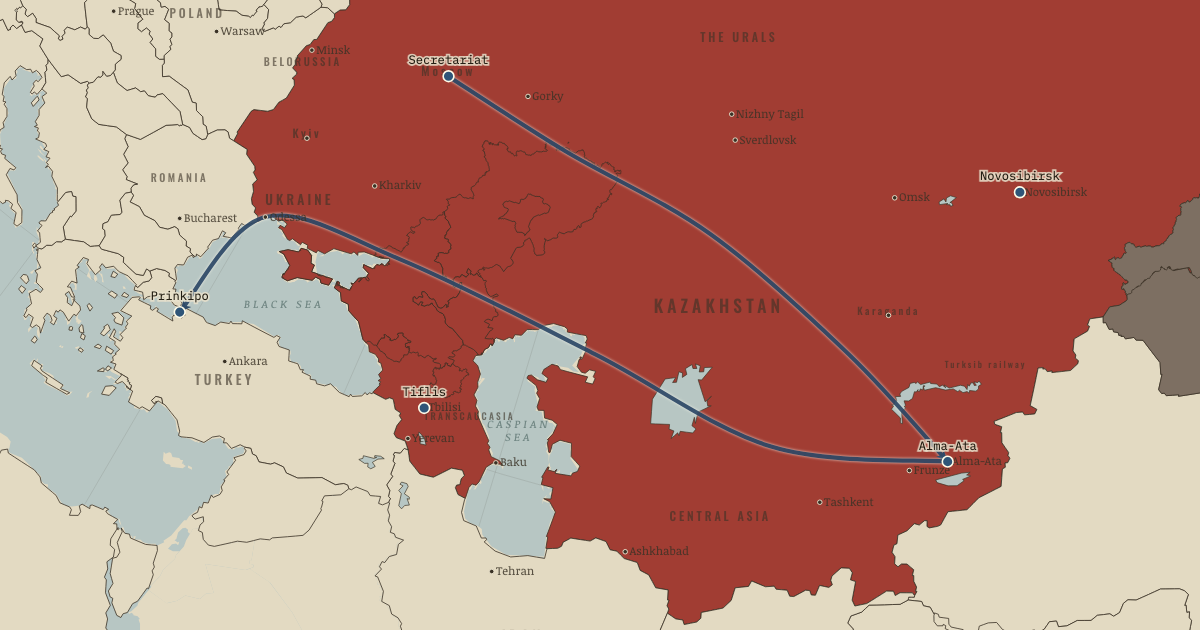
The map above is the world of The Soviet Union, January 1928 — Trotsky exiled; Stalin’s Siberian tour begins.
Every state on the map that year: The world in 1930 · Europe in 1930.
Part of IB History: The Soviet Union under Stalin →
SHORT EXPLANATION
When Lenin died in January 1924, the Communist Party had to decide who would guide the Soviet state he had founded. Leon Trotsky had built the Red Army, and Nikolai Bukharin was the party’s favorite thinker. Joseph Stalin seemed less formidable: as General Secretary, he supervised an office concerned with appointments. Yet this apparent administrator would acquire more power over more people than any earlier Russian ruler, hold it for a quarter of a century, and impose a great cost on those he governed.
The party, known as the Bolsheviks until 1918, allowed no rival parties and controlled the government much as a parent company controls a subsidiary. Its congresses elected the leadership, and local secretaries helped choose their delegates. Stalin’s Secretariat appointed those secretaries. What looked like a chief of staff’s work gave him influence over the votes on which the succession would depend.
Stalin joined Grigory Zinoviev and Lev Kamenev against Trotsky, broke with them in 1925, and defeated the three men when they united in 1926–27. His promise of “socialism in one country” gave a tired party reason to support him: the Soviet Union could build a new society without waiting for revolution abroad. Police sent Trotsky to Alma-Ata in Kazakhstan in January 1928, along the first blue arrow. The same month Stalin seized grain in Siberia, bringing him into conflict with Bukharin and the Right, who defended the free grain market under Lenin’s 1921 New Economic Policy (NEP). By Trotsky’s deportation to Turkey in 1929, shown by the second arrow, Stalin had eliminated his rivals through alliances, an appealing program, and control of party appointments.
The full story
Lenin had tried to warn his colleagues about Stalin. After strokes left him partly paralyzed, he dictated notes in December 1922 and January 1923 that became known as his Testament. He said Stalin had accumulated “unlimited authority” and, in a postscript dated 4 January 1923, called him “too rude” and proposed removing him as General Secretary. The dispute behind this warning was the Georgian Affair, marked at Tiflis: Stalin and his ally Sergo Ordzhonikidze had bullied Georgian communists into a federation with Armenia and Azerbaijan.
The warning reached the men who could act on it. At the Thirteenth Congress in May 1924, the notes were read to delegation leaders. Zinoviev and Kamenev wanted Stalin’s help against Trotsky and argued that he should remain in office. Their choice preserved the administrative position Lenin had regarded as dangerous. The Testament remained unpublished in the Soviet Union until 1956.
That office mattered because decisions about personnel reached all the way to the congress floor. Stalin’s apparatus installed provincial secretaries, who selected delegates; the congresses then elected the leadership. The “Lenin Enrolment” of 1924 added more than 200,000 members, mostly young workers whose careers depended on officials able to promote them. The system of posts reserved for appointment by the center later became known as the nomenklatura. It gave loyalty a practical reward and helped Stalin assemble majorities.
Appointments were not his only advantage. Trotsky’s “permanent revolution” held that socialism could survive only if revolution spread to Europe. Stalin’s “socialism in one country” offered the party a more immediate prospect: building a strong state at home. At the Fourteenth Congress in December 1925, Zinoviev and Kamenev’s Leningrad delegation was overwhelmingly outvoted. Sergei Kirov was then sent to take over their city. The debate ended in a defeat for which much of the organizing had already been done.
The defeated leaders tried to combine their forces. Trotsky, Zinoviev and Kamenev formed the United Opposition in 1926, but their supporters were dismissed and expelled; Trotsky and Zinoviev themselves were expelled from the party in November 1927. On 17 January 1928 the OGPU, the political police and a forerunner of the KGB, carried Trotsky to a train for Alma-Ata. He was deported to Turkey in February 1929, as the blue arrows show.
A crisis in grain deliveries now brought a different alliance to an end. In Siberia Stalin used force to seize grain, moving toward a measure the defeated Left around Trotsky and Zinoviev had demanded. Bukharin, Alexei Rykov and Mikhail Tomsky wanted to retain NEP, under which peasants could sell grain on the market. Branded the “Right deviation”, they were removed in 1929–30. Stalin had used NEP against the Left and then abandoned it against the Right. This made policy a weapon in the struggle, although historians disagree about how far conviction also guided his choices.
FULL EXPLANATION
Reading Lenin’s Testament
The Testament was dangerous reading for more than Stalin. Lenin praised Trotsky’s ability but criticized his “excessive self-assurance”; he called Bukharin the party’s favorite while questioning whether his views were fully Marxist. He recalled that Zinoviev and Kamenev had opposed the October 1917 seizure of power, and proposed a Central Committee of fifty to a hundred members to dilute disputes at the top. Only the postscript of 4 January 1923 proposed removing Stalin. The leaders had reasons of their own to keep the document quiet. Its authorship is disputed. Stephen Kotkin points out that the notes were typed and unsigned and passed through Lenin’s wife Nadezhda Krupskaya and his secretaries; he argues that authorship cannot be fully proved. Most historians, including Robert Service and Oleg Khlevniuk, accept them as Lenin’s, citing consistent dictation records and his angry letters about the Georgian Affair. In either account, the leaders treated the document as a political weapon, as Stalin would later treat Lenin’s legacy.
Machine politics or real support?
The machinery of appointments helps explain how Stalin obtained votes, but it does not by itself tell us why members supported him. Trotsky and his biographer Isaac Deutscher saw a bureaucracy that had smothered the revolution, represented by a mediocre Stalin. Robert V. Daniels described a “circular flow of power”: the General Secretary appointed regional secretaries, they chose congress delegates, the delegates elected the Central Committee, and the committee confirmed the General Secretary. Sheila Fitzpatrick and other social historians give more weight to the preferences of newly promoted workers and officials. Stalin’s blunt, practical manner and his promise of progress without foreign revolution appealed to them. Kotkin and Khlevniuk, drawing on archives, portray him as a tireless, well-read Leninist and accomplished committee worker. These explanations can reinforce one another: appointments helped secure the votes, while Stalin’s message gave many party members a reason to cast them for him.
The grain crisis that ended NEP
NEP allowed peasants to sell grain, but the state kept purchase prices low to finance industry. Manufactured goods were scarce and expensive, so the money from grain bought little. In autumn 1927 state purchases fell sharply, while a war scare grew after the Chinese Nationalists massacred communists in April and Britain broke relations in May. Stalin tested a coercive answer in Siberia in January–February 1928. His “Ural-Siberian method” closed markets, searched farms, and prosecuted grain holders under the criminal code. Bukharin warned that such measures would antagonize peasants and destroy NEP’s alliance between workers and peasants. Moshe Lewin and R. W. Davies show how emergency seizures reduced sowing the next year. The attempt to obtain grain could thereby deepen the shortage, and collective farms came to look to Stalin like the only exit.
Key places on the map
On this day
Why it happened
The party had no rules for succession. Lenin’s personal authority held together a leadership with no office of party leader and no settled succession procedure. The Politburo made policy, while the Orgburo and Secretariat dealt with personnel. When illness removed Lenin from active leadership in 1922, his colleagues governed collectively and competed for influence. Control of committees could gradually convert that collective authority into personal power.
The General Secretary controlled appointments. In April 1922 Stalin became General Secretary, a job his colleagues regarded as administrative. It gave him oversight of thousands of assignments and admissions, including the 1924 Lenin Enrolment. Provincial secretaries who owed him their positions selected congress delegates. Through these routine decisions he could gather a majority before his rivals recognized how formidable he had become.
His rivals feared Trotsky more than Stalin. The Bolsheviks knew the French Revolution’s history: a general, Napoleon Bonaparte, had seized power after it. Trotsky, creator of the Red Army, seemed the obvious candidate for that role. Zinoviev, Kamenev and Bukharin each joined Stalin to block him. Their choice made sense in light of their fear, but it left the quiet organizer free to turn the apparatus against each of them.
NEP’s grain problem made policy a weapon. Industrialization raised two connected questions: how fast should it proceed, and who should pay? The Left wanted resources taken from peasants for factories; the Right preferred the market and slower growth. The grain crisis of 1927–28 forced a choice. Having defended NEP against the Left, Stalin abandoned it and isolated the Right.
THE TURNING POINT
Alma-Ata, January 1928. On 17 January 1928 Trotsky was sent to Alma-Ata, 3,000 kilometres from Moscow, after expulsion from the party. The journey removed the last leader with an independent following and marks the settlement of the succession. Stalin traveled in the same month to Siberia, where he began taking grain by force. The defeated Left had urged a similar measure. With that opposition out of the way, Stalin could take up its program against the Right; the succession struggle was becoming a revolution against the peasants.
What it changed
A leader without rivals launched the Great Turn. Victory in 1927–29 left Stalin able to impose forced collectivization and rapid industrialization without an opposing faction to stop him. His choices for 1929–33 received the approval of a Politburo filled with allies, including Vyacheslav Molotov and Lazar Kaganovich. A leader who argued for slower change risked being called a “Rightist”. The succession had determined the pace of change as well as its author.
Defeated rivals became future defendants. The men defeated in the succession struggle later figured in the Great Terror. Zinoviev and Kamenev were shot in August 1936 after the first Moscow show trial; Bukharin and Rykov were shot in March 1938. Tomsky killed himself in 1936 before arrest, and an NKVD agent murdered Trotsky in Mexico in 1940. The trials accused former oppositionists of plotting with foreign powers since the 1920s.
Loyalty replaced debate inside the party. Public argument had already been weakened by the 1921 ban on factions. Once the remaining open factions were defeated, opposition brought expulsion and later arrest. Officials learned to anticipate Stalin’s wishes. Ian Kershaw used the phrase “working towards the Führer” for a comparable habit in Hitler’s Germany; under Stalin, anticipation also made the cult and the Terror easier to organize.
“Socialism in one country” justified the plans. The slogan “socialism in one country” gave the later plans a rationale as well as helping Stalin win. If socialism had to be built in a Soviet Union surrounded by enemies, industrialization could be presented as essential to survival. The Five-Year Plans put that idea into practice, with defense as their deepest purpose. Their sacrifices could be justified by the prospect of fighting a war alone.
DISCUSSION QUESTION — Did Stalin win the succession mainly through his own skill, or because his rivals made it easy for him?
Stalin made effective use of opportunities his rivals gave him. He recognized the value of Secretariat appointments in producing majorities, chose allies carefully, and offered “socialism in one country” to a party tired of waiting for revolution abroad. Zinoviev and Kamenev protected him from Lenin’s Testament in 1924; Trotsky declined to fight openly while he still had support in the army and among students; Bukharin underestimated Stalin until 1928. Historians assign different weights to these advantages. Deutscher and Daniels emphasize the machine, Kotkin Stalin’s intelligence and conviction, and Fitzpatrick support from below. The strongest judgment combines control of appointments with his rivals’ misjudgments: none of them matched his votes, timing and message. Where succession has no settled rules, routine administration can become a route to power.
An interesting fact
Alma-Ata was remote, but Trotsky continued to lead an opposition network from exile. His biographers Isaac Deutscher and Pierre Broué report that he and his son Lev Sedov sent about 800 political letters and 550 telegrams between April and October 1928. They received around 1,000 letters, many from oppositionists exiled across Siberia and Central Asia. The OGPU read much of this correspondence, helping convince Stalin that distance within the Soviet Union had not ended Trotsky’s influence. Deportation abroad in February 1929 removed him from the country but left him able to write. From 1929 his Bulletin of the Opposition, published abroad, continued attacking Stalin’s policies for the next decade.
Related
THE FREE PRINTABLE STUDY GUIDE
Get the printable study guide for The Soviet Union under Stalin free. I’ll send you a few short letters, then one when a new atlas opens. That’s all. — Paul
NO TRACKING · YOUR ADDRESS IS USED FOR THE DISPATCH AND NOTHING ELSE · UNSUBSCRIBE ANYTIME