Stalin’s Soviet Union · EPILOGUE ·
Death of Stalin and de-Stalinisation
Chapter 12 of The Soviet Union under Stalin, 1924–1953: “Death and Judgement”
After Stalin died in March 1953, his successors amnestied about 1.2 million prisoners, declared the Doctors’ Plot invented and began to dismantle the camps, while prisoners struck at Norilsk, Vorkuta and Kengir. In February 1956 Khrushchev’s Secret Speech denounced Stalin’s cult of personality.
Chapter 12 is included with every paid plan. WW2 is free in full, and chapter 1 of every atlas is free. A free account opens 3 more chapters a day. Starter, at $9 a month, opens all 21 with no daily limit — see the plans.
Free printable Stalin’s Soviet Union study guide, sent by email ↓
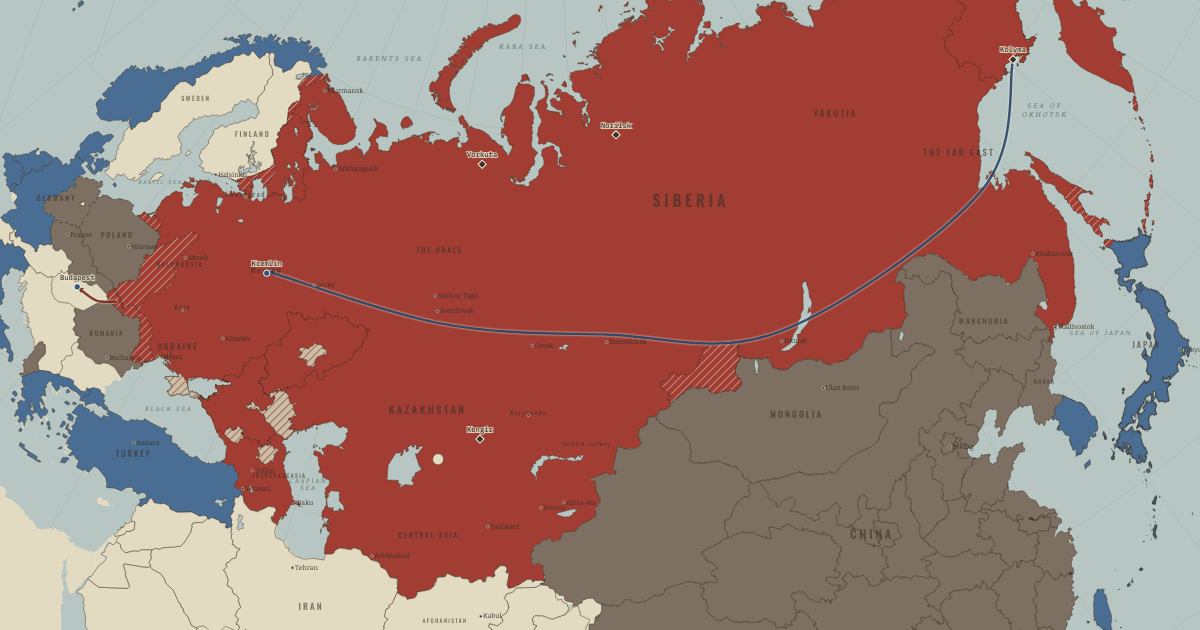
The map above is the world of The Soviet Union, February 1956 — The Secret Speech.
Every state on the map that year: The world in 1960 · Europe in 1960.
Part of IB History: The Soviet Union under Stalin →
SHORT EXPLANATION
Stalin built his power through control of the party machine, then preserved it through terror, propaganda, mobilization and victory. Millions paid with their lives or freedom. When he died in March 1953, his colleagues had to decide which parts of the system they would keep.
Their first decisions came quickly. An amnesty, a mass release by decree, freed about 1.2 million prisoners; the doctors accused in the fabricated “Doctors’ Plot” were released too. Prisoners themselves demanded reviews of their cases in strikes at Norilsk, Vorkuta and Kengir in 1953–54. The map no longer shows dark hatching over Kolyma: Dalstroi, the police trust that had ruled the region, lost its camps, and the land became an ordinary province. Police chief Lavrenty Beria initiated many reforms, but his colleagues arrested him in June 1953 and he was shot. The camp empire began to dissolve.
In February 1956 Nikita Khrushchev offered the fullest judgment yet made from inside the system. At a closed session of the Twentieth Party Congress, the national gathering of the party, he condemned Stalin’s “cult of personality”—the official worship of a living leader—and described the torture and execution of loyal communists and the deportation of whole nations. His “Secret Speech” said nothing about the famines or collectivization, the forced merger of peasant farms into state-run collectives. Many people in the hall had helped operate the system whose crimes he attributed to one man.
The effects reached beyond the congress. Prisoners returned home, as the long arrow from Kolyma suggests, and Poles and Hungarians demanded change. Soviet tanks crushed the Hungarian revolution in November. Was Stalinism the work of one man or of a system and a society? This atlas points to both: Stalin’s decisions were decisive, and many people carried them out.
The full story
On 1 March 1953 Stalin suffered a stroke at Kuntsevo, his dacha, or country house, outside Moscow. His guards were afraid to disturb him. He lay for hours before doctors were called and died on 5 March. The response of his colleagues revealed how much they had feared the man they served.
Georgy Malenkov, Beria, Khrushchev, Molotov and Nikolai Bulganin formed a collective leadership, a committee of supposed equals. Within weeks they began reversing measures associated with Stalin’s last years. The amnesty of 27 March released about 1.2 million prisoners, mostly people serving short sentences. On 4 April the Doctors’ Plot, which accused Kremlin doctors of murdering Soviet leaders, was declared a fabrication. Beria’s own control of the police frightened the others; they arrested him in June and had him shot in December. Their speed suggests that they had wanted reforms for years but had not dared propose them to Stalin.
The amnesty did not include many political prisoners. Since 1948 they had been concentrated in strict-regime “special camps”; many were former soldiers and partisans from the western borderlands. Younger, better organized and less afraid than the prisoners of the 1930s, they were able to press demands of their own. Strikes broke out at Norilsk in May 1953 and Vorkuta in July. At Kengir in Kazakhstan prisoners took control in May 1954 and held the camp for forty days, until tanks stormed it on 26 June.
They asked for sentence reviews, shorter working days and the right to write home. These strikes, marked on the map, were the last crisis of the Gulag, the forced-labor camp system. Commissions began freeing political prisoners, while the camp population fell from about 2.5 million in 1953 to under a million by the late 1950s. A system that had seemed permanent proved heavily dependent on Stalin’s will.
Khrushchev’s Secret Speech on 25 February 1956 attempted a different kind of change: it condemned the founder while seeking to save the system. Speaking for four hours, he read Lenin’s Testament aloud, described the torture of loyal communists and the deportation of whole peoples, and mocked Stalin’s wartime leadership. He dated the crimes from 1934. That choice left forced collectivization, the famines and the defeat of the oppositions outside the indictment; it also protected the party and men, including Khrushchev, who had served Stalin.
The speech was read at party meetings across the Union and leaked abroad. Its reception was not uniform. In Tbilisi in March 1956, students demonstrating in Stalin’s defense were fired on. In Poland and Hungary it encouraged demands for reform, and on 4 November Soviet tanks crushed the Hungarian revolution, as the last arrow shows. De-Stalinization meant dismantling Stalin’s cult and his worst methods. His successors would not let it threaten Soviet power itself.
FULL EXPLANATION
Totalitarianism and its critics
The totalitarian model begins with the state’s ambition and means of control. Hannah Arendt, in The Origins of Totalitarianism (1951), and Carl Friedrich and Zbigniew Brzezinski in 1956 described a single party, official ideology, terror and control of the economy and media dominating an atomized society. They compared Stalinism with Nazism. Robert Conquest and Richard Pipes wrote in this tradition. From the 1970s “revisionist” social historians, including Sheila Fitzpatrick, J. Arch Getty and Lynne Viola, asked what this picture left out. Workers and peasants negotiated, resisted and sometimes supported the regime; officials often governed in ways more chaotic and less powerful than the state’s claims suggested. The two schools also used different evidence: laws, speeches and émigré testimony for the first; local records, letters and ordinary lives for the second. Both illuminate the subject. One explains the regime’s aims and capacity for violence; the other shows how people lived under it and how policies changed in practice.
What the archives changed
After 1991 historians could examine Soviet records that had previously been closed. Politburo minutes, Stalin’s correspondence and NKVD reports confirmed his personal direction of the Terror, deportations and famine policies, supporting much of the totalitarian school’s account of the center. The documents also revealed resistance, adaptation, complaints and official improvisation, supporting social historians’ attention to society. The new evidence did not end the argument. Oleg Khlevniuk’s Master of the House (2009) and Stalin: New Biography of a Dictator (2015) show Stalin making key decisions himself, often in detail. Stephen Kotkin’s biography portrays a convinced Marxist-Leninist whose violence followed from his ideology and the structures Lenin left. Sheila Fitzpatrick’s On Stalin’s Team (2015) examines the surrounding politicians as a working group. An archival synthesis gives Stalin’s will a decisive place while using system, ideology and society to explain how his decisions became policy.
Memory and judgement
Stalin’s reputation has changed with political circumstances. Khrushchev began official de-Stalinization, but Brezhnev halted open criticism. Under Gorbachev’s glasnost after 1987 the full history became public, and Memorial began collecting victims’ names. After 1991 Ukraine, Kazakhstan, the Baltic states and others built national histories partly around famine, deportation and occupation. In Russia the image of Stalin as the wartime victor has been revived. Levada Center polls recorded rising positive views from the 2010s, reaching a record 70 per cent approval of his role in 2019; in 2021 Russia’s Supreme Court ordered Memorial dissolved. These memories have present political uses, but the historian must hold the evidence together. The state built factories that helped win the war, and it created camps and famines that killed millions. Neither fact cancels the other.
Key places on the map
On this day
Why it happened
The system depended on one man. Stalin’s colleagues had approved and carried out his policies, even while fearing him and privately doubting many of them. His concentration of power held the system’s extremes in place. After his death none of the heirs could claim his authority, and none had the authority or wish to continue mass terror. Within days they replaced personal rule with a collective leadership.
The Gulag had become too large and too costly. The camps held about 2.5 million people in 1953, with another 2.7 million in special settlements. Forced labor was unproductive and expensive to guard; Gulag officials and economic ministers knew that the system cost more than it produced. Beria proposed reducing it. Releasing prisoners and abandoning huge projects such as the Arctic railway from Salekhard to Igarka promised savings as well as relief from fear.
Prisoners and borderlands had stopped being afraid. Many political prisoners had served as soldiers or partisans and knew how to organize. In the special camps they built networks across national lines. Excluded from the amnesty, they refused to work, leaving the authorities to choose between reform and massacre. Tanks crushed Kengir in June 1954, while elsewhere the leadership mostly chose reforms. The strikes showed the limits of governing the camps through fear alone.
Stalin’s heirs needed a new legitimacy. Khrushchev and his colleagues needed an explanation for the killing of so many loyal communists under their government. Dating the crimes from 1934 and blaming Stalin personally allowed them to condemn the Terror while retaining the party, collectivization and the planned economy. The Secret Speech also strengthened Khrushchev against rivals such as Molotov and Malenkov, more closely associated with the worst years. It served his political ascent as well as the party’s search for legitimacy.
THE TURNING POINT
The Secret Speech, 25 February 1956. The Secret Speech transformed Stalin’s official place in the communist world from infallible leader to criminal. Khrushchev named the torture of loyal communists and deportation of nations, making rehabilitation and the return of prisoners official policy. But he omitted collectivization and famine and placed blame on one man, protecting the system and its leaders. Within months the speech encouraged demands in Polish and Hungarian streets. Soviet tanks then marked the limit beyond which the party would not let de-Stalinization go.
What it changed
The return of the prisoners. Hundreds of thousands of political prisoners were released between 1954 and 1960, and many were formally rehabilitated, often after death. Historian Stephen F. Cohen called this “the victims return”: survivors came home to colleagues and neighbors who had denounced them. For a time literature could describe the camps in print, including Solzhenitsyn’s One Day in the Life of Ivan Denisovich (1962).
Restored homelands, for some. The state restored some homelands sooner than others. In 1957 it restored the Chechen-Ingush, Kalmyk, Karachay and Balkar autonomies and allowed those peoples to return. Volga Germans were cleared of collective guilt in 1964 but never regained their republic. Crimean Tatars, whose homeland is still hatched on the 1956 map, could return only in 1989. Recognition of the wrong done to entire nations came slowly and unevenly.
Revolt and repression in the bloc. Reform in the Soviet bloc met different limits in Poland and Hungary. Polish protests in June 1956 brought Władysław Gomułka back without a Soviet invasion. Hungary’s October revolution was crushed by Soviet forces on 4 November, killing about 2,500 Hungarians and 700 Soviet soldiers. The speech had encouraged reformers, but the crisis showed that Moscow would allow changes of leadership without allowing a country to leave the Soviet alliance.
An unfinished reckoning. Stalin’s body left the Mausoleum in 1961, and cities bearing his name were renamed: Stalingrad became Volgograd. The reckoning did not reach the system itself. Under Brezhnev criticism was muted again, and only in the late 1980s did the full history of famine, Terror and the camps become public. The states that emerged in 1991 continue to debate his legacy.
DISCUSSION QUESTION — Was Stalinism the creation of one man, or of the Soviet system and society?
Stalin’s personal responsibility is central. Archives show him launching collectivization, approving famine measures, ordering the Terror and its quotas, signing execution lists and deciding the deportation of nations. Mass terror ended within weeks of his death. But a single man could not govern 170 million people or carry out those decisions alone. Lenin’s party supplied a ban on factions and a secret police; Marxist-Leninist ideology supplied a language in which class enemies and saboteurs had to be destroyed. Officials, police, activists and neighbors, millions of them, acted from conviction, fear or ambition. Social historians also show how resistance forced retreats and support sustained the regime. Stalin made decisive choices, while institutions and people turned them into action. The distinction helps explain why a dictatorship’s crimes can persist in institutions and memory after the dictator dies.
An interesting fact
After Stalin died, his embalmed body was placed beside Lenin in the Red Square Mausoleum, renamed the Lenin–Stalin Mausoleum. At the Twenty-Second Party Congress in October 1961, the elderly Bolshevik Dora Lazurkina, who had spent years in camps, told delegates that Lenin had appeared to her in a dream and disliked lying next to Stalin. The congress voted to remove him. On the night of 31 October his body was buried beside the Kremlin wall under a layer of concrete, and the Mausoleum again bore Lenin’s name alone.
Related
THE FREE PRINTABLE STUDY GUIDE
Get the printable study guide for The Soviet Union under Stalin free. I’ll send you a few short letters, then one when a new atlas opens. That’s all. — Paul
NO TRACKING · YOUR ADDRESS IS USED FOR THE DISPATCH AND NOTHING ELSE · UNSUBSCRIBE ANYTIME