Stalin’s Soviet Union · CHAPTER 3 ·
Holodomor and the Soviet famines
Chapter 3 of The Soviet Union under Stalin, 1924–1953: “The Famines”
Between 1930 and 1933 Soviet policy turned a crisis into famines in Kazakhstan, Ukraine, the Kuban and the Volga, with an estimated 5.5 to 8.7 million dead across the Union. In Kazakhstan forced settlement destroyed the nomads’ herds; in Ukraine and elsewhere Moscow kept grain quotas high after poor harvests.
Chapter 3 is included with every paid plan. WW2 is free in full, and chapter 1 of every atlas is free. A free account opens 3 more chapters a day. Starter, at $9 a month, opens all 21 with no daily limit — see the plans.
Free printable Stalin’s Soviet Union study guide, sent by email ↓
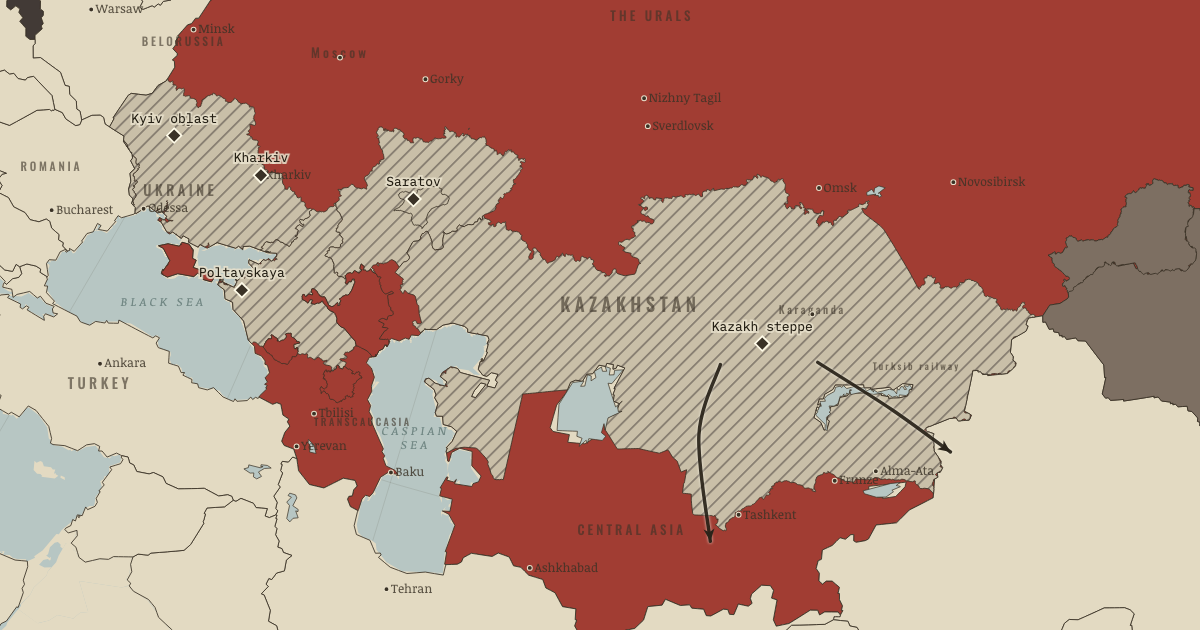
The map above is the world of The Soviet Union, winter 1932–33 — The famine at its height; Hitler in power.
Every state on the map that year: The world in 1930 · Europe in 1930.
Part of IB History: The Soviet Union under Stalin →
SHORT EXPLANATION
The hatched areas show a catastrophe made by Soviet policy, though its causes differed across the Union. In Kazakhstan the state forced nomadic herders onto collective farms and destroyed the herds on which they depended. A collective farm pooled villagers’ land and animals under state management; workers received what was left after the state’s share, rather as a sharecropper keeps what remains after a landlord’s cut.
In Ukraine, the Kuban in the North Caucasus, and the Volga region, the state demanded grain. Each farm owed a quota, a fixed delivery like a tax paid in kind. Moscow kept demands high as the harvests of 1931 and 1932 fell, leaving villages to bear the shortage. Across the Union, an estimated 5.5 to 8.7 million died. The estimates include 3.5 to 5 million in Soviet Ukraine, where the famine is called the Holodomor, “death by hunger”, and 1.5 to 2.3 million in Kazakhstan, perhaps two in five Kazakhs. These were the deadliest famines in Europe’s peacetime history.
Policy caused the famine; what the leadership intended remains disputed. Late in 1932 and early in 1933, blacklists cut villages off from goods, a December decree blamed Ukrainian nationalism, and the directive of 22 January 1933 prevented starving peasants from leaving to find food. These measures fell especially hard on Ukraine and the Kuban. Andrea Graziosi and Anne Applebaum see a famine deliberately turned against Ukrainians. Ukraine and many other states recognize it as genocide, the crime of seeking to destroy a national, ethnic or religious group, defined in international law in 1948. R. W. Davies, Stephen Wheatcroft and Stephen Kotkin see a ruthless pursuit of grain and control without an aim to destroy a nation. Both sides agree that the state could have saved most victims and chose not to.
The full story
Under Lenin’s New Economic Policy in the 1920s, peasants could sell their surplus much as farmers elsewhere sell to the highest bidder. Collectivization changed that bargain. The collective farms created in 1929–33 owed Moscow fixed deliveries, and the state took its share before the people who grew the grain could consume what remained. In 1930–32 it took about twice as much as peasants had sold under the earlier system.
A falling harvest therefore placed the villages in danger even before the state sent men to search them. In 1932 Stalin’s close colleagues Vyacheslav Molotov in Ukraine and Lazar Kaganovich in the North Caucasus led commissions that seized hidden grain, often taking seed needed for the next sowing. Hungry people could be punished for taking even a pocketful of ears from a field: the Law of 7 August 1932 made theft of collective-farm property punishable by death or ten years in a camp, and peasants who gleaned were prosecuted. The state continued to enforce its claim while the means of survival disappeared.
The largest hatched area shows a different disaster, which began earlier in Kazakhstan. Most Kazakhs were nomadic herders, moving animals between seasonal pastures. Party officials regarded this life as backward. From 1929 they requisitioned livestock for the towns, forced herders onto collective farms without adequate grazing, housing or wells, and punished resistance. Requisition meant taking animals by order; settlement deprived the remaining herds of the conditions that had sustained them. Between 1929 and 1933 their numbers collapsed by about nine-tenths.
The loss of the animals destroyed the herders’ livelihood. Between 1.5 and 2.3 million people died, perhaps 38 to 42 percent of all Kazakhs, and over a million fled. The arrows trace refugees toward Xinjiang in China and the oases of Uzbekistan. Death and flight left Kazakhs a minority in their own republic for half a century.
In Ukraine and the Kuban, the question was how the authorities responded once famine had begun. Between November 1932 and January 1933, decisions in Moscow and Kharkiv, then the capital of Soviet Ukraine, made it much deadlier. Villages behind on deliveries were blacklisted: manufactured goods were withheld and fines imposed in meat and potatoes. Entire Cossack settlements in the Kuban, including Poltavskaya, were deported north. The Cossacks descended from the frontier soldier-farmers of the tsarist empire.
The leadership also treated the grain crisis as a national political danger. The decree of 14 December 1932 linked the failures to Ukrainian nationalism and ended promotion of Ukrainian language and culture in the Kuban. On 22 January 1933 a directive ordered police to stop peasants fleeing Ukraine and the North Caucasus. By mid-February tens of thousands had been arrested, and many were sent back to villages where they died. Grain exports continued at a reduced level; relief arrived in spring 1933, after deaths had peaked. The hatching runs from the Dnieper to the Volga, and death rates were highest precisely where the state pressed hardest.
FULL EXPLANATION
How the dead are counted
The census of 1937 exposed a population shortfall, but the state suppressed it and arrested its organizers. Many deaths had never been registered. Demographers must therefore estimate how many more people died than would have died under normal mortality; they generally count births lost to the famine separately. For Soviet Ukraine, Omelian Rudnytskyi, Natalia Levchuk, Oleh Wolowyna and colleagues estimated about 3.9 million excess deaths in 1932–34 in a 2015 study. Other careful estimates range from 3.5 to 5 million. The 7 to 10 million figures circulated before the archives opened lack demographic support. For the Union in 1930–33, R. W. Davies and Stephen Wheatcroft suggest 5.5 to 6.5 million; Wolowyna’s 2020 estimate reaches about 8.7 million. Sarah Cameron and Kazakh demographers estimate 1.5 to 2.3 million in Kazakhstan. Different baselines, migration and the treatment of deaths in 1934 help explain the ranges.
The debate on intent
The evidence that policy caused famine is common ground; the question is what the leadership meant to accomplish. The case for genocide gives particular weight to measures directed at Ukraine and the ethnically Ukrainian Kuban: blacklists, the 14 December 1932 decree linking grain failures to Ukrainian nationalism, the January 1933 sealing of borders and simultaneous arrests of Ukrainian intellectuals. Raphael Lemkin, who coined “genocide”, described the destruction of the Ukrainian nation in a 1953 speech. Robert Conquest, Andrea Graziosi, Timothy Snyder and Anne Applebaum, with differing emphases, see famine deliberately turned against Ukrainians; Ukraine’s parliament declared it genocide in 2006. R. W. Davies, Stephen Wheatcroft and Stephen Kotkin read the documents differently. They see Stalin seeking grain and punishing resistance across regions, with Ukraine suffering most as the largest grain producer, but find no plan to exterminate Ukrainians. Michael Ellman calls the policies mass murder and argues that they fit broader definitions of genocide even without a plan. The dispute concerns both the documents and the intent a legal definition requires.
Kazakhstan: a forgotten famine
The Kazakh famine killed a larger share of a people than any other Soviet famine, yet it received little study before the 1990s. Its nomadic victims left few written records. Sarah Cameron’s The Hungry Steppe (2018), Niccolò Pianciola’s research and Robert Kindler’s Stalin’s Nomads (2014, in English 2018) show what happened when settlement was combined with livestock and grain requisitions. Ethnic tensions between Kazakhs and European settlers made the disaster worse, while officials reported success as districts emptied. Cameron argues that the famine created modern Soviet Kazakhstan: nomadism was destroyed and Kazakhs became a minority in their republic. She finds no evidence that it was planned as an attack on Kazakhs as a nation. Kazakhstan commemorates the victims each 31 May. In both Kazakhstan and Ukraine, policies for control and output became lethal; only in Ukraine were they explicitly tied to suspicion of a nation.
Key places on the map
Why it happened
Quotas set in Moscow ignored the harvest. A delivery target was also a test of loyalty. Moscow fixed quotas, and officials who reported a shortfall risked being accused of sabotage. After collectivization the state’s grain take roughly doubled, while harvests fell in 1931 and 1932 amid disorganized farms, exhausted horses, poor weather and peasants with little reason to work. Since the quota came first, the villages had to absorb the loss.
Collectivisation had destroyed the peasants’ reserves. A household facing a bad harvest once might have drawn on a cow or a store of grain. Collectivization removed much of that protection: in 1929–31 peasants slaughtered or lost about half their livestock, and the most productive farmers were deported as kulaks. When collective farms failed, families had little private reserve to fall back on. This helps explain why the shortage killed on a scale earlier shortfalls had not.
The party treated nomadism as backwardness. Soviet planners wanted settled farming and industry to replace what they regarded as primitive nomadic herding. From 1929 they pressed settlement and requisitioned livestock in Kazakhstan without providing the wells, fodder, housing or tools settled life required. They also wanted meat and grain for the towns, so livestock quotas rose as herds shrank. Officials competing to show progress drove herders onto farms unable to support them; their animals were eaten, confiscated or died.
Stalin read hunger as political resistance. Stalin saw falling deliveries in Ukraine and the Kuban as sabotage by kulaks and Ukrainian nationalists. In August 1932 he warned Kaganovich that “we may lose Ukraine”. That reading made the food crisis a political threat to be met with blacklists, deportations, purges of local officials and sealed borders. Hunger itself could be treated as evidence of resistance in the Union’s main grain region.
THE TURNING POINT
Kharkiv, November 1932 – January 1933. Famine was already killing when decisions in Moscow and Kharkiv closed off ways to survive. Blacklists of 18 November 1932 withheld goods; the decree of 14 December tied grain failures to Ukrainian nationalism; and the directive of 22 January 1933 sealed Ukraine and the Kuban as reserves ran out. Deaths peaked in spring 1933 in the villages cut off by these measures. Whether judged genocide or ruthless policy, the decisions help explain why Ukraine and the Kuban suffered more than any region except Kazakhstan.
What it changed
A demographic wound that shaped two nations. The losses changed the population of both republics. Millions died in Ukraine, overwhelmingly in the countryside, and Kazakhstan lost perhaps two-fifths of its Kazakh population. Russian and Ukrainian settlers later moved into emptied villages; Kazakhs did not again become a majority in Kazakhstan until after independence. The regime suppressed the 1937 census that revealed the losses and arrested the statisticians who recorded them.
Silence, then memory. For decades the state denied the famine, and mentioning it could bring arrest. Survivors in the diaspora preserved its memory until official denial ended in the late 1980s. After 1991 Ukraine made the famine central to national history, with a memorial museum in Kyiv and a November day of remembrance. Its meaning remains contested in Ukrainian and Russian politics, where it figures in each state’s account of the other.
The collective farm survived. The regime kept the collective farm while changing its rules. From 1933 fixed quotas per hectare sown replaced arbitrary requisitions, private plots were allowed, and grain stocks were rebuilt against another bad harvest. Peasants had learned that the state would take what it wanted first. The kolkhoz bargain settled into place: the famines secured the system that had caused them.
A pattern for treating nations as suspects. The December 1932 decree publicly linked a national culture to sabotage for the first time. Its underlying suspicion—that a whole people could be disloyal—returned in the Terror’s national operations of 1937–38 and the wartime deportations of entire peoples. What appeared in one decree became a recurring way of governing.
DISCUSSION QUESTION — Should the famine in Ukraine be judged as genocide, or as a famine caused by policy without the intent to destroy a nation?
The strongest case for genocide focuses on the measures from November 1932 to spring 1933 that fell specifically on Ukraine and the Kuban: blacklists, the 14 December decree linking grain failures to Ukrainian nationalism, sealed borders and arrests of Ukrainian intellectuals. Those who reject that conclusion point out that quotas and seizures also struck the Volga, Siberia and, proportionally worst of all, Kazakhstan. Stalin’s correspondence concentrates on grain and resistance, which he blamed on nationalists whom he suspected. The UN Genocide Convention requires intent to destroy a group “as such”, difficult to prove from documents written in the language of grain targets; Lemkin’s broader idea of destroying a nation’s social and cultural life fits more readily. A strong answer identifies the definition it uses and distinguishes the agreed cause from disputed intent. On either reading, deliberate choices made the dead victims.
An interesting fact
The famine reached Western news while it was happening, but reports were largely disbelieved. In March 1933 Welsh journalist Gareth Jones walked through Ukrainian villages and told a Berlin press conference he had seen mass hunger. Walter Duranty of The New York Times, who had won a Pulitzer Prize in 1932 for his Moscow reporting, replied with “Russians Hungry, But Not Starving”; other Moscow correspondents supported him. In 2003 the Pulitzer board declined to revoke the prize, while judging that his prize-winning reporting fell seriously short of today’s standards. Jones was killed in Inner Mongolia in 1935.
Related
THE FREE PRINTABLE STUDY GUIDE
Get the printable study guide for The Soviet Union under Stalin free. I’ll send you a few short letters, then one when a new atlas opens. That’s all. — Paul
NO TRACKING · YOUR ADDRESS IS USED FOR THE DISPATCH AND NOTHING ELSE · UNSUBSCRIBE ANYTIME