Stalin’s Soviet Union · CHAPTER 5 ·
Gulag forced-labour camps
Chapter 5 of The Soviet Union under Stalin, 1924–1953: “The Gulag”
From 1930 the Gulag, run by the political police, held prisoners in forced-labour camps, colonies and special settlements across the USSR. About 18 million people passed through the camps and colonies between 1930 and 1953, many sent to remote regions such as Kolyma to work the resources the plans needed.
Chapter 5 is included with every paid plan. WW2 is free in full, and chapter 1 of every atlas is free. A free account opens 3 more chapters a day. Starter, at $9 a month, opens all 21 with no daily limit — see the plans.
Free printable Stalin’s Soviet Union study guide, sent by email ↓
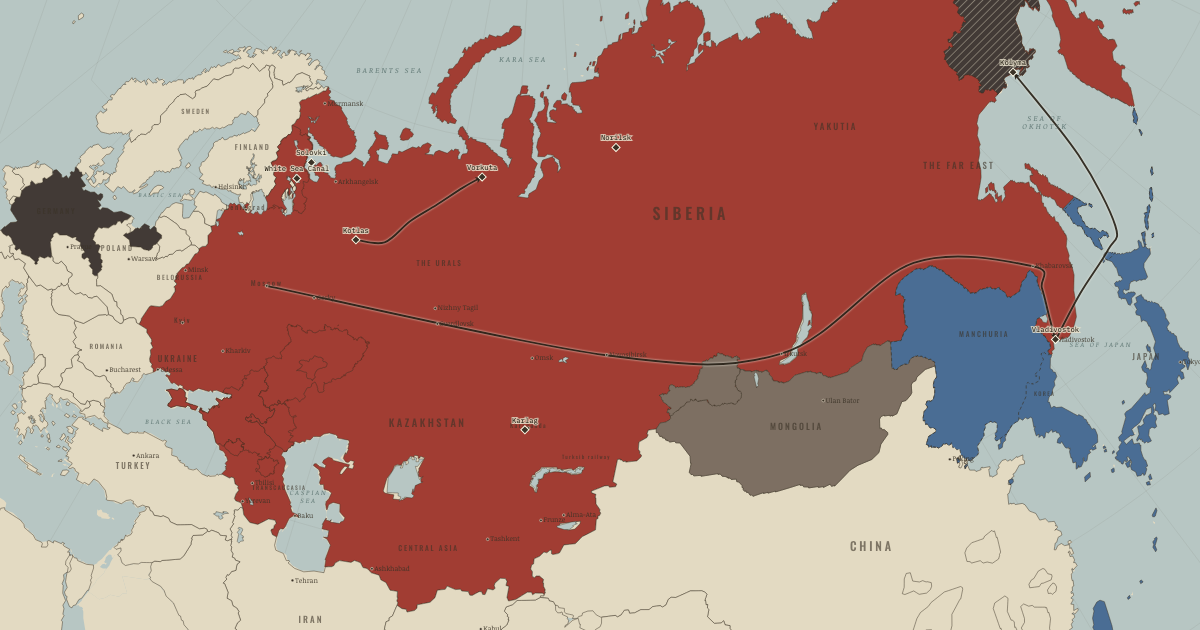
The map above is the world of The Soviet Union, August 1935 — The Second Five-Year Plan: steel, coal and camps.
Every state on the map that year: The world in 1938 · Europe in 1938.
Part of IB History: The Soviet Union under Stalin →
SHORT EXPLANATION
The diamonds trace a network that gave the Soviet state power over both the punishment and the work of millions of people. Gulag stood for the Main Administration of Camps, a department of the political police, a forerunner of the KGB, which ran forced-labour camps from 1930. Camps took prisoners sentenced to three years or more, colonies those with shorter sentences. Deported families who had not been formally convicted were confined in ‘special settlements’.
The numbers describe different parts of that system. About 18 million people passed through camps and colonies between 1930 and 1953, and millions more lived in special settlements. At its early-1950s peak, the camps and colonies held about 2.5 million at once. People entered, left or died over the years, so even that enormous population was only a portion of those affected.
The places on the map show what the state wanted from this captive workforce. The first great camp developed on the Solovetsky islands in the White Sea; prisoners dug the White Sea Canal in 1931–33. Later camps supplied workers for Vorkuta’s coal, Norilsk’s nickel, Karlag’s farms in Kazakhstan and Kolyma’s gold, in places few free workers wanted to go. The dark hatching marks Kolyma, governed by the police trust Dalstroi like a vast company town.
The arrows trace the journeys: rail across Siberia to Vladivostok, ships to Magadan, and the route north from Kotlas to the Arctic mines. Camps and colonies recorded about 1.5 to 1.8 million deaths, and more prisoners died soon after release. The state could move this workforce where it wished, and the work and conditions could kill it.
The full story
In June 1929 the Soviet leadership joined two ambitions: punishing prisoners and exploiting distant resources. On 27 June the Politburo, the party’s small ruling committee, which worked like a cabinet, assigned prisoners serving three years or more to camps run by the OGPU, the political police and a forerunner of the KGB. A July decree called for camps in remote areas ‘for the purpose of colonising these regions and exploiting their natural resources’. The people sent there would work to sustain their own imprisonment and help open up the empire’s empty regions.
There was already a model on the Solovetsky islands. At Solovki, food depended on work: a prisoner too weak to meet the norm received less to eat and could become weaker still. Collectivisation supplied another population under police control. In 1930–31 deported ‘kulaks’, better-off peasants branded rural capitalists, were sent to guarded villages of exile called special settlements. Punishment and deportation had become sources of labour; the police now had a reason to seek workers among those they arrested, helping to explain later links between arrests and labour plans.
The journeys shown on the map followed the demands for resources. Dalstroi, a police-run company founded in November 1931, governed the Kolyma basin like the owner of an immense company town. From Vladivostok prisoners were shipped to Magadan and sent to mine gold in permafrost. The poet Osip Mandelstam died in the Vladivostok transit camp in December 1938. Farther north, prisoners opened Vorkuta’s coalfield and Norilsk’s nickel mines, building railways and cities that still stand. At Karlag, they farmed the Kazakh steppe.
Who was sent to do this work? Some were political prisoners convicted under Article 58 of ‘counter-revolutionary’ crimes. Most were ordinary people convicted of offences such as petty theft, absence from work or leaving a job. Laws reaching into everyday life brought the Gulag close to almost every family.
The camp’s demand for output governed daily survival. Prisoners worked twelve hours or more, often in extreme cold, and their rations depended on meeting daily work norms. Criminal convicts were often allowed to dominate political prisoners, further weakening solidarity. In the famine years of 1933 and during the war, mortality soared; in 1942 alone about a quarter of camp prisoners died.
The recorded death toll leaves out some of the people whose imprisonment killed them. Officials released many prisoners close to death, so deaths soon afterward fell outside camp records. Historians therefore treat the archive’s approximately 1.5 to 1.8 million deaths as a minimum. Camps and colonies continued to grow, reaching about 2.5 million prisoners in the early 1950s. Only Stalin’s death allowed the camps on the map to be emptied: no one beneath him had dared propose it.
FULL EXPLANATION
What the archives count
A count taken on one day tells us how many people were held then; it cannot tell us how many passed through the system over decades. NKVD statistics opened after 1991 record roughly 500,000 prisoners in camps and colonies in 1934, about 1.9 million in 1938–41 and close to 2.5 million at the 1950–53 peak, with about 2.7 million more in special settlements. The peak was below Cold War estimates of more than ten million at one time. Anne Applebaum, in Gulag: A History (2003), calculates that some 18 million passed through camps and colonies between 1930 and 1953 and about 6 million more were deported to exile. The recorded 1.5 to 1.8 million deaths also require interpretation. Golfo Alexopoulos, in Illness and Inhumanity in Stalin’s Gulag (2017), shows that camps routinely released the dying, whose subsequent deaths escaped the count. Michael Ellman and others treat the records as a floor and debate how much should be added. The dispute concerns how far the true toll lies above the archival minimum.
An economy or an instrument of terror?
The Gulag had several purposes, and each helps explain features the others leave out. Aleksandr Solzhenitsyn’s The Gulag Archipelago (1973) portrayed a system for destroying people. Oleg Khlevniuk and other archival historians have emphasized its economic role: the NKVD was a major builder, produced most Soviet gold and much timber, and planned arrests and transfers partly around labour needs. Yet officials themselves complained that guarding and transporting prisoners, sickness and death made forced labour expensive and unproductive. Steven Barnes, in Death and Redemption (2011), argues that camps also sorted people between those labour could ‘reforge’ and those to be discarded; this helps explain why releases and deaths could rise together. Economic work, repression and the idea of re-education reinforced one another. Each purpose could excuse the others, and their combination made the camps deadlier than any one purpose alone.
The camps in testimony
Administrative files count and classify prisoners, but survivors describe what those arrangements meant to people living under them. Varlam Shalamov spent most of 1937–1951 in Kolyma; his Kolyma Tales tells of men reduced to struggling for bread. Evgenia Ginzburg, a party member arrested in 1937, recounted her journey to Kolyma and eighteen years of imprisonment and exile in Journey into the Whirlwind. Imprisoned from 1945 to 1953, Solzhenitsyn combined his experience with letters from hundreds of former prisoners. Memorial, founded in 1989 and dissolved by Russia’s Supreme Court in 2021, gathered names, documents and testimony across former camp regions. These accounts, often published abroad or decades later, are subjective and shaped by memory and sometimes political conviction. Historians compare them with camp records; on rations, work norms and mortality they largely agree. Each kind of evidence checks and enriches the other.
Key places on the map
On this day
Why it happened
Punishment was redefined as productive labour. Bolsheviks saw labour as a way to reform criminals and objected to the state paying to keep prisoners idle. At Solovki, opened in a former White Sea monastery in 1923, police tied food to prisoners’ work. The June 1929 resolution extended this approach nationally: long-term prisoners would work in remote camps. The punishment itself became a means of carrying out economic plans.
The plans needed labour in empty places. Industrialisation needed gold, coal, nickel and timber from the Arctic, Siberia and the Far East, where few free workers wanted to live. The state could order prisoners and deportees there, guard them and pay them almost nothing. Camps multiplied alongside the Five-Year Plans; by 1940 prisoners mined most of the Union’s gold. The camps’ distribution follows much of the geography of the resources the plans demanded.
Collectivisation produced a forced-labour population. In 1930–31 about 1.8 million ‘kulaks’ were deported, creating the first mass forced-labour population outside prisons. The OGPU had to house, feed and employ hundreds of thousands in special settlements. Barracks, transit points and convoys, together with the experience of managing this population, could later be used for convicted prisoners. Dekulakisation supplied methods and infrastructure for the camps.
New laws turned everyday life into crime. The Law of 7 August 1932 on socialist property, internal passport rules of 1932 and labour laws of 1940 made petty theft, unauthorised travel and lateness crimes carrying long sentences. Most Gulag prisoners were convicted under such laws; political enemies were a minority. Courts could consequently feed prisoners into the camps between campaigns as well as during the Terror, and the camp population kept rising in quieter years.
THE TURNING POINT
The White Sea Canal, 1931–1933. The White Sea–Baltic Canal gave the regime an impressive demonstration, though its usefulness was another matter. Prisoners dug the first great project built entirely by their labour: some 227 kilometres, mostly by hand, in twenty months during 1931–33. Officially about 12,000 died; other estimates are higher. Stalin sailed along the canal in July 1933. A book by thirty-six writers, edited by Maxim Gorky, celebrated the ‘reforging’ of criminals. The canal was too shallow for most ships, but the regime took rapid construction as proof of police capacity and gave the NKVD larger projects.
What it changed
A police empire with its own territory. Dalstroi governed Kolyma from 1931 to 1953, in the territory marked by dark hatching. There the NKVD was government, employer and jailer at once. Camp complexes at Vorkuta, Norilsk and Karaganda built entire cities, and the NKVD became one of the Union’s largest economic ministries. Its authority over territory and people survived the Terror and lasted until after Stalin’s death.
A channel that the Terror could fill. The Terror of 1937–38 encountered a system already equipped to move and employ prisoners. Convoys, transit camps and work sites sent hundreds of thousands to Kolyma, the north and Kazakhstan within months; the Gulag population nearly doubled. In Kolyma, new arrivals were driven to meet gold plans through the Arctic winter of 1938, when deaths rose steeply. The camp network enabled arrests on this scale to be absorbed, while the Terror supplied its largest workforce yet.
Forced labour built the wartime and postwar economy. Prisoner labour remained useful to the state during war and peace. In 1941–45 prisoners made munitions, built railways and mined coal; about a million were released into the Red Army. After 1945 returning soldiers, people from annexed lands and prisoners convicted under harsh new theft laws enlarged the Gulag to its greatest size. Its fastest growth in peacetime shows how deeply forced labour had entered the regime’s routine.
A memory that still divides. After 1953 survivors returned to a society reluctant to hear their accounts. Khrushchev’s government acknowledged the camps only partially. Solzhenitsyn’s One Day in the Life of Ivan Denisovich appeared in 1962, then was banned again. The memory remains contested in Russia, where Memorial, which documented the Gulag, was dissolved by court order in 2021.
DISCUSSION QUESTION — Was the Gulag primarily an economic institution or an instrument of political terror?
The Gulag was a political institution given an economic job, and the two purposes helped it grow. The 1929 resolution sent prisoners to colonise remote regions; camps followed resources needed by the plans, and the NKVD built major projects and produced most Soviet gold. But laws disciplining everyday behaviour sent millions into the system, and the Terror of 1937–38 filled it regardless of labour needs. The conditions killed people at rates no rational employer would accept. Khlevniuk’s account of forced labour’s inefficiency suggests that economic arguments also justified a system whose deeper purpose was control. Steven Barnes adds another purpose: labour was treated as a test of who could be redeemed. None of these aims operated alone.
An interesting fact
The Soviet aviation designer Andrei Tupolev worked on the Tu-2 bomber while imprisoned in a Moscow design bureau. Arrested in 1937, he worked in one of the special camps for scientists that prisoners called sharashki. Sergei Korolev, arrested in 1938, spent months in a Kolyma gold mine in 1939 before being moved to Tupolev’s bureau. Korolev later became chief designer of the rocket that launched Sputnik and Yuri Gagarin. Both were released during the war; their imprisonment remained publicly unacknowledged in the Soviet Union for decades.
Related
THE FREE PRINTABLE STUDY GUIDE
Get the printable study guide for The Soviet Union under Stalin free. I’ll send you a few short letters, then one when a new atlas opens. That’s all. — Paul
NO TRACKING · YOUR ADDRESS IS USED FOR THE DISPATCH AND NOTHING ELSE · UNSUBSCRIBE ANYTIME