Feminism and the Tunisian Revolution · CHAPTER 5 ·
Equal Rights Amendment
Chapter 5 of Protest and Change: Second-Wave Feminism and Tunisia, 1945–2015: “The ERA and the Backlash”
Congress passed the Equal Rights Amendment on 22 March 1972, and 22 states ratified it that year, reaching 30 by March 1973, with 38 needed. In autumn 1972 Phyllis Schlafly founded STOP ERA, and a counter-movement organised largely by women stalled ratification until the amendment failed.
Chapter 5 is included with every paid plan. WW2 is free in full, and chapter 1 of every atlas is free. A free account opens 3 more chapters a day. Starter, at $9 a month, opens all 21 with no daily limit — see the plans.
Free printable Feminism and the Tunisian Revolution study guide, sent by email ↓
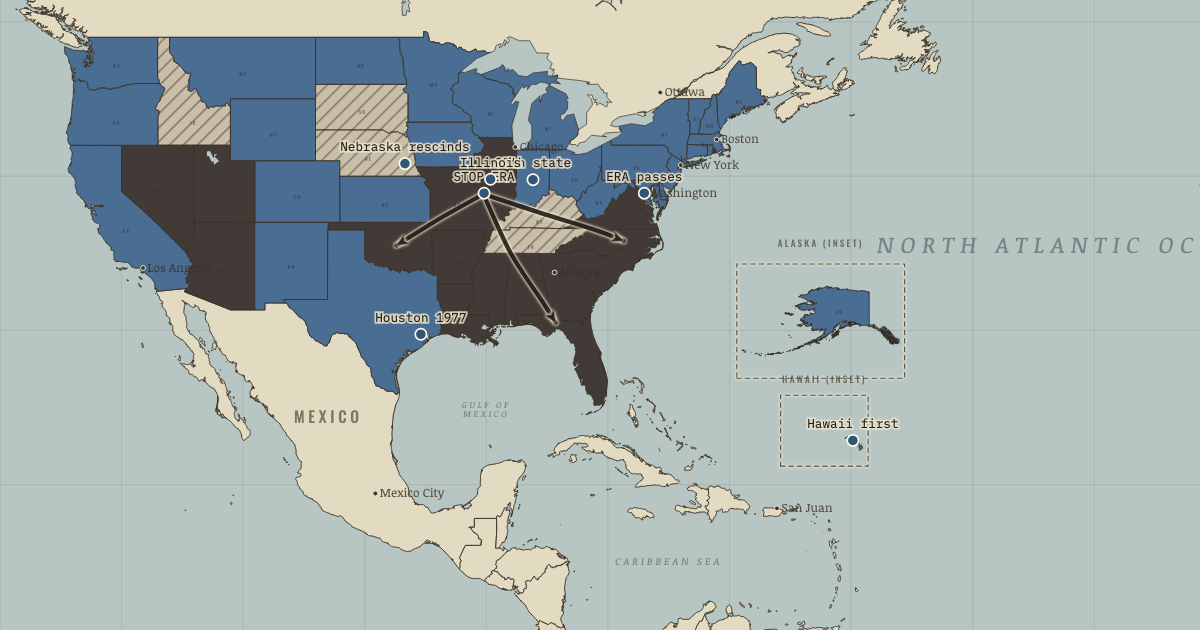
The map above is the world of Women’s rights, 30 June 1982 — The ERA deadline: 35 ratified, five rescinded, 15 never.
Every state on the map that year: The world in 1980 · Europe in 1980.
Part of IB History: Second-wave feminism and Tunisia →
SHORT EXPLANATION
The Equal Rights Amendment seemed close to success after Congress passed it on 22 March 1972. Its central sentence promised: “Equality of rights under the law shall not be denied or abridged by the United States or by any State on account of sex.” Hawaii ratified within hours, and 22 states turn blue on the map that year.
Changing the Constitution takes more than a national majority. Two-thirds of each house of Congress must approve an amendment, and three-quarters of the states—38 of 50—must ratify it. Like a club with a supermajority rule, the system gives a minority power to prevent a change if it holds enough votes in the right places.
Phyllis Schlafly, an Illinois activist, organized conservative women in STOP ERA to reach those votes. She argued that the amendment threatened homemakers: women would be sent to war, wives would lose legal claims to financial support, and toilets would become unisex. She also linked the ERA to abortion and gay rights.
Thirteen more states ratified after 1972, but five attempted to withdraw their ratifications (shown by the hatch). When the extended deadline expired on 30 June 1982, fifteen states had never ratified; they turn charcoal on the map, across much of the South, the Mormon West and Illinois. A majority told pollsters they supported the ERA, yet determined opponents held enough legislatures to block it. Courts and ordinary laws brought much of its content by other routes.
The full story
The ERA had been waiting a long time for the reception it received in 1972. Alice Paul of the National Woman’s Party first drafted an amendment in 1923, and both major parties had endorsed it in their platforms for decades. President Nixon, a growing number of trade unions and new women’s organizations now supported it. The Senate approved it by 84 votes to 8.
The states seemed to be following Congress. Hawaii ratified on the day Congress passed the amendment; New Hampshire, Delaware, Iowa, Idaho, Kansas, Nebraska and Texas followed within about a week. The map’s first snapshot shows 22 ratifications in nine months, many with little debate. By March 1973 there were 30, and only eight more were needed. But a quick vote left room for a change of mind: legislators who had scarcely discussed the amendment could face a much harder decision once its possible consequences became contentious.
Phyllis Schlafly helped make them contentious. In February 1972 the Republican activist from Alton, Illinois, published “What’s Wrong with ‘Equal Rights’ for Women?” In the autumn she founded STOP ERA, which she said meant “Stop Taking Our Privileges”. This was a backlash: a counter-movement organized against another movement’s gains. Its women could speak as people who believed they had something to lose, giving their testimony a force that opposition from men alone would have lacked.
Many volunteers came through churches. They brought home-baked bread to legislators and warned that daughters would be drafted into combat and husbands would no longer have a duty to support their wives. The three arrows trace the campaign into states that never ratified. Nebraska withdrew, or rescinded, its ratification in March 1973; Tennessee, Idaho, Kentucky and South Dakota followed. After 1973 only five states ratified. Indiana’s vote in January 1977 brought the total to 35, three short.
Supporters still had places where a few votes could matter. Some 100,000 marched in Washington in 1978, after which Congress extended the deadline to 30 June 1982; NOW also organized a boycott of conventions in unratified states. Illinois was especially important: Schlafly lived there, and its constitution required a three-fifths majority for amendments. In 1980 the ERA won 102 votes to 71 in the Illinois House and still lost. A majority in that chamber could not supply the votes the rule required.
The final protests made the stakes visible. In June 1982 seven women fasted for 37 days in the Illinois capitol, and others chained themselves outside the Senate chamber. On 30 June the deadline passed with fifteen states unratified, shown in charcoal. Courts had meanwhile begun treating sex discrimination as suspect under the Fourteenth Amendment’s guarantee of equal protection. Opponents used those decisions to argue that the ERA was unnecessary; the amendment failed while much of the equality it sought was already advancing through other legal routes.
FULL EXPLANATION
Why the ERA lost
The result was decided in state legislatures, but that leaves a further question: what persuaded legislators to stop an amendment with so much early support? Jane Mansbridge, a political scientist who campaigned for it, argues in Why We Lost the ERA (1986) that both sides exaggerated its effects. Courts were already moving, so its likely legal impact was modest. Supporters nevertheless promised transformation to inspire volunteers, giving opponents arguments to use against it. When some feminists insisted that equality required drafting women into combat, a wavering legislator could take that promise as a reason to vote no. Donald Critchlow puts Schlafly’s organizing at the center. STOP ERA made conservative women into a disciplined grassroots network, which later contributed to the New Right and Ronald Reagan’s election. Donald Mathews and Jane De Hart, studying North Carolina, locate the conflict in competing ideas of gender roles: the legal text had become a choice about a way of life. Marjorie Spruill traces the rival Houston conferences of 1977 and the division of American politics into “women’s rights” and “family values”. These explanations need not compete for a single cause. Arguments about the amendment supplied reasons to oppose it; organizers brought opponents to legislators; and a wider struggle over gender gave those arguments force. The ratification rules made concentrated, passionate opposition sufficient to defeat a more lukewarm majority.
Can a state take back a ratification?
Five states tried to withdraw their ratifications. Whether they could do so remains a constitutional question. Article V sets out how amendments are made, but says nothing about rescissions or deadlines. The precedent cuts both ways: Ohio and New Jersey tried to withdraw their ratifications of the Fourteenth Amendment in 1868, yet Congress counted them. In December 1981 Idaho federal judge Marion Callister held in Idaho v. Freeman that rescissions were valid and Congress’s 1978 deadline extension unconstitutional. Callister was a senior official of the Church of Jesus Christ of Latter-day Saints, which actively opposed the ERA. After the deadline passed in 1982, the Supreme Court declared the case moot. The issue returned when Nevada ratified in 2017, Illinois in 2018 and Virginia in 2020. The amendment’s legal status remains disputed. A campaign for a principle can thus become a fight over the procedure by which that principle might enter the Constitution.
Why did so many women oppose equal rights?
Women did not divide neatly into supporters and male opponents. Late-1970s surveys found women divided much like men, although the strongest supporters were employed and college-educated women, while committed opponents were often full-time homemakers and frequently active church members. The difference calls for an explanation of what the amendment appeared to mean to each. Mansbridge and Spruill argue that many homemakers heard the women’s movement judging the lives they had chosen. Descriptions of housework as drudgery and dependence on a husband as a trap could make those women feel devalued. Schlafly offered them dignity and a political voice, together with a defense of the legal claims to support that protected wives without their own incomes. Critchlow shows how they became skilled organizers. The campaign to defend traditional roles brought women, Schlafly among them, into public political life. There is a parallel in the atlas’s second case study. In 2012 women in Tunisia’s Islamist party Ennahda argued for a constitutional clause describing women as “complementary” to men. In both cases, an opposing movement drew support from people the movement for change claimed to represent.
Key places on the map
On this day
Why it happened
A supermajority rule. The requirement of 38 ratifications gave opponents a smaller task: hold 13 states, by persuading one chamber in each. Support spread widely across the country could therefore lose to opposition concentrated in particular legislatures. The South and the Mormon West provided favorable ground for that opposition: conservative churches were strong there, and the amendment could be presented as a threat to local values.
A counter-movement of women. Women speaking for STOP ERA presented themselves as homemakers protecting the respect and security they believed the law afforded them. Their presence made it harder to dismiss the campaign as men defending privilege. Schlafly gave followers a positive identity as wives and mothers when many felt feminism looked down on them. Like the women’s movement it opposed, the backlash could mobilize people around a shared identity.
Abortion and the culture war. The argument over the ERA widened after Roe v. Wade in 1973. Opponents said the amendment would protect abortion and, later, gay rights, making it a question about the family as well as legal equality. Catholic, evangelical and Mormon churches joined the campaign, and by the late 1970s congregations had supplied many of STOP ERA’s most active volunteers. A victory for one movement could give another reason to organize.
The decision lay with legislators. National polls showed majority support, but ratification depended on a few thousand state legislators, mostly men. Many served in part-time assemblies where personal lobbying mattered enormously. They heard especially from intensely committed citizens, and by the late 1970s opponents were the most intense. In Illinois, Florida and North Carolina, only a handful of legislators separated the sides in decisive votes.
THE TURNING POINT
STOP ERA, autumn 1972. In 1972, 22 states ratified; in 1973, eight did. The number fell to three in 1974, one in 1975, none in 1976 and one in 1977. Nebraska’s attempted withdrawal in March 1973 gave another sign of changing momentum. STOP ERA had turned a measure often passed with little debate into a controversy over the future of the family. Cautious legislators now had reasons to hesitate where they had once seen consensus.
What it changed
Equality by other routes. Legal change continued without the amendment. In Reed v. Reed (1971) and Craig v. Boren (1976), the Supreme Court applied stricter review to sex discrimination, asking for a strong justification for laws treating men and women differently. Congress passed the Equal Credit Opportunity Act (1974) and the Pregnancy Discrimination Act (1978). These courts and statutes supplied much of what the ERA had promised.
The rise of the New Right. The women organized through STOP ERA helped build a conservative coalition with churches and other grassroots activists. Its political setting changed in 1980: the Republican Party abandoned its ERA endorsement, held since 1940, and Ronald Reagan won the presidency. A “gender gap” also appeared in that election, with women voting less Republican than men; it has persisted since.
An amendment that never quite died. The ERA returned in almost every Congress after 1982. Ratifications by Nevada, Illinois and Virginia between 2017 and 2020 brought the total to 38, but the expired deadline and five rescissions left its legal status disputed. The amendment remained a symbol even as much of its practical purpose had been met through other laws.
DISCUSSION QUESTION — Did the ERA fail because of Phyllis Schlafly, or because of the rules for amending the Constitution?
Schlafly made the opposition effective. STOP ERA provided arguments, volunteers and pressure on wavering legislators in Illinois, Florida, North Carolina and elsewhere, while ratifications slowed sharply after it formed. Mansbridge also assigns a part to supporters who overstated the amendment’s effects and supplied opponents with useful arguments. The rules determined how that pressure could win. A national poll majority could not overcome opposition in 13 states; Illinois required three-fifths of its legislature; and the deadline gave opponents a date until which they needed to hold their ground. Without the supermajority rule Schlafly’s campaign could only have delayed the ERA, while without her campaign the rule would probably not have mattered. She turned an institutional possibility into an actual defeat.
An interesting fact
Schlafly’s own career gave both sides an argument. She had run unsuccessfully for Congress in Illinois more than once, beginning in 1952. Her 1964 book A Choice Not an Echo, supporting Barry Goldwater’s presidential campaign, sold about three million copies. Amid the ERA struggle she earned a law degree from Washington University in St. Louis, graduating in 1978 in her fifties. Opponents saw irony in her success while she fought an amendment designed to open careers to women; supporters saw proof of her argument that women could achieve their aims without it.
Related
THE FREE PRINTABLE STUDY GUIDE
Get the printable study guide for Protest and Change free. I’ll send you a few short letters, then one when a new atlas opens. That’s all. — Paul
NO TRACKING · YOUR ADDRESS IS USED FOR THE DISPATCH AND NOTHING ELSE · UNSUBSCRIBE ANYTIME