Feminism and the Tunisian Revolution · CHAPTER 4 ·
Black and Chicana feminism
Chapter 4 of Protest and Change: Second-Wave Feminism and Tunisia, 1945–2015: “Who Was Left Out?”
The largest feminist organisations reflected the priorities of mostly white, middle-class leaders. Black women, Chicanas, women on welfare and lesbians built their own groups, among them the National Black Feminist Organization (1973) and Boston’s Combahee River Collective, whose April 1977 statement linked race, sex and class.
Chapter 4 is included with every paid plan. WW2 is free in full, and chapter 1 of every atlas is free. A free account opens 3 more chapters a day. Starter, at $9 a month, opens all 21 with no daily limit — see the plans.
Free printable Feminism and the Tunisian Revolution study guide, sent by email ↓
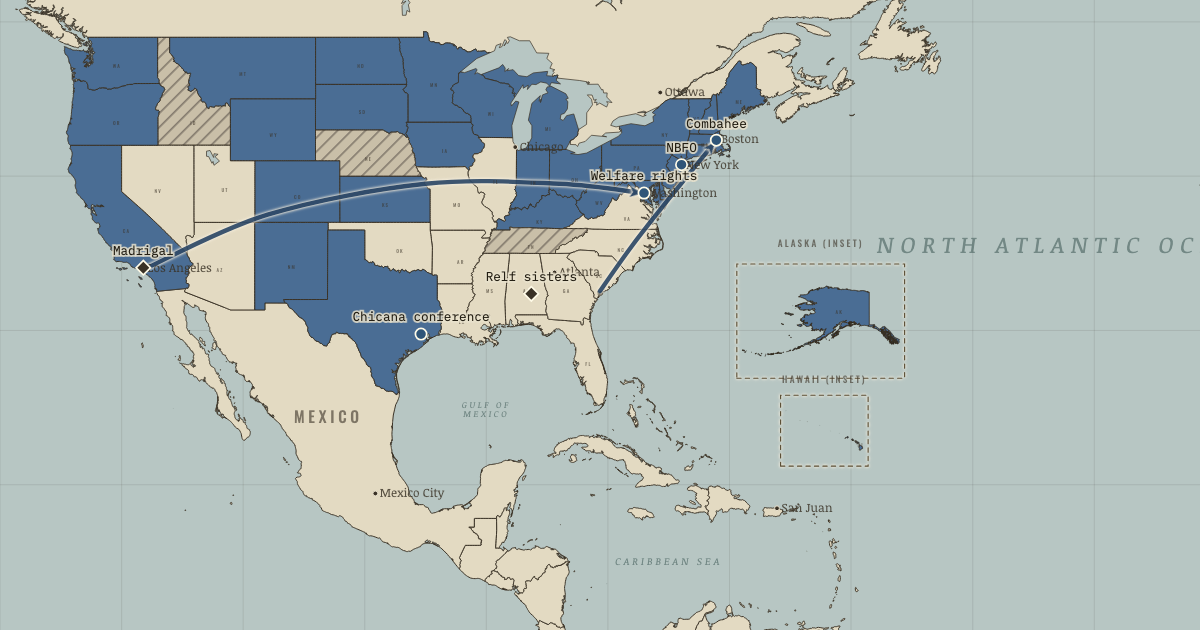
The map above is the world of Women’s rights, November 1977 — The ERA: 35 states, three short; three rescissions.
Every state on the map that year: The world in 1980 · Europe in 1980.
Part of IB History: Second-wave feminism and Tunisia →
SHORT EXPLANATION
Who was represented when feminists spoke of women? The National Organization for Women (NOW), the largest feminist lobby, sought access to professions, abortion as a woman's “choice,” and the Equal Rights Amendment, a proposed constitutional guarantee of equal rights for women. Its mostly white, middle-class leaders brought important problems to public attention. Black women, Chicanas (Mexican-American women), working-class women on welfare and lesbians also faced problems that this agenda gave too little room.
They organized as feminists in their own right. Among their groups were the National Black Feminist Organization, founded in 1973, and Boston's Combahee River Collective, active in 1974–80. They argued that race, sex, class and sexuality were “interlocking”: a woman facing several forms of oppression could not be freed by fighting just one. The term intersectionality, coined in 1989, later gave a name to an idea that women overlooked by the mainstream had helped develop.
The map brings two struggles together. In November 1977, 35 states had ratified the Equal Rights Amendment and three had already withdrawn. The two diamonds mark coerced sterilization: operations permanently preventing pregnancy without real consent. Two Black girls in Montgomery, Alabama, in 1973 and Mexican-American mothers in Los Angeles were among the victims. For women facing such treatment, reproductive freedom included the ability to have children.
The critics had more influence on feminist ideas than on laws. Federal sterilization consent rules followed in 1978; the federally funded National Women's Conference at Houston in 1977 adopted a section of its program written by women of color. This “plank” resembled an item in a party manifesto. Most of the groups were small, poor and short-lived, and their agenda entered the mainstream only decades later.
The full story
Frances Beal asked feminists to look at the lives behind their general claims about women. A veteran of the student civil-rights group SNCC, she argued in her 1969 essay “Double Jeopardy” that Black women faced racism and sexism together. Housework might be described as a prison for women confined to their own homes. That description left out Black women who had long cleaned other people's houses for wages.
Beal's Third World Women's Alliance, named for formerly colonized peoples, marched in August 1970 with placards defending the Black activist Angela Davis. One organizer told them that Davis's case had nothing to do with women's liberation. Other women faced pressure from within their communities. At La Conferencia de Mujeres por la Raza (“the Conference of Women for the People”) in Houston in May 1971, more than 600 Chicanas, or Mexican-American women, met and divided over whether feminism weakened the Mexican-American civil-rights movement. In May 1970 lesbians calling themselves the “Lavender Menace” seized a feminist congress to protest being kept out of sight. Each dispute exposed a limit to the promised sisterhood and helped explain why women organized apart.
The National Welfare Rights Organization (NWRO) began from the circumstances of poor mothers. Welfare meant government payments for mothers raising children alone; the organization, mostly Black mothers on welfare, claimed some 25,000 members by 1969 under its chair Johnnie Tillmon. Her arrow on the map traces a journey from a Los Angeles housing project to Washington. The NWRO demanded an adequate guaranteed income, comparable to today's proposals for universal basic income, and an end to “midnight raids,” when caseworkers searched homes for evidence of a man.
The meaning of work depended on the woman's circumstances. Betty Friedan urged women confined to the home to seek freedom in jobs. Welfare mothers who were told to take any job also wanted the freedom to raise their own children with dignity. Tillmon wrote in 1972 that “welfare is a women’s issue”. The mainstream gave the cause little support, and the NWRO went bankrupt in 1975. Its members had organized around women's lives, but had few resources with which to sustain their claim.
Reproductive freedom also meant more than access to abortion. In June 1973 a federally funded clinic in Montgomery sterilized Mary Alice and Minnie Lee Relf, neither yet fifteen, after their mother, who could not read, marked an X on a consent form. The operations permanently prevented pregnancy. In Los Angeles, Mexican-American mothers were sterilized during labor after signing English forms. They lost their 1978 lawsuit, Madrigal v. Quilligan, but their testimony helped win federal rules that year requiring consent in the patient's language and a 30-day wait.
In April 1977 the Boston-based Combahee River Collective brought such concerns together. Named for a South Carolina river linked to Boston by an arrow on the map, the collective argued that racism, sexism, class exploitation and homophobia had to be fought together. It listed sterilization abuse alongside abortion rights. The right to bear children and the right not to bear them belonged in the same account of freedom, an argument later activists called reproductive justice.
FULL EXPLANATION
Left out, or on separate roads?
Accounts of second-wave feminism long centered on NOW and radical collectives, bringing women of color into the story later as critics. Becky Thompson's 2002 essay “Multiracial Feminism” challenges that chronology. From the late 1960s, Black, Latina, Asian American and Native American women were already building feminist politics, often within civil-rights, labor and nationalist movements. Where the story begins affects who appears to belong to it. Benita Roth's Separate Roads to Feminism (2004) asks why women organized apart. White feminists often neglected their concerns; meanwhile Black and Chicana women faced an “organisational mandate” from Black and Chicano nationalists who put community unity first and called feminism a white distraction from fighting racism. Separate institutions offered room for their concerns, but were fragile. Kimberly Springer's study finds that the NBFO dissolved within about four years and Combahee had only a few dozen members. Exclusion and choice both shaped these separate roads: women were pushed away from the mainstream and built institutions where neither it nor their communities' movements could accommodate all of their concerns.
The evidence of coerced sterilisation
A count of sterilizations cannot alone tell us how many were abusive. The operation might be freely chosen, pressured or forced, and surviving records rarely establish the circumstances. Court cases offer more direct evidence. In Relf v. Weinberger (1974), Judge Gerhard Gesell accepted as credible the plaintiffs' estimate that 100,000 to 150,000 low-income people were sterilized each year under federal programs. He also found that some had been told they would lose welfare payments if they refused. A 1976 General Accounting Office report counted 3,406 sterilizations of Native American women in four of the Indian Health Service's twelve areas between 1973 and 1976; many consent forms violated the rules. Higher activist estimates of the proportion of Native women affected remain disputed. In Puerto Rico, a 1965 survey found that about a third of ever-married women aged 20 to 49 had been sterilized. The operation was so common that it was called la operación, “the operation”. Historians including Iris López caution against treating the women only as victims: many chose sterilization within narrow options. Elena Gutiérrez shows that the women's testimony in Madrigal changed the law even though they lost the case in 1978. The evidence varies in what it can establish, but consistently places the burden on poor women of color.
Welfare rights as feminism
Premilla Nadasen argues that the National Welfare Rights Organization's members practiced feminism on their own terms, though most did not use the word and the mainstream seldom recognized them. Consider their demands. They wanted motherhood counted as work deserving income, privacy from caseworkers who policed their sex lives, and the ability to refuse low-paid jobs that took them away from their children. Each challenged how the state treated women. Some claims succeeded in court: in King v. Smith (1968), the Supreme Court struck down Alabama's “substitute father” rule, which cut off payments to a mother suspected of a relationship with a man. But legal gains did not supply the organization with lasting resources. It had the fewest of any branch of feminism and depended on a few male-led foundations and allies. Funding dried up as the political climate turned against welfare in the 1970s, and the movement collapsed. Women most directly harmed by poverty had built a movement with little power to protect itself.
Key places on the map
On this day
Why it happened
A movement built in the image of its founders. The second wave's early texts and organizations grew from the experience of educated white women: suburban isolation, exclusion from professions and unwanted pregnancy. Other experiences received less attention. Friedan's book, for example, said almost nothing about the millions of women already working for wages; women facing racism, poverty or coerced sterilization also found their concerns missing. A movement must hear such experiences before it can make them part of its agenda.
The pull of other loyalties. Many Black and Chicana women participated in civil-rights, Black Power and Chicano movements. Leaders of both sexes in those movements often called feminism a white middle-class luxury that would divide their communities. Women could face pressure both when joining white-led groups and when organizing as feminists within their own movements. Many also feared that criticizing Black or Chicano men publicly would give ammunition to racists who already depicted their communities as disordered. Separate groups gave them another place to pursue their concerns.
The same issue meant different things. The same demand could mean different things in different lives. Mainstream feminists made abortion central to reproductive rights because unwanted pregnancy was the principal risk their leaders faced. Poor women of color also faced doctors and welfare officials who wanted them to have fewer children. Paid work might promise a suburban housewife freedom while bringing hardship to a domestic worker. Treating one experience as universal could conceal the needs of another group.
Exclusion inside the organisations. The problem appeared inside organizations as well as in their agendas. Lesbians were pushed to NOW's margins in 1969 and 1970, while women of color reported being ignored or treated as tokens at meetings and marches. Many concluded that reform from within was impossible and built autonomous organizations led by those most affected. Aileen Hernandez, elected NOW's first Black president in 1970, later left, criticizing its failure to address minority women's concerns.
THE TURNING POINT
The Combahee River Collective Statement, April 1977. In April 1977 Barbara Smith, Beverly Smith and Demita Frazier gave the Combahee River Collective's grievances a lasting formulation. Race, sex, class and sexuality, they argued, were interlocking oppressions; fighting them separately could leave the same women exposed to the others. They rooted their politics in their identity as Black women, in the first known use of “identity politics”. Their claim that freedom for the most oppressed would require freedom for everyone reversed the mainstream's logic of starting with the most privileged. The collective was tiny and ended in 1980, but its ideas became a basis of intersectional feminism.
What it changed
From reproductive rights to reproductive justice. The Committee to End Sterilization Abuse and other groups pressed for safeguards against coercion. Federal rules in 1978 required a 30-day waiting period and consent in the patient's language, and banned sterilizing people under 21. In 1994 Black women activists coined “reproductive justice” for an account descended from the 1970s arguments: the rights to have children, not to have them, and to raise them safely.
Houston, 1977: inclusion in the official agenda. The federally funded National Women's Conference in Houston in November 1977 adopted a “minority women” plank drafted by Black, Latina, Asian American and Native American women. Coretta Scott King was among its champions. The gathering was the most diverse in the movement's history; conservative women also organized a counter-rally, defining the backlash taken up in the next chapter.
A literature that changed feminist theory. The criticism developed by women at the margins entered feminist thought through writing. Audre Lorde, bell hooks, Cherríe Moraga and Gloria Anzaldúa helped make the critique of white feminism central to it; Moraga and Anzaldúa's anthology This Bridge Called My Back appeared in 1981. In 1989 Kimberlé Crenshaw gave the concept the name “intersectionality,” which spread worldwide. The writers' essays became among the movement's most widely taught texts.
Fragile institutions. The organizations themselves had brief lives. The NWRO went bankrupt in 1975, the NBFO dissolved by the late 1970s and Combahee ended in 1980. They were small and poorly funded, and practical demands such as adequate income for mothers were largely defeated, culminating in welfare cuts in the 1990s. Their ideas nonetheless continued through books and later movements, giving them an influence that outlasted their institutions.
DISCUSSION QUESTION — Were Black, Chicana and working-class women “left out” of second-wave feminism, or did they build a different feminism of their own?
The answer changes with what we mean by the movement. In the national organizations and legal campaigns that dominated the press, these women were largely excluded from power. NOW and the mainstream offered welfare rights little support, ignored coerced sterilization until activists forced the issue, and treated lesbians and women of color as embarrassments or tokens. But the Third World Women's Alliance, the 1971 Chicana conference, the NWRO and Combahee show women building organizations and developing theory themselves. They also won changes, including the 1978 sterilization rules. Historians such as Thompson and Roth therefore describe second-wave feminism as plural: the picture of one movement reflects choices made by those who wrote its history. These women could be excluded from mainstream power and still be central to feminism's ideas.
An interesting fact
The name Combahee River Collective recalled an American Civil War operation. On the night of 1–2 June 1863 Harriet Tubman, who had escaped slavery and was working as a Union army scout, guided Union steamboats up the Combahee River in South Carolina. The raid destroyed plantations and freed more than 700 enslaved people, who ran to the boats as the steam whistles sounded. Tubman is widely credited as the first woman to lead an armed military operation in American history. More than a century later, the Boston collective chose the name to place its politics in a long tradition of Black women's collective action.
Related
THE FREE PRINTABLE STUDY GUIDE
Get the printable study guide for Protest and Change free. I’ll send you a few short letters, then one when a new atlas opens. That’s all. — Paul
NO TRACKING · YOUR ADDRESS IS USED FOR THE DISPATCH AND NOTHING ELSE · UNSUBSCRIBE ANYTIME