Feminism and the Tunisian Revolution · CHAPTER 6 ·
UN Decade for Women and CEDAW
Chapter 6 of Protest and Change: Second-Wave Feminism and Tunisia, 1945–2015: “A Global Movement”
The UN declared 1975 International Women’s Year and 1976–1985 the Decade for Women, with world conferences in Mexico City, Copenhagen and Nairobi. Its most lasting result was CEDAW, the Convention on the Elimination of All Forms of Discrimination against Women, adopted by the General Assembly on 18 December 1979.
Chapter 6 is included with every paid plan. WW2 is free in full, and chapter 1 of every atlas is free. A free account opens 3 more chapters a day. Starter, at $9 a month, opens all 21 with no daily limit — see the plans.
Free printable Feminism and the Tunisian Revolution study guide, sent by email ↓
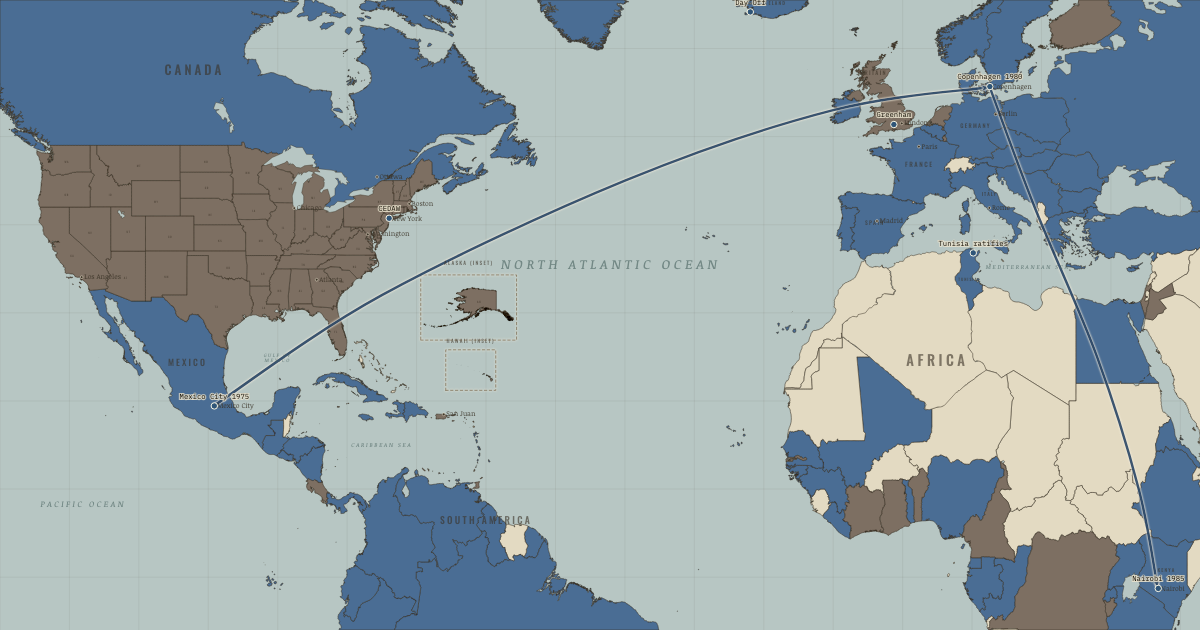
The map above is the world of Women’s rights, December 1985 — CEDAW: who had ratified the women’s convention.
Every state on the map that year: The world in 1990 · Europe in 1990.
Part of IB History: Second-wave feminism and Tunisia →
SHORT EXPLANATION
The United Nations gave women’s movements a place to meet across national borders. It declared 1975 International Women’s Year and 1976–1985 the Decade for Women. The arrows connect the three world conferences—in Mexico City, Copenhagen and Nairobi—where governments negotiated plans of action and thousands of activists met at parallel forums for non-governmental organizations (NGOs), much like gatherings beside a modern climate summit.
The Decade produced an international standard in the Convention on the Elimination of All Forms of Discrimination against Women (CEDAW), adopted in December 1979. A state that ratifies it promises to end discrimination in law, work, education, health and family life and reports regularly to a UN committee. Activists could use those commitments to hold their governments to account.
The map at the end of 1985 shows where states had accepted the treaty. Mexico, Canada, France, most Nordic countries, the Soviet bloc—the USSR and its communist allies—and much of Africa are blue. The United States is grey-tan: President Carter signed in 1980, but the Senate never ratified. The movement’s most famous homeland remained outside its most important international law.
The meetings also raised the question of whose lives would set the agenda. Women from the Global South, the poorer and mostly formerly colonized countries, insisted that poverty, development, war and apartheid—South Africa’s system of legal racial segregation—were women’s issues alongside legal equality. A Bolivian miner’s wife made that case to Western feminists in Mexico City. At Nairobi in 1985 most of the 12,000 to 15,000 NGO Forum activists came from the South. The challenge Black and working-class women had raised in the United States had become a worldwide argument.
The full story
Women’s movements had a reason to look to the United Nations: it could bring governments together, collect information and set standards against which they could be judged. Its Commission on the Status of Women, a committee of government delegates, had monitored women’s rights since 1946. In 1972 the Soviet-bloc-aligned Women’s International Democratic Federation proposed an International Women’s Year. Rivalry between Cold War powers helped put the proposal on the agenda, as each had reason to appear progressive.
The first World Conference on Women met in Mexico City in June and July 1975, with 133 governments represented. Alongside it, citizens’ groups called non-governmental organizations—much like today’s charities—met at the Tribune. The two gatherings brought women into a shared discussion, but they did not bring a single account of what women needed.
At the Tribune, Domitila Barrios de Chungara, the wife of a Bolivian tin miner, challenged middle-class feminists from the North. In her community, she argued, poverty and mine owners were the enemies, and women and men had to fight together. Her intervention exposed a problem for an international movement: a demand for legal equality addressed one set of urgent concerns, while women whose families struggled to survive could place other demands first.
The UN also offered a way to turn demands into obligations. The General Assembly adopted CEDAW on 18 December 1979 by 130 votes to none, and it took effect in September 1981. Like a trade agreement, a treaty binds states that ratify it. CEDAW supplied a standard against which women could judge those governments; its Article 5 went beyond formal law, requiring states to change social and cultural patterns based on ideas of women’s inferiority.
Signing and ratifying were different steps. Dozens of states signed at Copenhagen in July 1980, including the United States, but the US Senate never ratified, leaving it grey-tan on the map. Other governments ratified with reservations, formal statements excluding particular articles. Tunisia, for example, ratified in September 1985 while reserving provisions on family law and nationality. The same treaty could therefore provide a common standard while states accepted different limits on their commitments.
At the final conference in Nairobi in July 1985, 157 governments were represented. Most of the 12,000 to 15,000 people at the NGO Forum came from Africa, Asia and Latin America—the poorer, mostly formerly colonized countries known as the Global South. The conference adopted its Forward-Looking Strategies by consensus, after the meetings in 1975 and 1980 had split over Zionism, the movement for a Jewish state, and apartheid, South Africa’s system of racial segregation.
The shared language of rights connected movements whose priorities remained different. Development Alternatives with Women for a New Era (DAWN), a Southern network, argued that debt, rural poverty and structural adjustment belonged in feminism. Structural adjustment meant the spending cuts international lenders demanded in return for loans; decisions about those cuts affected the conditions in which women and their families lived. European activists also acted beyond legal equality: nine in ten Icelandic women stopped work for a day in October 1975, and from 1981 women camped at England’s Greenham Common air base against American nuclear missiles. By the end of the Decade, the international movement had acquired both common institutions and a wider account of women’s concerns.
FULL EXPLANATION
Was the Decade “politicised”?
The Declaration of Mexico in 1975 listed Zionism alongside colonialism and apartheid as obstacles to women’s equality. Five years later the Copenhagen Programme of Action passed over the opposition of the United States, Israel, Canada and Australia. Many Western delegates and feminists saw Cold War and Middle East politics as an intrusion into the Decade. Jocelyn Olcott’s history of International Women’s Year challenges the boundary assumed in that complaint. Delegates from newly independent states saw the economic order keeping their countries poor, apartheid in South Africa and the occupation of Palestinian land as conditions shaping women’s lives. To exclude those subjects from a women’s conference would have been a political decision too. Arvonne Fraser, a US delegate, and Peggy Antrobus, a Caribbean founder of DAWN, wrote contrasting memoirs of the same rooms. Their differences recall the American argument about who had been left out and whose experience should set a movement’s priorities. The consensus reached at Nairobi in 1985 suggests that participants had found a way to negotiate such disagreements together.
Does ratifying a treaty change anything?
A government can ratify a treaty without giving up every practice its critics object to. Many states attached sweeping reservations to CEDAW, especially to Article 16 on marriage and family; some critics argue that such reservations empty ratification of meaning. Tunisia kept its specific reservations until 2014. A treaty has no police to settle the matter for its supporters. It does, however, give them a way to challenge their governments. States must describe their laws to an expert committee every four years, and activists can use the reports and the committee’s comments to press for change. Political scientist Beth Simmons found statistical evidence associating ratification with improvements in girls’ education, access to contraception and women’s employment. The association was especially strong in countries neither fully democratic nor fully closed, where activists had room to mobilize and could use an international standard. In the United States, opponents argued that domestic law already offered equivalent protections and that CEDAW threatened national sovereignty and state family law. The Senate never ratified. The wider evidence suggests that a treaty’s force often depends on domestic movements able to use its commitments.
“Let me speak”: testimony as evidence
Domitila Barrios de Chungara’s account gives readers access to a life seldom represented in print. Si me permiten hablar (1977; in English Let Me Speak!) tells of hunger, strikes and massacres in Bolivia’s tin-mining camps and of the housewives’ committee she led. Brazilian journalist Moema Viezzer recorded and edited the life story after the Mexico City Tribune; it became one of the most widely read Latin American books of its kind. The route from speech to book matters when we use it as evidence. Domitila spoke, her words were transcribed, and an editor with her own politics shaped them for an international audience of sympathizers. Historians such as Olcott read such testimony alongside conference records and press reports. These sources establish a real clash between “feminism of equality” and “feminism of survival”, even though famous exchanges were often sharpened in later retellings. Testimony tells us how people understood their experience, and its presentation is part of the evidence to examine.
Key places on the map
On this day
Why it happened
The UN as an amplifier. The UN had machinery that a movement could use: the Commission on the Status of Women, established in 1946, and authority to declare years, call conferences and draft treaties. International Women’s Year brought delegations and reports on women’s status. Ministries and statisticians gathered evidence of inequality, and activists with little influence at home could appeal to an institution that had made their questions international business.
Decolonisation changed the room. Decolonization changed the balance inside the UN. By 1975 it had 144 members, most from Africa, Asia and Latin America; many had been independent for less than twenty years, and African states held about a third of the seats. Their delegates brought experiences of poverty and colonialism and could outvote Western states. Development and peace consequently joined legal equality on the agenda, widening the discussion and sharpening its disputes.
A Western movement looking outward. After a decade of campaigns at home, American and European feminists sought international solidarity. Their organizations brought money, publications and experience, but resentment followed when they treated abortion rights or workplace equality as everyone’s priorities. Many Southern delegates regarded men in their communities as allies against poverty and imperialism. Western radical feminists found that position difficult to accept.
Cold War competition. The Soviet Union and its allies pointed to high female employment and state childcare as evidence of their leadership on equality. The Women’s International Democratic Federation proposed International Women’s Year, while the United States and its allies had reason to avoid appearing less committed. Cold War rivalry raised the political cost of ignoring women’s rights.
THE TURNING POINT
CEDAW adopted, 18 December 1979. Declarations could express an ambition without creating a body to hear how governments acted. The 1967 Declaration on discrimination against women had neither a committee nor a reporting system. CEDAW gave ratifying states a legal standard and gave campaigners grounds to measure and press them. More than seventy states had ratified by the end of 1985. Articles 5 and 16 reached into culture and family law, areas many governments had treated as off limits. These commitments could endure after a conference or protest ended.
What it changed
A standard for movements everywhere. The CEDAW Committee of independent experts first met in October 1982 and reviewed its first national reports in 1983. Campaigners gained an international audience and, in dozens of countries, used the treaty to challenge nationality, inheritance and family laws. Tunisian organizations campaigned for decades against the reservations with which their country ratified in 1985. After the 2011 revolution the government withdrew its specific reservations while retaining a general declaration. The treaty gave those campaigners a standard to use over a long struggle.
Feminism of the Global South. Women at the Nairobi Forum and networks such as DAWN made debt, development and poverty central to international feminism. That broader agenda appeared at the next world conference in Beijing in 1995. Its Platform for Action declared that “women’s rights are human rights” and placed violence against women at the center, although that issue was largely missing from CEDAW’s original text.
The United States stays outside. Despite hearings in later decades, the US Senate never ratified CEDAW, leaving the country among a handful of UN members outside it. Opposing senators cited national sovereignty and possible intrusion into family law. The United States changed its own laws through courts and statutes while declining the treaty’s international oversight, a gap critics abroad have continued to cite.
DISCUSSION QUESTION — Did the UN Decade for Women unite women across the world, or reveal how divided they were?
The Decade brought disagreements into view. In Mexico City, Domitila Barrios de Chungara, a Bolivian miner’s wife, challenged Western feminists with a struggle for survival that did not fit neatly into an agenda of legal equality. The 1975 and 1980 conferences divided over Zionism, the movement for a Jewish state, apartheid and the world economy. Class, region and politics affected what women asked the movement to do. Yet the participants also built common ground on which to argue. The General Assembly adopted CEDAW without a vote against it, and the Nairobi Forum brought together 12,000 to 15,000 people, many of whom had never met. Olcott’s work suggests that the quarrels themselves were an achievement: Western feminists had to recognize their priorities as one agenda among several. The resulting coalition did not require a single experience of womanhood. Shared institutions let movements with different priorities negotiate and act together.
An interesting fact
The first UN world conference on women had a male president. At Mexico City in June 1975 delegates elected the host government’s nominee, Mexico’s attorney general Pedro Ojeda Paullada. Delegates and journalists noticed the irony; custom gave the chair to the host country. The conference also acquired an enduring emblem. American graphic artist Valerie Pettis combined a stylized dove, the symbol for woman and an equals sign; her design became the symbol of the whole Decade for Women.
Related
THE FREE PRINTABLE STUDY GUIDE
Get the printable study guide for Protest and Change free. I’ll send you a few short letters, then one when a new atlas opens. That’s all. — Paul
NO TRACKING · YOUR ADDRESS IS USED FOR THE DISPATCH AND NOTHING ELSE · UNSUBSCRIBE ANYTIME