Meiji Japan and post-Soviet Russia · CHAPTER 10 ·
Shock therapy in Russia
Chapter 10 of Remaking the State: Meiji Japan 1600–1912 and Post-Soviet Russia 1964–2000: “Shock Therapy”
On 2 January 1992 Yegor Gaidar’s government freed most prices at once, betting that one sharp change would hurt less than a slow one. Goods returned to the shops, but prices rose about 2,500% in 1992 and wiped out savings, and from October 1992 voucher privatisation handed most ownership to insiders.
Chapter 10 is included with every paid plan. WW2 is free in full, and chapter 1 of every atlas is free. A free account opens 3 more chapters a day. Starter, at $9 a month, opens all 21 with no daily limit — see the plans.
Free printable Meiji Japan and post-Soviet Russia study guide, sent by email ↓
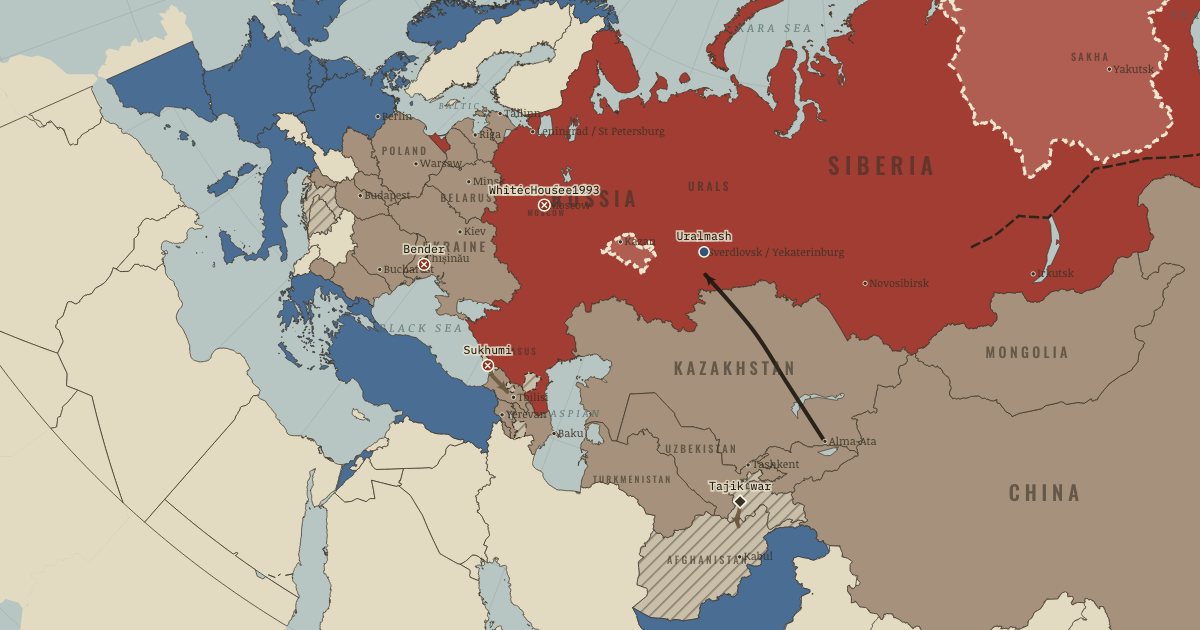
The map above is the world of Russia and the former Soviet Union, October 1993 — The White House shelled.
Every state on the map that year: The world in 1990 · Europe in 1990.
Part of IB History: Meiji Japan and post-Soviet Russia →
SHORT EXPLANATION
At independence Russia inherited shops with little to sell, almost exhausted reserves of gold and foreign currency, and a government paying its bills by printing money. Prices had been fixed by Soviet planners. On 2 January 1992 the team led by economist Yegor Gaidar freed most prices, allowing sellers to set them. Their policy, shock therapy, sought a rapid move to market prices, free trade and private ownership: like setting a broken bone in one movement, a sharp change might hurt less than a long one. Goods returned, but prices rose about 2,500% during 1992, wiping out savings accumulated when people had little to buy.
The government also transferred state firms to private owners. Beginning in October 1992 each citizen received a voucher worth 10,000 roubles to exchange for shares. By mid-1994 around 14,000 large and medium firms, including the Uralmash machinery works, were private. Most came under their managers’ control. The offer of a share to every citizen had chiefly made factory bosses owners.
Economic reform unfolded amid a contest over political authority. The Soviet-era parliament fought President Yeltsin over reform, and in September 1993 he dissolved it by decree. Armed supporters resisted; on 4 October army tanks shelled parliament’s White House. Official counts put deaths in the fighting at about 150–190, with some unofficial estimates higher. Voters approved a constitution giving the president sweeping powers in December, although turnout remains disputed. On the hatched borderlands, wars in Moldova’s Transnistria, Georgia’s Abkhazia and South Ossetia, Azerbaijan’s Karabakh, and Tajikistan exposed a further weakness. Moscow was struggling to govern itself, leaving local Russian garrisons to decide several conflicts. Russia was building a market and a state at once, and the speed of the first task left the second weaker.
The full story
The reformers inherited an economy in which a price on a shop shelf told only part of the story. By late 1991 prices were fixed, but shops were nearly empty and people held far more money than there were goods to buy. Gold and foreign currency reserves had been spent. Keeping controls meant queues; freeing prices would mean an immediate rise. Yegor Gaidar, aged 35, Anatoly Chubais and their colleagues, advised by Western economists including Jeffrey Sachs, chose rapid change. They expected free prices to bring goods back and feared that delay would give the old bureaucracy time to regroup. Shock therapy promised one sharp operation rather than a series of smaller ones.
On 2 January 1992 the government freed most prices, keeping controls on energy and some staples. Goods appeared again, but many people could barely afford them. Inflation reached about 2,500% that year. The central bank was still lending cheaply to failing enterprises, adding money to an economy whose prices had just been released. Free prices could fill shelves without stabilizing the money people needed to shop there; stabilization came only years later.
Chubais’s privatization program faced another practical problem. Reformers wanted to transfer ownership quickly enough to make a return to planning difficult, but factory directors already controlled the enterprises whose cooperation they needed. Every citizen received a voucher with a face value of 10,000 roubles, about 144 million in all, to sell or invest in share auctions. The law also allowed employees and managers to buy a controlling stake in their own firms, and most chose that option. Managers bought up workers’ shares and some entrepreneurs bought vouchers cheaply. At Uralmash, businessman Kakha Bendukidze gained control this way. Many Russians concluded that the state’s wealth had gone to a few.
For households with fixed incomes, the change was costly. Output fell 14.5% in 1992, wages and pensions arrived months late, and male life expectancy declined from about 64 years in 1990 to under 58 in 1994. The arrows beyond Russia trace other upheavals: Russians returning from Central Asia, Georgians fleeing Abkhazia after the fall of Sukhumi, and Tajiks escaping south into Afghanistan.
Russia’s argument over reform became a fight over who had the right to govern. The amended Soviet constitution gave both the president and the Congress of People’s Deputies—a large Soviet-era parliament able to rewrite that constitution—a claim to supreme authority. Congress forced Gaidar out in December 1992. On 21 September 1993 Yeltsin dissolved it by decree, which the Constitutional Court ruled illegal. Deputies barricaded themselves inside the White House. Their armed supporters attacked the mayor’s office and the Ostankino television center on 3 October; the following morning tanks shelled parliament into surrender.
The December referendum approved a new constitution with 58.4% of the vote, although turnout remains disputed. In the election, Vladimir Zhirinovsky’s nationalist party won the largest share of votes cast for parties, a sign that hardship had pushed many voters toward nationalism. The constitution gave Russia a powerful president, but the first great dispute over its democratic institutions had been settled by force.
FULL EXPLANATION
Shock therapy or gradualism?
A government facing empty shelves and a collapsing economy could hardly leave the old system untouched. Jeffrey Sachs and Anders Åslund argued that it could not afford to move slowly either. Gorbachev’s partial reforms had failed, and opponents might regroup once the brief political opening closed. Åslund later maintained that the problem was too little shock: central-bank lending and subsidies to energy and industry prolonged inflation for years instead of months. Joseph Stiglitz, former World Bank chief economist, saw a different danger in the order of change. Markets need courts, property rights, regulation and tax collection. Sell assets and free prices before those institutions work, he argued, and theft becomes an invitation. Peter Reddaway and Dmitri Glinski called Gaidar’s approach “market Bolshevism”, a revolution imposed from above with little regard for its victims. Poland’s rapid reforms from 1990 succeeded faster; China took a gradual route in a very different society. The comparisons leave us asking which institutions and reforms came first, as well as how quickly change occurred.
Why voucher privatisation produced insiders
To understand the vouchers, consider the bargain Chubais and his advisers needed to make. They wanted private ownership established quickly enough to prevent a return to central planning. Factory directors already controlled the enterprises, and could obstruct the transfer. The law therefore offered employees and managers 51% of their firm’s shares; about three-quarters of enterprises chose this route. Andrei Shleifer and Daniel Treisman argue that accommodating powerful insiders was the price of passing reform at all. It was a costly bargain for many citizens. Some sold vouchers for small sums or invested them in funds that later vanished. Managers consolidated control and often sold company property for private gain instead of investing. Russians turned the word for privatization into the pun “grab-itisation”. By mid-1994 most industry was private, but few firms had owners with the money or incentive to modernize it.
The October crisis and the 1993 constitution
The October conflict arose under rules that allowed both sides to claim authority. Russia’s 1978 constitution, amended hundreds of times, made the Congress of People’s Deputies the supreme state body while also creating a powerful elected president. Timothy Colton’s biography presents Yeltsin as believing parliament was blocking reform and choosing decree and force over compromise. His opponents included communists and nationalists, some armed. The constitution approved in December 1993 resolved the deadlock in the president’s favor. He appoints the prime minister, issues decrees with the force of law and dominates the government; if the Duma, the new lower house, rejects his nominee three times, he may dissolve it. Michael McFaul argues that this design, adopted after violence and on disputed turnout, laid foundations for the more authoritarian presidency that followed. Russia fixed its rules during a crisis, whereas Japan had done so in 1889 during a moment of calm.
Key places on the map
On this day
Why it happened
The Soviet economy left too much money and too few goods. Perestroika left people holding savings for which state shops had little to offer, while the government financed its budget by printing money. Price controls kept the prices down but lengthened queues and increased rationing. Removing them would bring a sudden rise. Gaidar chose immediate liberalization, believing that postponement would make the eventual shock larger.
Reformers believed speed protected reform. Gaidar, Chubais and their Western advisers had seen communists and old ministries obstruct Gorbachev’s reforms. They feared slow change would give those opponents another chance. Rapid privatization would create owners with an interest in the new system and make a return to planning impossible. That political aim placed speed ahead of fairness and careful design.
Two branches claimed the same authority. The parliament elected in 1990 under Soviet rules and the president elected in 1991 could both claim supreme authority under Russia’s constitution. Inflation and falling living standards turned parliament against the president’s government. Neither side accepted a way to settle the dispute, and each exercised its claimed powers until force decided it.
The Union’s collapse broke trade and supply. Soviet factories depended on suppliers across fifteen republics. Independence made those transactions foreign trade, often paid in roubles that new states printed themselves. Until 1993 the shared currency allowed republics to create rouble credits, adding to inflation. Broken supply chains also cut output: some decline attributed to shock therapy came from the Union’s dissolution itself.
THE TURNING POINT
Prices freed, 2 January 1992. The decision on 2 January 1992 put prices in place of officials as the means of rationing goods, ending the planned economy in a single day. Empty shelves filled again. Yet households lost most of their savings, high inflation continued for years and reform became deeply unpopular. That opposition fed the political conflict of 1993. The choices made around this moment, when speed seemed the only defense against collapse, shaped later disputes over vouchers and oligarchs.
What it changed
A new owning class took shape. Millions received nominal shares through privatization, while managers, bankers and traders gained effective control over much of the property. Among the bankers who made fortunes were Vladimir Potanin and Mikhail Khodorkovsky; they would soon lend to the state in exchange for its best companies. Ownership had moved faster than the laws governing it.
A presidency above parliament. After December 1993 the president could appoint governments, issue decrees and dissolve the Duma. Yeltsin governed through the crises of the 1990s with these powers, including the decision to go to war in Chechnya. His successor inherited a constitutional system already weighted toward the executive.
The borderlands were left to Russia’s soldiers. The wars left Russian soldiers with a continuing role beyond Russia. Ceasefires in Transnistria and South Ossetia in 1992, and Abkhazia and Karabakh in 1994, left Russian peacekeepers or garrisons in several successor states. Their presence gave Moscow lasting influence over neighbors and set precedents for its treatment of breakaway regions within Russia.
DISCUSSION QUESTION — Did shock therapy cause Russia’s economic collapse in the 1990s, or was it a response to a collapse that had already begun?
The crisis began before shock therapy. Anders Åslund and Yegor Gaidar point to empty shops, exhausted reserves and a budget financed by printing money in 1991; the Union’s breakup also severed supply chains that no policy could have saved. Some defenders argue that central-bank money creation prolonged inflation because reform was too timid. Critics including Joseph Stiglitz, Peter Reddaway and Dmitri Glinski hold that freeing prices and selling assets before institutions were built caused hyperinflation and theft amid an output fall deeper than America’s Great Depression. Poland’s rapid reforms worked better, while China’s gradual reforms took place in a very different society. A strong answer separates the collapse Russia inherited from decisions about who bore its costs, and asks who made those decisions. Markets need governing institutions if their outcomes are to be fair, whatever the speed of change.
An interesting fact
The architect of Russia’s market reforms at 35 had deep roots in Soviet culture. Yegor Gaidar’s grandfather Arkady Gaidar wrote children’s adventure stories read by generations of Soviet pupils. His other grandfather, Pavel Bazhov, wrote Ural folk tales that became a classic Soviet book and a famous ballet score. His father, a naval officer and Pravda correspondent, reported from Cuba. Gaidar himself edited economics at Kommunist, the Central Committee’s theoretical journal and ideological voice, before taking charge of reform.
Related
THE FREE PRINTABLE STUDY GUIDE
Get the printable study guide for Remaking the State free. I’ll send you a few short letters, then one when a new atlas opens. That’s all. — Paul
NO TRACKING · YOUR ADDRESS IS USED FOR THE DISPATCH AND NOTHING ELSE · UNSUBSCRIBE ANYTIME