Meiji Japan and post-Soviet Russia · CHAPTER 11 ·
Oligarchs and the First Chechen War
Chapter 11 of Remaking the State: Meiji Japan 1600–1912 and Post-Soviet Russia 1964–2000: “A State at War with Itself”
Russia in the mid-1990s was a state too weak to collect taxes, pay soldiers and teachers, or govern its regions. Tatarstan signed a treaty with Moscow in February 1994, Chechnya was invaded in December 1994, and the loans-for-shares auctions of late 1995 made the oligarchs a power in politics.
Chapter 11 is included with every paid plan. WW2 is free in full, and chapter 1 of every atlas is free. A free account opens 3 more chapters a day. Starter, at $9 a month, opens all 21 with no daily limit — see the plans.
Free printable Meiji Japan and post-Soviet Russia study guide, sent by email ↓
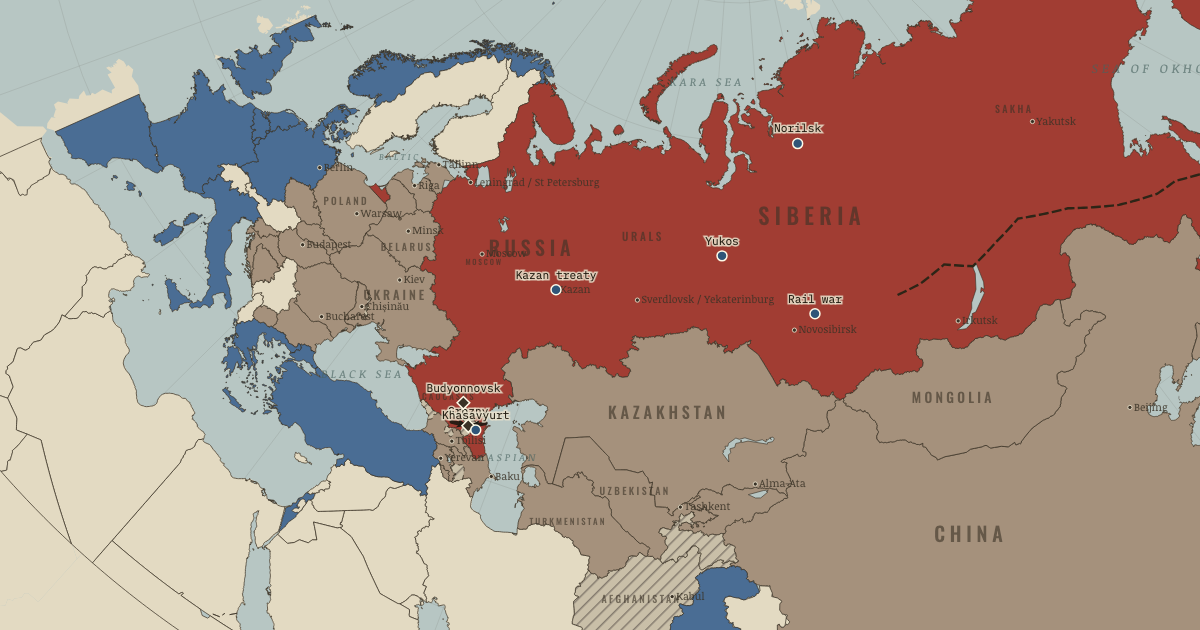
The map above is the world of Russia and the former Soviet Union, August 1996 — Khasavyurt; Yeltsin re-elected.
Every state on the map that year: The world in 2000 · Europe in 2000.
Part of IB History: Meiji Japan and post-Soviet Russia →
SHORT EXPLANATION
In the mid-1990s Moscow faced a choice about how to hold Russia together. Its republics were homelands of non-Russian peoples with their own constitutions. Tatarstan had declared sovereignty in 1990, asserting priority for its laws much as a state might claim it over federal law. A February 1994 treaty gave it generous terms inside Russia, and its dashed outline disappears from the map after 1994. Chechnya had declared full independence in 1991. In December 1994 Russia sent the three columns shown by the arrows toward Grozny. Bombardment took the city and killed tens of thousands of civilians, including elderly ethnic Russians with nowhere to go. Chechen fighters retook Grozny in August 1996; the Khasavyurt accord ended the war but left independence unsettled.
The government also needed money it could not raise in taxes. In 1995 banks lent it funds against shares in companies including Norilsk Nickel and Yukos. When the state failed to repay, as everyone expected, the banks kept the companies. Their owners became known as oligarchs, tycoons whose wealth gave them political power. They financed and televised Yeltsin’s 1996 election comeback after his approval had fallen to single digits. Yet wages and pensions remained unpaid, and in May 1998 miners blocked the Trans-Siberian Railway in the rail war. That August the government defaulted—failed to pay its debts, like a bankrupt borrower—and the ruble collapsed. The state had struggled both to tax the new wealth and to control its own army.
The full story
Before the Soviet Union fell, Yeltsin had a reason to encourage the republics inside Russia to resist Moscow. In his struggle with Gorbachev, he told them to “take as much sovereignty as you can swallow”. Tatarstan, Sakha and others declared sovereignty in 1990, claiming that their laws took precedence over Moscow’s. The dashed outlines on the maps of 1990–94 mark those claims. Regional leaders retained tax revenue, controlled local police and courts, and bargained with the center.
After the Union’s collapse, those bargains became a means of keeping Russia together. Tatarstan, an oil-rich Volga republic whose population was about two-fifths Russian, held a sovereignty referendum in 1992. Its February 1994 treaty kept it in Russia while giving it control over its oil, budget and much of its law. Dozens of regions had made similar agreements by 1998. The price of agreement was a center with less revenue and authority: federal tax collection collapsed, firms paid one another in goods, and teachers, doctors and soldiers waited months for wages.
Chechnya’s leaders sought a different settlement. The former Soviet air force general Dzhokhar Dudayev declared full independence in November 1991, and Russian troops withdrew in 1992. After a covert attempt to remove him failed, Yeltsin ordered an invasion in December 1994. Three columns approached Grozny from the north, west and east. The New Year’s Eve assault was disastrous for poorly trained conscripts, young men drafted for compulsory service. The army took the city with artillery and air bombardment instead; by March 1995 tens of thousands of civilians had been killed.
The fighting reached beyond Chechnya. In June 1995 Shamil Basayev’s fighters seized a hospital in the southern Russian town of Budyonnovsk, taking more than 1,500 hostages. The official count put the dead at about 130; other counts put it at about 165. Chechen fighters retook Grozny in August 1996. Alexander Lebed then signed the Khasavyurt accord, ending the war while postponing the question of independence. Estimates of the war’s dead range from about 35,000 to 100,000, most of them civilians.
While the government fought the war, it was also looking to bankers for money. Vladimir Potanin proposed in 1995 that banks lend against state shares in major companies. Unpaid loans would lead to auctions, and the banks bidding for the shares also ran those auctions. Potanin’s Oneximbank acquired Norilsk Nickel for $170.1 million; Mikhail Khodorkovsky’s Menatep acquired Yukos for about $309 million. The resulting owners, oligarchs whose wealth carried political power, had a stake in Yeltsin’s survival. They and their television channels backed him against the Communist Gennady Zyuganov in 1996, and Yeltsin won the run-off with 53.8%.
The transfer of valuable companies did not solve the treasury’s problem. Unable to collect enough tax, the government borrowed through short-term bonds, IOUs repayable within months, at rising interest rates. Wages went unpaid, and miners blocked railways in the May 1998 rail war. Falling oil prices and investors’ flight after the Asian financial crisis made borrowing still harder. On 17 August 1998 the government defaulted; within weeks the ruble lost about two-thirds of its value. Private wealth had grown alongside public poverty, while the state accumulated debts it could no longer pay.
FULL EXPLANATION
Why war in Chechnya and a treaty in Tatarstan?
Tatarstan and Chechnya both declared sovereignty in 1990, yet their leaders sought different futures. Anatol Lieven, Carlotta Gall and Thomas de Waal point to geography, history and leadership when comparing them. Tatarstan lies deep inside Russia, surrounded by Russian regions, with a large Russian population and an economy tied to Russian markets. Its president, Mintimer Shaimiev, a former Soviet party chief, wanted better terms within Russia. Chechnya lies on the southern border. Its people remembered Stalin’s deportation of the entire Chechen nation to Central Asia in 1944, when a large share died in transit and exile. Dudayev demanded full independence, and criminal networks and smuggling flourished in the unrecognized state. None of this made Moscow’s response automatic. Defense minister Pavel Grachev claimed that one airborne regiment could quickly take Grozny, and Yeltsin’s advisers expected a short, popular war. Their decision to invade turned a difficult dispute into catastrophe.
Loans-for-shares and the birth of the oligarchs
How did bankers become owners of Russia’s natural resources? Chrystia Freeland’s Sale of the Century and David Hoffman’s The Oligarchs identify loans-for-shares as the decisive moment. The government presented the auctions as a way to fund a desperate budget. The banks that won them also organized them, rival bids were excluded on technicalities, and the prices were a small fraction of the companies’ later value. The bargain had political value too: facing defeat in 1996, Yeltsin needed the banks and television channels that could help run his campaign, while the new owners had reason to keep him in office. Daniel Treisman argues that the economic damage has been exaggerated, since several firms were later run more efficiently. The effect on legitimacy was another matter. Most Russians came to see private property as the product of insider deals, making it easier for the state later to take it back.
The 1998 default: a state that could not tax
A government can borrow to cover a deficit, but it must eventually find the money to repay. Russia’s federal revenue had shrunk: large firms paid taxes late, in goods or not at all, and regions kept much of what they collected. The government sold short-term bonds called GKOs to cover the gap. Interest rates rose above 50% a year, attracting foreign investors while making repayment dependent on further borrowing. The Asian financial crisis of 1997 frightened investors and oil fell toward ten dollars a barrel. An IMF-led rescue package in July 1998 could not sustain the arrangement. On 17 August the government defaulted on domestic bonds, froze some foreign payments and let the ruble float. It fell from about six to more than twenty to the dollar within weeks. Banks failed and savings were lost for the second time in a decade. The cheaper ruble also made Russian goods more competitive, however, and output grew by 6.4% in 1999.
Key places on the map
On this day
Why it happened
The state could not collect its own taxes. The government depended on revenue from large firms after privatization and inflation, but those firms often paid late, in goods or not at all. Regions retained much of what they collected, and the new rich moved money abroad. The shortage made it difficult to pay soldiers, officials and creditors; it ran through crises from the poor performance of conscripts in Grozny to the 1998 default.
The regions had taken power as the Union fell. Yeltsin had encouraged the republics to claim sovereignty in 1990–91 to weaken Gorbachev. Once the Union fell, their leaders controlled resources, police and votes that Moscow needed. Bilateral treaties kept most regions in the federation, but the special terms produced a patchwork of authority, echoing the domains Japan’s leaders abolished in 1871.
Chechnya’s history made compromise harder. Chechen resistance to Russian conquest in the nineteenth century was followed by Stalin’s deportation of the entire nation in 1944; survivors returned only in 1957. Dudayev’s demand for independence drew on that memory. After Russian authority withdrew, weapons and smuggling flourished. Moscow refused serious negotiations with the elected leader and expected a quick victory, turning a political problem into war.
The government needed cash and a re-election. With an empty budget and the 1996 election approaching, Yeltsin’s government needed both money and allies. Banks lent against valuable state shares, then auctioned them when the loans went unpaid, usually to themselves. The arrangement resembled a pawnbroker selling an unredeemed pledge to his own relatives. Ownership gave the bankers a reason to support Yeltsin; the immediate struggle for survival helped shape one of modern history’s largest transfers of wealth.
THE TURNING POINT
Loans-for-shares, November–December 1995. The auctions of November–December 1995 joined the government’s need for money to Yeltsin’s need for political support. Banks organized the sales and bid in them, keeping rivals out; a handful of bankers acquired oil, nickel and other assets for a fraction of their value. They then financed and broadcast Yeltsin’s campaign. The deal helped save him in 1996, but discredited privatization for a generation. Moscow could give away companies it had been unable to tax.
What it changed
Oligarchs became a power in politics. Ownership gave oligarchs tools with which to shape politics after 1996. Boris Berezovsky and Vladimir Gusinsky used banks and television channels to influence ministers and elections; Berezovsky briefly became deputy head of the Security Council. Their leverage depended on a weak Kremlin, and a stronger president would move first against the most politically active among them.
An unresolved war and a humiliated army. Khasavyurt left Chechnya effectively independent, but did not settle its future. The elected president Aslan Maskhadov struggled to control warlords and kidnapping gangs. Many Russian officers saw the accord as betrayal, and many Russians blamed Chechens for kidnappings and bombings. Raids from Chechnya into neighboring Dagestan in 1999 would provide the occasion for a second war.
The default cleared the ground for recovery. The cheaper ruble made imports expensive and Russian products more competitive, helping output grow in 1999. Oil prices rose afterward and state revenue recovered quickly. Yeltsin’s successor inherited a country emerging from its deepest crisis and a budget refilled by oil; he would take much of the credit for recovery.
DISCUSSION QUESTION — Were Russia’s oligarchs a product of weak state institutions, or the cause of their weakness?
Both directions matter. Weak courts, an ineffective tax service and a government desperate for money and votes created the opportunity: loans-for-shares exchanged assets for loans and political support. Once oligarchs controlled banks, natural resources and media, they could lobby for tax exemptions, capture regulators and shape elections through their television channels. The 1996 campaign shows how their resources could help determine who governed. David Hoffman and Daniel Treisman describe a cycle in which weak institutions enabled oligarchs and their influence deepened that weakness. A later president broke the cycle by restoring central power, while also curbing media and courts. The case suggests a wider danger: markets built before the rule of law can create owners with an interest in keeping it weak.
An interesting fact
The 1996 slogan “Vote or lose” was aimed at young voters. In June, the 65-year-old Yeltsin danced on stage at a Rostov-on-Don rock concert before the cameras. Just over two weeks later, between election rounds, he suffered a serious heart attack. Staff concealed it with old footage and statements in his name; voters learned the truth only after his run-off victory. In November Russian surgeon Renat Akchurin performed quintuple bypass surgery, advised by American heart surgeon Michael DeBakey.
Related
THE FREE PRINTABLE STUDY GUIDE
Get the printable study guide for Remaking the State free. I’ll send you a few short letters, then one when a new atlas opens. That’s all. — Paul
NO TRACKING · YOUR ADDRESS IS USED FOR THE DISPATCH AND NOTHING ELSE · UNSUBSCRIBE ANYTIME