Refugee crises · CHAPTER 4 ·
Displaced persons camps after WW2
Chapter 4 of Uprooted: Refugees in Europe 1945–1960 and Indochina 1975–1990: “The DP Camps”
Camps for displaced persons were meant to be waiting rooms for a few weeks but became communities for years. By late September 1945 nearly six million people had left the western zones, and the Soviet Union recovered about 5.35 million citizens, some by force. About a million people were still in the camps in 1947.
Chapter 4 is included with every paid plan. WW2 is free in full, and chapter 1 of every atlas is free. A free account opens 3 more chapters a day. Starter, at $9 a month, opens all 21 with no daily limit — see the plans.
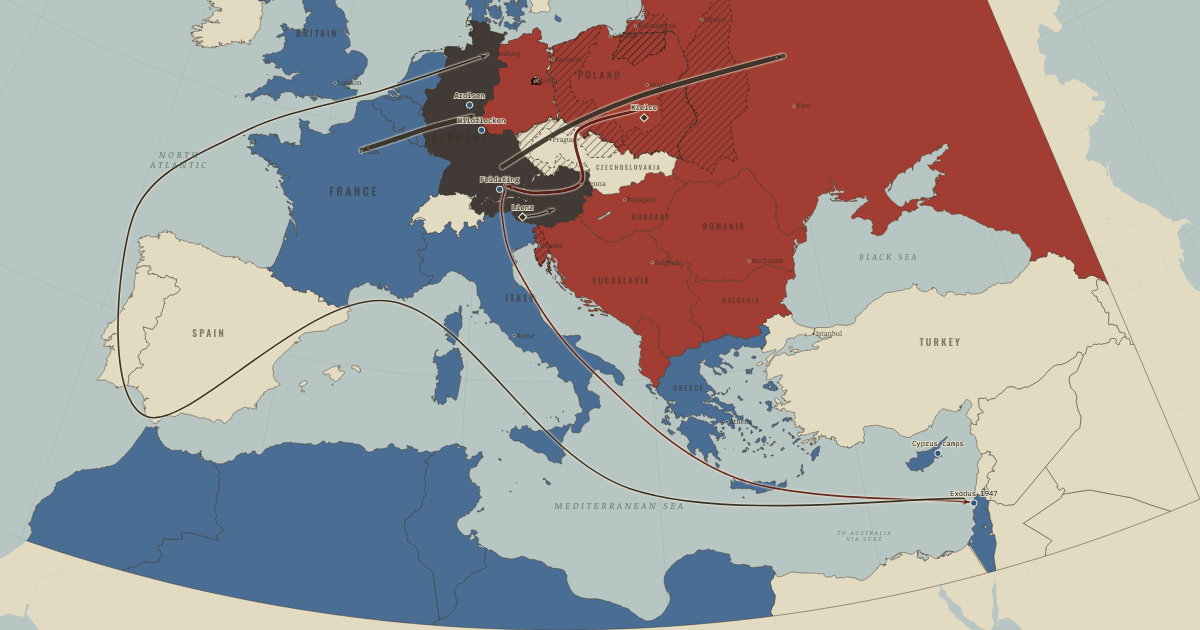
The map above is the world of Refugees in Europe, July 1947 — The IRO; the Exodus turned back.
Every state on the map that year: The world in 1945 · Europe in 1945.
Part of IB History: Refugees in Europe and Indochina →
SHORT EXPLANATION
The Allies expected displaced persons (DPs)—civilians stranded abroad by war, including forced laborers and camp survivors—to spend only a short time in camps before going home. Allied armies and UNRRA, a relief agency founded in 1943, returned nearly six million people from Germany’s western zones in 1945; the thick charcoal arrows trace their journeys. Across Europe the Soviet Union recovered about 5.35 million citizens, some forcibly under the Yalta accords. At Lienz British troops handed over Cossacks, Russian frontier horsemen who had fought for Germany, and their families; at Dachau American guards forced former Soviet soldiers onto trains. Some chose death rather than return. Sending people home, Western commanders had to recognize, could expose them to persecution.
About a million stayed, largely Poles, Ukrainians and Balts unwilling to live under communism, and Jewish survivors whose homes and communities had been destroyed. In August 1945 the American lawyer Earl Harrison reported to President Truman that Jewish survivors remained behind barbed wire, sometimes beside former collaborators. Eisenhower ordered separate Jewish camps across the zone on the model of Feldafing. After the July 1946 Kielce pogrom, another 90,000 to 100,000 Jews fled Poland for the American zone. Many sought Palestine, then ruled by Britain, whose warships intercepted vessels including the Exodus. The camps raised two connected questions: who could refuse to go home, and where could that person go instead?
The full story
For millions of people, repatriation—the return to their country of citizenship—offered a quick end to displacement. French, Belgian and Dutch workers went home within weeks. By the end of September 1945 nearly six million people had left Germany’s western zones. Soviet citizens presented a harder problem. Britain and the United States had agreed at Yalta in February 1945 to return them, but Stalin regarded people who had lived under German rule with suspicion.
At Lienz on 1 June 1945 British troops forced Cossacks who had fought for Germany, and their families, onto lorries for handover to Soviet authorities. At Dachau in January 1946 eleven of 399 former Soviet soldiers killed themselves rather than board a train. Officers and chaplains protested, and reports of Soviet punishment reached the West. As the wartime alliance collapsed, Western governments narrowed and then abandoned forced return. The emerging right to refuse it reflected both the consequences witnesses had seen and the changing relationship between the Allies.
By 1947 roughly a million people remained in camps that had become communities as well as shelters. Wildflecken in Bavaria held about 20,000 Poles at its peak. Other camps housed Ukrainians, Latvians, Lithuanians or Estonians, who organized priests, schools, newspapers and elected committees. These institutions gave people a way to live together while their future remained unsettled.
Under army control, UNRRA supplied food, health care and welfare, screened residents for collaborators and war criminals, and helped separated families search for one another through the tracing center that became the Arolsen archive. German neighbors often resented DPs receiving Allied rations. For many residents, refusing repatriation was itself a political choice: the governments now ruling their countries were ones they rejected.
For Jewish survivors, return could mean confronting the loss of family and community as well as continuing antisemitism. Harrison’s August 1945 report told Truman that “we appear to be treating the Jews as the Nazis treated them except that we do not exterminate them”. He called for separate camps and recognition of Jews as a group, and supported the Jewish Agency’s request for admission of 100,000 to Palestine. The Agency represented Jews there; Britain governed the territory under a League of Nations mandate, a form of international trusteeship.
The danger in Poland drove more survivors west. After the Kielce pogrom of 4 July 1946 killed at least 42 Jews, the Bricha—Hebrew for ‘flight’, and the name of an underground network—moved tens of thousands through Czechoslovakia and Austria to the American zone, along the arrow on the map. By 1947 about 250,000 Jewish DPs waited in Germany, Austria and Italy.
Britain admitted about 1,500 Jews a month to Palestine, far fewer than sought a place there. Clandestine ships left Italian and French ports. Britain seized the Exodus 1947 off Haifa and forced its passengers ashore in Hamburg; about 52,000 others were interned on Cyprus. Escape from one place did not settle where survivors could live. That decision had become a matter of international politics.
FULL EXPLANATION
Forced return and the Yalta accords
The agreement behind forced return began with Allied prisoners. At Yalta on 11 February 1945 Britain and the United States sought to recover prisoners held by Germany in territory occupied by Soviet forces; in exchange they promised to return Soviet citizens found in the West. By early 1946 the Soviet repatriation administration counted about 5.35 million people returned from across Europe, most willingly. On arrival they passed through filtration camps, where security officers decided whether they would go home, join labor battalions or enter the Gulag, the Soviet forced-labor camp system. Lienz became especially controversial because many Cossacks had left Russia after the civil war and had never been Soviet citizens. Even Yalta’s terms did not cover them. Nikolai Tolstoy’s Victims of Yalta (1977) accused British officers of knowing deception; he lost a libel case in 1989. Mark Elliott’s Pawns of Yalta (1982) follows the American side, tracing the change by 1947 from forced return to protection of those who refused. Such experiences helped shape non-refoulement, the principle against returning people to persecution.
Jewish DPs and the question of Palestine
In Jews, Germans, and Allies (2007), Atina Grossmann describes survivors rebuilding religious and political life in the American zone, in the country of their persecutors. They called themselves the She’erit Hapletah, the “surviving remnant”, and made the camps centers of Zionist politics, the movement for a Jewish state in Palestine. The Bricha brought perhaps 250,000 people west in 1945–48, most in the months after Kielce. Harrison’s report gave survivors a status defined by persecution. In April 1946 the Anglo-American Committee of Inquiry recommended admitting 100,000 Jews to Palestine. Britain, facing Arab opposition and a Jewish insurgency, refused. During the Exodus affair of July to September 1947, members of the UN Special Committee on Palestine saw passengers transferred at Haifa to deportation ships. Historians debate how far the DP crisis caused the UN partition vote in November 1947. Most agree that it lent humanitarian urgency to the Zionist case and that the camps supplied many of Israel’s first soldiers and citizens.
The camps as societies in waiting
Waiting in camp did not mean waiting without activity. Anna Holian’s Between National Socialism and Soviet Communism (2011) describes Polish, Ukrainian, Russian and Jewish DPs in Munich rebuilding national communities through schools in their own languages, theaters, sports clubs and political parties. These communities were often more strongly nationalist than the societies they had left. After forced labor, self-government restored some agency; it also sharpened divisions as leaders defended national claims and campaigned against repatriation. Relief workers, many of them women, came to understand their task as social reconstruction as well as feeding people. At the same time, screening boards examined documents and histories to distinguish genuine victims from collaborators who had fled the Soviet advance. The boundary was often blurred. Ben Shephard and Gerard Daniel Cohen argue that the camps gave practical shape to the modern idea of a refugee as a person defined by political persecution and needing resettlement.
Key places on the map
On this day
Why it happened
Yalta’s promise of return. The Allies’ Yalta agreement promised the return of one another’s citizens. Repatriation also seemed the practical answer to millions of foreigners in an occupied Germany unable to feed them. For most western Europeans it worked; for Britain and America it also meant handing over Soviet citizens regardless of their wishes. The coercion discredited forced return in Western eyes and made refusal a recognized category.
Soviet rule over the DPs’ homes. Many of the remaining DPs came from eastern Poland, the Baltic states and western Ukraine, annexed by the Soviet Union in 1939–40 and retained in 1945. Their neighbors had been deported in 1940–41. To go home was to become a citizen of the regime responsible for those deportations. Their refusal was rational, and the border changes in chapter 3 helped produce the ‘last million’.
The Holocaust and post-war antisemitism. The Holocaust had murdered about three million Polish Jews. Survivors returning to Poland found strangers in their homes and hostility in their towns. The July 1946 Kielce pogrom killed at least 42 Jews and convinced many that they had no future there. Flight to the American zone meant waiting for a home in Palestine or overseas; a year after the war, the camps filled again.
Britain’s limits on Palestine. Britain’s 1939 White Paper capped Jewish immigration to Palestine at 75,000 over five years. After the war London allowed about 1,500 certificates a month, seeking to avoid inflaming Arab opinion. Many more survivors wanted to enter, and the gap produced clandestine immigration in 1945–48, interception at sea and internment on Cyprus.
THE TURNING POINT
The Harrison Report, August 1945. Nationality was an inadequate guide to what a Jewish survivor needed. A Polish Jew could be placed with Polish Catholics, some hostile, and expected to return to Poland. Earl Harrison asked officials to recognize the persecution Jewish survivors had suffered. Truman asked Eisenhower to act, and Feldafing, opened as an all-Jewish camp in May 1945, became a model for separate camps across the zone. The report changed the organization of aid there and anticipated an idea developed further in the 1951 Refugee Convention: protection could depend on persecution.
What it changed
Survivors to Israel. The end of the British Mandate in May 1948 opened a destination for Jewish DPs: the new State of Israel admitted them, and most of the camp population left within three years. The International Refugee Organization helped about 132,000 reach Israel. The same war displaced about 700,000 to 750,000 Palestinians; chapter 5 considers their parallel exodus and the limits of the new refugee regime.
From UNRRA to the IRO. UNRRA relied heavily on American funding, and Washington criticized it for helping repatriate people to communist states. In 1947 the International Refugee Organization replaced it; the Soviet bloc refused to join. Its emphasis on resettlement abroad acknowledged that many people would not go home. The Cold War made that change possible, as chapter 5 explains.
The right not to be returned. Article 33 of the 1951 Convention prohibits returning a refugee to territories where life or freedom would be threatened on specified grounds, subject to exceptions in the article. Forced return at Lienz and Dachau forms part of the history behind that protection. The rule against return does not itself identify a state obliged to admit the refugee, a gap later exposed in Southeast Asia.
An echo in Hong Kong. In 1989, forty-four years after Lienz, Hong Kong put screened-out Vietnamese on a dawn flight to Hanoi. Consent, persecution and host states’ duties were again at issue. Chapter 11 examines how refugee protection applied when authorities judged the people being returned to be migrants rather than refugees. The principle endured, while its application remained contested.
DISCUSSION QUESTION — Why did the Western Allies abandon forced repatriation by 1947, and what does the change reveal about how refugee protection is created?
The decision to abandon forced repatriation grew from several pressures. At Lienz, Dachau and Plattling soldiers saw people kill themselves rather than return; officers and chaplains protested through their chain of command. Reports of executions and the Gulag gave Western governments further reason to take their fears seriously. But the timing also matters. By 1946–47 the wartime alliance was collapsing, and flight from Soviet rule supported the Western case in the Cold War. DP communities and their American diasporas added political pressure. Protection grew where principle and interest met. Neither revulsion in 1945 nor strategy alone would have overturned a signed agreement so quickly. Rights depend on political decisions as well as law, and can weaken when the interests supporting them fade, as the screening and return of Vietnamese in the late 1980s would show.
An interesting fact
Kathryn Hulme, an American who helped run Wildflecken for UNRRA, described the Bavarian camp in The Wild Place (1953), winner of the Atlantic non-fiction prize. There she befriended Marie Louise Habets, a Belgian nurse who had left a convent during the war. Habets’s life became the basis of Hulme’s The Nun’s Story (1956), filmed in 1959 with Audrey Hepburn. A friendship among Polish DPs in an army camp thus helped bring the story to millions of cinema-goers.
Related
THE FREE PRINTABLE STUDY GUIDE
Get the printable study guide for Uprooted free. I’ll send you a few short letters, then one when a new atlas opens. That’s all. — Paul
NO TRACKING · YOUR ADDRESS IS USED FOR THE DISPATCH AND NOTHING ELSE · UNSUBSCRIBE ANYTIME