Refugee crises · CHAPTER 2 ·
Expulsion of Germans after WW2
Chapter 2 of Uprooted: Refugees in Europe 1945–1960 and Indochina 1975–1990: “The Expulsions of Germans”
Between 12 and 14 million Germans fled or were driven out of the lands east of the Oder and Neisse and from Czechoslovakia, Hungary and other states after 1945. At Potsdam in August 1945 the Allies accepted this ‘transfer’, asking that it be orderly and humane, but the expulsions had begun before any agreement and were neither.
WW2 is free in full, and chapter 1 of every atlas is free. A free account opens 3 more chapters a day. Starter, at $9 a month, opens all 21 with no daily limit — see the plans.
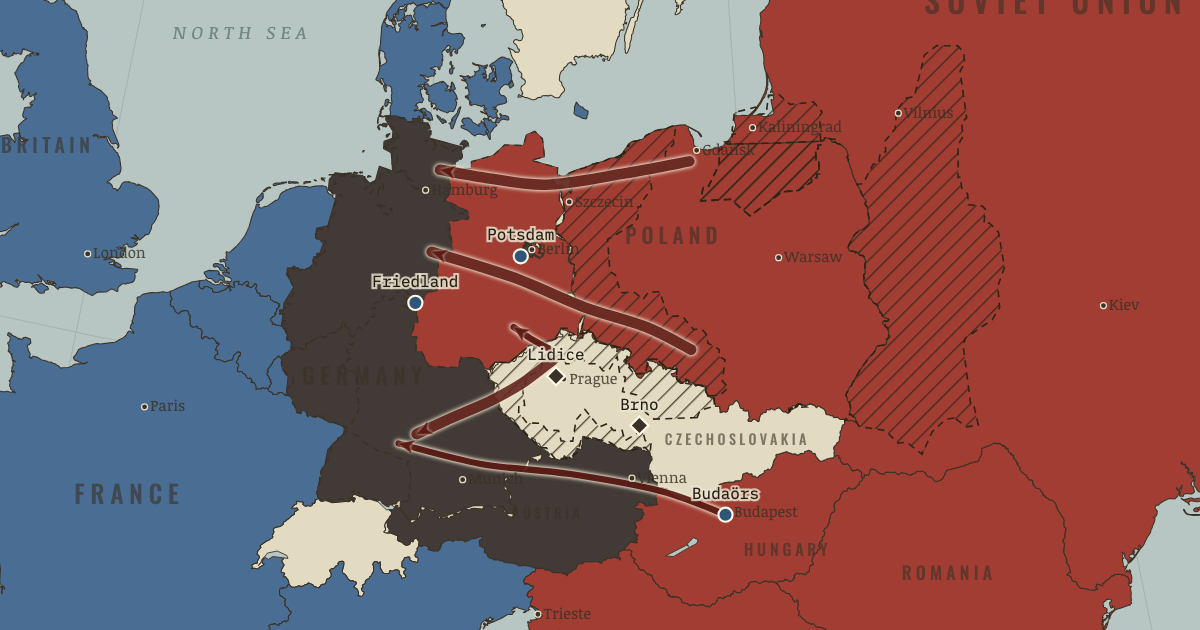
The map above is the world of Refugees in Europe, August 1945 — Potsdam: borders move west.
Every state on the map that year: The world in 1945 · Europe in 1945.
Part of IB History: Refugees in Europe and Indochina →
SHORT EXPLANATION
German communities had lived for centuries across eastern Europe. During and after the Second World War, between 12 and 14 million Germans fled or were expelled from the lands east of the Oder and Neisse, from Czechoslovakia and Hungary, and from other countries. At Potsdam near Berlin, Britain, the United States and the Soviet Union accepted the “transfer” from Poland, Czechoslovakia and Hungary, stipulating that it be “orderly and humane”. Their decision followed six years of German occupation: about six million Polish citizens had been killed, Czech villages including Lidice destroyed, and many local Germans had welcomed the Nazi state.
On the map, hatching marks the old German east and the Sudetenland, the German-speaking rim of Bohemia; arrows lead to the four zones of occupied Germany. The movement began before Potsdam, as soldiers and local militias carried out violent “wild expulsions”. Organized trains followed in 1946. By 1950 West Germany counted 7.9 million expellees, about a sixth of its population. Estimates of deaths range from about 500,000 to more than two million, partly because the methods differ. The new borders endured after the removal of people who might have contested them.
The full story
The leaders who advocated transfer believed they had learned something from the road to war. Hitler had used the grievances of Sudeten Germans to dismember Czechoslovakia in 1938, then invoked Poland’s German minority before invading in 1939. If a minority could be used as a pretext for aggression, removing it might prevent a future aggressor from doing the same. From 1942 Czech and Polish exiles argued that removal would make their states safe. Churchill told the House of Commons in December 1944 that expulsion was the most “satisfactory and lasting” method and that “a clean sweep will be made”. Planners could point to the 1923 Treaty of Lausanne, under which about 1.2 million Orthodox Christians left Turkey and about 400,000 Muslims left Greece. This compulsory exchange of minorities seemed a precedent for peace. Its sponsors assumed that transfer could also be humane.
Events on the ground had already overtaken the agreement at Potsdam. From May to August 1945 Czechoslovak soldiers, militias and local committees drove an estimated 700,000 to 800,000 Germans out in “wild expulsions”. Around 20,000 residents of Brno were marched toward Austria; Polish troops cleared a strip along the new western border. A Czechoslovak presidential decree of 2 August removed citizenship from many Germans and Hungarians, leaving them stateless in their homes. On 20 November the Allied Control Council, the four powers’ governing body in Berlin, planned transfers of 6.65 million people, including 3.5 million from Poland and 2.5 million from Czechoslovakia. In 1946 organized trains took families carrying a few kilograms of luggage to camps such as Friedland. By 1950 West Germany counted 7.9 million expellees and East Germany about 4.3 million. The country that had started the war was now home to Europe’s largest displaced population, a reversal that shaped German memory for decades.
The journey could be fatal. People died from violence in camps and on marches, and many more from hunger, cold and disease. Elderly people, young children and women without men faced particular hardship: men of military age had often been killed or taken prisoner. Survivors lost farms, houses and savings, while churches and dialects disappeared from places their communities had long inhabited. Poland and Czechoslovakia became nearly homogeneous nation-states, and the border disputes that had helped cause two wars did not return. This helps explain why leaders thought removal would secure peace. It also leaves the cost of that policy to be judged: millions who had not individually chosen the war bore it.
FULL EXPLANATION
Half a million or two million dead?
The figures for deaths are far apart because the investigators counted different things. In 1958 the West German Federal Statistical Office used a population balance to calculate about 2.2 million “losses”, comparing Germans who had lived in the east with those accounted for afterward. The churches’ tracing service in 1964 confirmed 473,013 deaths and left about 1.9 million cases unresolved. Those missing might have died in the war, remained under Polish names or never registered; an unresolved case is not a documented death during expulsion. A 1974 Federal Archives report estimated about 600,000 deaths from crimes. Helmut Schmidt’s government withheld it to protect relations with the East, and it appeared in 1989. Later, Rüdiger Overmans and Ingo Haar assessed the documented toll at around 500,000 to 600,000, while the German Red Cross cites 2.25 million. For Czechoslovakia, a joint Czech–German historians’ commission estimated 15,000 to 30,000 deaths in 1996, against older German estimates of 220,000 to 270,000. Methods and periods differ, and the dispute also has a Cold War political history.
Who decided: the Allies and Potsdam
Who decided on expulsion? German postwar memory long blamed Poles and Czechs alone, while Polish and Czech memory emphasized Allied approval. The record gives both national governments and outside powers a part. Detlef Brandes traced lobbying in London and Moscow from 1942 by Edvard Beneš, Czechoslovakia’s president in exile, and the Polish government; the British cabinet accepted transfer in principle that year. R. M. Douglas argues in Orderly and Humane (2012) that Britain and the United States endorsed expulsions despite knowing by summer 1945 that they were brutal and deadly. In his account they used Section XIII chiefly to slow arrivals in zones they struggled to feed. The section requested a pause while the Control Council planned transfers, but that request was largely ignored. Douglas describes an international policy carried out by national governments: Allied consent adds responsibility without excusing those who performed the removals. In Indochina, outside powers likewise accepted a mass departure they thought would settle a regional conflict, then bargained over its cost.
Transfer, removal, expulsion: words as arguments
The names given to these events tell us what their speakers want us to see. Potsdam used the administrative word “transfer”. Czech usage long favored odsun, “removal” or “transfer”, presenting a legal measure; Polish official usage used wysiedlenie, “resettlement”. German Vertreibung, “expulsion”, emphasizes force and victims. Since the Yugoslav wars of the 1990s, Norman Naimark in Fires of Hatred (2001) and Philipp Ther in The Dark Side of Nation-States (2014) have used “ethnic cleansing” for the forced removal of an ethnic group from territory, placing 1945 in a European history from the Balkan wars to Bosnia. Language can also serve reconciliation. In the Czech–German Declaration of 1997 Germany acknowledged responsibility for Nazi occupation, and the Czech side expressed regret for the “much suffering and injustice” inflicted on innocent people. A source’s choice of word is part of its interpretation.
Key places on the map
On this day
Why it happened
The lesson drawn from Munich. Hitler invoked the grievances of three million Sudeten Germans when he dismembered Czechoslovakia in 1938, and Poland’s German minority when he justified invasion in 1939. Czech and Polish leaders, followed by British supporters of transfer, drew a lesson from those precedents: a mixed borderland could supply a pretext for another war. Removing the minority appeared both a response to occupation and a lasting security measure.
Six years of occupation. Occupation gave many Poles and Czechs reasons to associate their German neighbors with Nazi rule. About six million Polish citizens were killed, half of them Jews; villages including Lidice were destroyed in reprisal, and Nazi plans envisaged deporting or eliminating Slavic populations. Many local Germans served the occupation, and in 1935 about two-thirds of Sudeten German voters had backed Konrad Henlein’s pro-Nazi party. These facts helped make collective blame plausible, though individual Germans had made very different choices.
Poland moved west. Poland lost its eastern provinces to the Soviet Union under the settlement accepted at Yalta, with compensation to come in the west. Potsdam placed the Oder–Neisse lands under Polish administration “pending the final determination” of the border. Warsaw sought permanence by settling Poles there and removing Germans. The uprooting of Poles in the east and the expulsion of Germans in the west were connected.
Allied consent and the Lausanne precedent. The 1923 Greek–Turkish exchange, which moved about 1.6 million people, offered Allied planners a precedent they thought had brought peace. Churchill called expulsion the most “satisfactory and lasting” method in December 1944. Belief that transfer could prevent conflict and be managed humanely helped secure great-power support for Polish and Czechoslovak plans.
THE TURNING POINT
Potsdam, Section XIII, 2 August 1945. By 2 August 1945 removals were already under way. At Potsdam the three powers declared that transfers from Poland, Czechoslovakia and Hungary “will have to be undertaken” and should be “orderly and humane”. They accepted transfer in principle while requesting a suspension until the Control Council could plan the flow. The occupying powers controlled the receiving zones and could organize arrivals; their appeal for humane treatment had little means of enforcement.
What it changed
A sixth of West Germany. West Germany’s September 1950 census counted 7.9 million expellees, 16.5 percent of its population. Many were first housed in rural Bavaria, Lower Saxony and Schleswig-Holstein. Housing programs, the Equalisation of Burdens law of 1952 and the postwar boom helped integrate them, a founding achievement of the Federal Republic explored in chapter 6. Expellees also organized a party and associations that kept claims to the lost east in politics for a generation.
Room for Poles from the east. The departure of Germans opened homes in Silesia and Pomerania to Poles from central Poland and provinces annexed by the Soviet Union. Breslau became Wrocław within three years. Some settlers found German furniture still in their houses; many expected for years to be moved again. Chapter 3 follows these linked journeys, in which one removal made room for another.
Outside the refugee regime. German expellees arriving in Germany were generally treated by international agencies as Germany’s responsibility. The 1951 Refugee Convention excludes people recognized by their country of residence as having the rights and obligations attached to nationality there. Chapter 5 examines a protection system in which access depended in part on whether a person had a state’s protection.
A memory still contested. Expellee associations became influential in West German politics. Remembering German suffering alongside responsibility for Nazi occupation remained a question in relations with Poland and the Czech Republic for decades. The 1990 border treaty and the Berlin documentation center opened in 2021 mark later stages of the argument, discussed in the epilogue.
DISCUSSION QUESTION — How should responsibility for expelling Germans be divided between the Allied powers and the governments that carried out the removals?
The Allied powers accepted responsibility when they agreed at Potsdam that transfer “will have to be undertaken”. Churchill had already endorsed a “clean sweep”, and the Control Council planned for 6.65 million people to enter zones the powers controlled. Poland and Czechoslovakia could hardly have sent millions there without that consent. National authorities, however, had begun expulsions before Potsdam and made decisions of their own, including the Czechoslovak citizenship decree. The Allies asked for a pause, though removals continued. Following R. M. Douglas, we can describe an international policy carried out by national governments: the powers accepted and organized transfers, while national authorities initiated and executed removals. Both helped produce the outcome in different ways. Chapter 10 tests the significance of international consent against the Geneva bargains.
An interesting fact
The Sudeten German community found a particular place in Bavaria, which received more of its members than any other part of Germany. In 1954 the Bavarian government formally became its patron. Politicians call Sudeten Germans the state’s “fourth tribe”, alongside Old Bavarians, Franconians and Swabians; Sudeten German Day at Whitsun remains a fixture of Bavarian politics. Expellees from Gablonz (Jablonec nad Nisou) founded Neugablonz near Kaufbeuren on the site of a wartime explosives works, rebuilding their glass and costume-jewelry trade there.
Related
THE FREE PRINTABLE STUDY GUIDE
Get the printable study guide for Uprooted free. I’ll send you a few short letters, then one when a new atlas opens. That’s all. — Paul
NO TRACKING · YOUR ADDRESS IS USED FOR THE DISPATCH AND NOTHING ELSE · UNSUBSCRIBE ANYTIME