Haiti and Kenya independence · CHAPTER 5 ·
Dessalines and the birth of Haiti
Chapter 5 of Two Roads to Independence: Haiti 1789–1838 and Kenya 1895–1978: “Dessalines and the Making of Haiti”
On 1 January 1804 at Gonaïves, Jean-Jacques Dessalines and his generals declared independence and named the country Haiti, from the Taíno Ayiti. In early 1804 Dessalines ordered the killing of most remaining French, perhaps 3,000 to 5,000 people, and his 1805 constitution declared that all Haitians would be known as Black.
Chapter 5 is included with every paid plan. WW2 is free in full, and chapter 1 of every atlas is free. A free account opens 3 more chapters a day. Starter, at $9 a month, opens all 21 with no daily limit — see the plans.
Free printable Haiti and Kenya independence study guide, sent by email ↓
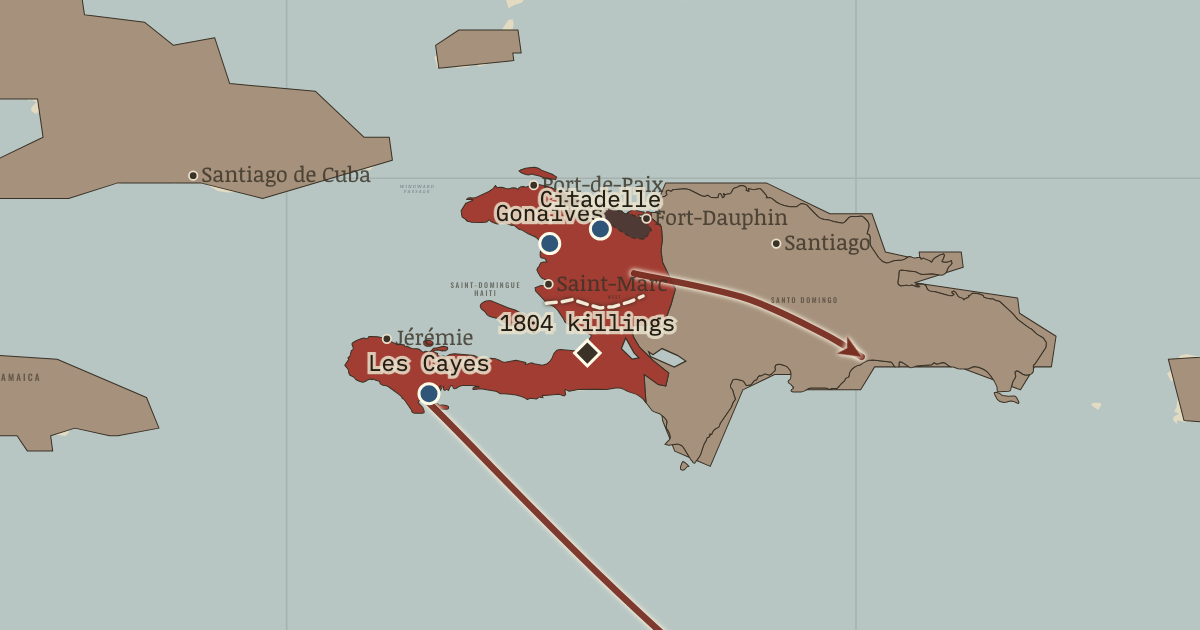
The map above is the world of Haiti, 1807–20 — Two Haitis: Christophe’s north, Pétion’s south.
Every state on the map that year: The world in 1800 · Europe in 1800.
Part of IB History: Haiti and Kenya →
SHORT EXPLANATION
At Gonaïves on 1 January 1804, Jean-Jacques Dessalines and his generals declared independence and renounced France for ever. They called the country Haiti, from Ayiti, a name used by the island’s Indigenous Taíno people and often translated as land of mountains. Thirteen years of war had won freedom, but the founders feared a French return. In the following months Dessalines ordered the killing of most French residents who remained, perhaps 3,000 to 5,000 people; the map marks their deaths with a memorial, and historians still debate the event. The 1805 constitution barred white property owners and named all Haitians Black, giving every citizen the name of the lowest rank in the colonial colour order.
The victors also had to decide who would work and own the land. Dessalines’ officers killed him at Pont-Rouge in October 1806, and the country split. In the north Henry Christophe maintained plantations under strict labour laws, using their revenue for defence, including the Citadelle; the charcoal plain around Le Cap survives on the map only in his territory. His state later became a kingdom. In the south Alexandre Pétion’s republic began giving soldiers small farms, and in 1816 Pétion armed Simón Bolívar on condition that he free South America’s enslaved people. The dashed frontier remains until Christophe’s death in 1820 and the country’s reunification. The two states had offered rival answers to a question Haitians had faced since Toussaint: plantations or family land?
The full story
A declaration could end colonial rule on paper, but Haiti’s founders also had to say what would take its place. At Gonaïves on 1 January 1804, they heard the declaration drafted by Dessalines’ secretary, Louis Boisrond-Tonnerre. It called on citizens to swear “to the whole world, to posterity, to ourselves” that they would renounce France for ever. The new name, Haiti, displaced the colonial one and claimed the land for the people who now lived there.
The laws of the new state carried the separation further. Dessalines became governor-general for life, then crowned himself emperor in October 1804, two months before Napoleon’s coronation in Paris. His 1805 constitution abolished slavery for ever and barred white property owners. It named Haitians collectively Black, while providing exceptions for naturalised Polish and German soldiers and white women. The nation’s membership was being defined through slavery and the war that had ended it.
The rupture with France also took a terrible form. Between February and April 1804, as Dessalines toured the towns, soldiers acting on his orders killed most of the French residents who remained. Perhaps 3,000 to 5,000 died; their memorial appears on the map. Some doctors, priests and craftsmen, many white women, and the Polish and German soldiers were spared.
Haitian leaders made these decisions after two years of exterminatory war under Leclerc and Rochambeau. French forces still held Santo Domingo, and the leaders feared that colonists would help an invading army. Historians differ over the meaning of the killings: Philippe Girard calls them genocide, while others stress revenge and fear of reconquest; Julia Gaffield argues that the principal victims were men judged enemies of the state. For a century the killings were used to portray Haiti as savage, while the suffering of enslaved people went largely unrecorded.
The question of land divided the men who had won independence. Dessalines’ officers assassinated him at Pont-Rouge, just north of Port-au-Prince, on 17 October 1806. Henry Christophe established a state in the north, made a kingdom in 1811. His rural code tied labourers to estates, whose revenue paid for schools and the Citadelle. As many as 20,000 conscripted workers built the fortress on a 900-metre peak. Christophe also created a Haitian nobility.
Alexandre Pétion’s republic in the south and west followed another course. From 1809 it divided state land into small grants for soldiers; smallholders gained farms, but exports fell. Pétion also made Haitian support available beyond the island. At Les Cayes in 1816, he supplied Simón Bolívar with muskets, ships and a printing press on condition that he free enslaved people in the lands he won. Christophe shot himself in October 1820, and Jean-Pierre Boyer reunited Haiti. The smallholders’ republic had outlasted the plantation kingdom, and its rural way of life would define the country.
FULL EXPLANATION
The killings of 1804: evidence and debate
The number of people killed in 1804 and the meaning of their deaths are separate questions. In The Slaves Who Defeated Napoleon (2011), Philippe Girard reconstructs the killings from late February to about 22 April, with escalations when Dessalines reached Port-au-Prince in March and Le Cap in April. He estimates 3,000 to 5,000 dead and regards contemporary claims of 3,000 at Le Cap alone as exaggerated. In a 2005 article Girard called the killings genocide, linking them to the French army’s exterminatory methods. C. L. R. James saw revenge; Laurent Dubois and David Geggus emphasize fear of a French return, since France still held Santo Domingo and refused recognition. Deborah Jenson reads Dessalines’ proclamations as messages made for foreign audiences. Julia Gaffield argues that the principal targets were men identified with the French cause, while many women and foreign merchants were spared. For a century, European and American anti-Haitian and pro-slavery arguments repeatedly used the killings. The memorial keeps both the victims and the causes in view.
“All Haitians are Black”: defining a citizen
The constitution of 20 May 1805 made citizenship a deliberate break with the slave colony. Article 12 declared that no white person, whatever their nation, would set foot on Haitian soil as master or proprietor. Article 13 exempted white women naturalised by the government and naturalised Germans and Poles. Article 14 then declared that colour distinctions among the children of one family must cease: Haitians would be known only by the generic name of Black. In Modernity Disavowed (2004), literary scholar Sibylle Fischer reads this as a radical political definition, open to people of any origin who joined the nation. Pétion’s 1816 constitution extended the invitation: Article 44 offered citizenship after one year’s residence to any African or Indigenous American who came to live in Haiti. Boyer invited free Black Americans to settle in 1824, and several thousand came. The founders’ opposite to the slave colony was a nation that could also offer refuge to its victims.
Kingdom and republic: two models of freedom
The kingdom and the republic organized freedom in different ways, and the results depend on what we measure. Christophe’s Code Henry of 1812 kept labourers on estates with fixed hours and shares of the crop. Estate revenue supported an army, palaces such as Sans-Souci and schools on English models. Christophe corresponded with British abolitionists including Thomas Clarkson. Europeans mocked his nobles, among them the Duke of Marmelade, though monarchies elsewhere also rewarded supporters with titles. Pétion’s grants allowed families to grow food and coffee on their own plots and pay few taxes; exports and state revenue fell. Laurent Dubois, in Haiti: The Aftershocks of History (2012), and Jean Casimir argue that rural Haitians deliberately chose this independence and defended it against later attempts to restore estate labour, including Boyer’s Rural Code of 1826. The kingdom was richer and the republic freer. The rural majority chose family land, and the state never found a way to tax that choice without coercion.
Key places on the map
Why it happened
Victory without recognition. Vertières expelled the French army, but it did not persuade France to recognise Haiti. A French garrison remained in Santo Domingo. Haitian leaders prepared for a continuing threat with a large army, mountain fortresses and laws intended to keep colonists from returning. Fear of reconquest shaped the declaration, the constitution and the killings of 1804.
A war that drew the line by colour. The French campaign of 1802–03 made race a line of conflict. Under Rochambeau the army used massacres, drownings and attack dogs; France’s restoration of slavery in Guadeloupe gave people of African descent in Saint-Domingue reason to fear for their survival. The new state’s ban on white landowners and its description of citizens as Black grew out of that war.
The land question left open. Toussaint had forced cultivators to work plantations, and they had resisted. Independence brought the ownership question back: would estates belong to the state, to the generals who had seized them, or to former slaves seeking family plots? Dessalines alarmed powerful officers when he tried to check land titles. His successors would choose opposing courses in north and south.
Rivalries among the generals. The victorious generals had fought together despite different pasts. Dessalines and Christophe had been enslaved; Pétion was a free man of colour, and the War of Knives remained in their memories. Dessalines’ autocratic rule brought rivals together against him. His officers killed him, and with no institution yet able to settle the victors’ disputes, Haiti divided along old regional lines.
THE TURNING POINT
Gonaïves, 1 January 1804. At Gonaïves the generals declared a new nation outside European empire. Their renunciation of France and choice of the Taíno name claimed the land for those who had been enslaved there. No state of formerly enslaved people had existed before in the Americas. Separation answered the fear of reconquest, and helps explain the 1804 killings, the 1805 constitution and France’s determination to demand payment for recognition.
What it changed
A nation without recognition. Independence did not bring diplomatic acceptance. France refused recognition; the United States, under pressure from slaveholding states, banned trade in 1806; Britain traded quietly without formal ties. Isolation restricted Haiti’s access to credit and left it exposed to French threats. The next chapter follows the price France demanded in 1825.
The island reunited, then the east. Boyer reunited Haiti in 1820 and marched into Santo Domingo in February 1822. He abolished slavery in the east and governed the whole island until 1844. Union could protect Haitian independence, but many Dominicans experienced it as occupation. They won their independence in 1844 against Haiti.
A beacon and a warning to the Americas. From Jamaica to Virginia, enslaved people could see freedom in Haiti’s example; slaveholding governments saw danger. Slaveholders from Virginia to Cuba tightened their laws. Pétion made abolition a condition of his aid to Bolívar, yet the new Spanish American republics excluded Haiti from their diplomacy. For two centuries it carried both reputations: beacon and warning.
DISCUSSION QUESTION — How did Haiti’s founders define who belonged to the nation, and why?
The founders made the struggle against slavery central to belonging. In 1804 they renounced France and reclaimed the Taíno name; in 1805 they barred white landowners and named citizens Black, while naturalising Polish and German soldiers and white women who had sided with Haiti. The republic’s 1816 constitution offered citizenship to any African or Indigenous American who came. These choices asserted dignity and addressed a danger: France had tried to restore slavery, still held Santo Domingo and refused recognition. Historians disagree about the costs, including the killings and isolation, and whether the definition was racial or political; Fischer stresses its political openness. A definition made against an escaped power could endure beyond the danger that produced it.
An interesting fact
Haiti’s Declaration of Independence survived in the records of neighbours watching the new state. For two centuries historians knew of no printed copy. In 2010 Julia Gaffield, then a Duke University doctoral student, found an eight-page pamphlet among Jamaica’s colonial papers at the UK National Archives in Kew. Haiti’s government press had printed it in Port-au-Prince in 1804; the Governor of Jamaica sent it to London that March with a report on Haiti. Gaffield later found a one-page printed version in British Admiralty records.
Related
THE FREE PRINTABLE STUDY GUIDE
Get the printable study guide for Two Roads to Independence free. I’ll send you a few short letters, then one when a new atlas opens. That’s all. — Paul
NO TRACKING · YOUR ADDRESS IS USED FOR THE DISPATCH AND NOTHING ELSE · UNSUBSCRIBE ANYTIME