Haiti and Kenya independence · EPILOGUE ·
Independence in Haiti and Kenya
Chapter 12 of Two Roads to Independence: Haiti 1789–1838 and Kenya 1895–1978: “Two Independences Compared”
Haiti won independence in 1804 by defeating the French army in the only successful revolution of enslaved people, and made all its citizens Black by law. Kenya won it in 1963 through rebellion and negotiation, after Mau Mau lost on the battlefield, and defined its citizens by a territory and flag many communities had not chosen.
Chapter 12 is included with every paid plan. WW2 is free in full, and chapter 1 of every atlas is free. A free account opens 3 more chapters a day. Starter, at $9 a month, opens all 21 with no daily limit — see the plans.
Free printable Haiti and Kenya independence study guide, sent by email ↓
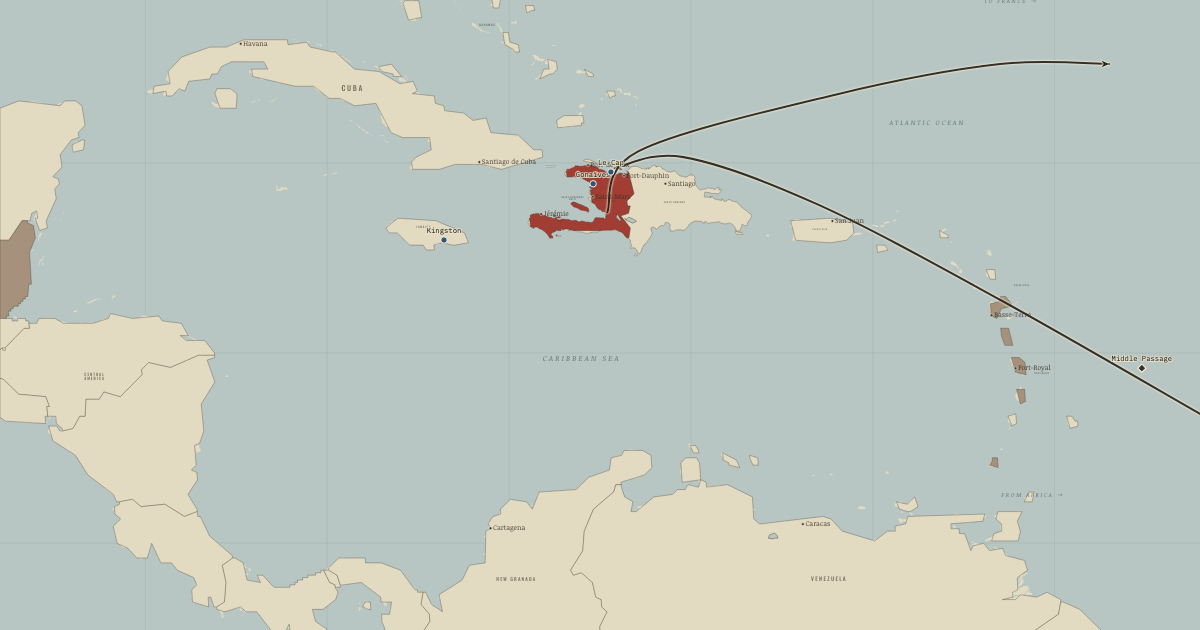
The map above is the world of Haiti, 1975 — The Caribbean decolonises.
Every state on the map that year: The world in 1980 · Europe in 1980.
Part of IB History: Haiti and Kenya →
SHORT EXPLANATION
Haiti and Kenya entered independence by different roads. Haiti’s army defeated France outright in history’s only successful revolution of enslaved people. Freedom from slavery shaped its idea of citizenship: its people were free, Black by law and, if they could manage it, landholders. In Kenya the Mau Mau fighters for land and freedom lost on the battlefield; rebellion was followed by negotiation. The new nation took in communities within a colonial territory, under a flag many of them had not chosen.
The final map shows the Caribbean in 1975. Jamaica and Trinidad became independent in 1962, a year before Kenya but 158 years after Haiti’s declaration at Gonaïves. The route Haiti had opened alone became common in Kenya’s generation.
The price of each settlement continued to be paid after the flag changed. France made recognition of Haiti conditional on an indemnity demanded in 1825 for planters’ lost property, including enslaved people. Peasants were taxed to pay the state’s creditors, even as rural families built free lives on their own land. Kenya retained colonial borders, institutions and the land market. Loyalists, who had sided with the colonial government, joined politicians and other buyers in acquiring much of the White Highlands, once reserved for European settlers; many fighters received little.
The struggles themselves also had to be recovered from official silence. Western histories largely ignored the Haitian Revolution for a century, and Kenya kept Mau Mau banned until 2003. Each independence opened an argument about whom the nation was for. The manner of victory shaped where that argument began.
The full story
Haiti’s founders defined their nation against slavery and the color hierarchy that had justified it. The constitution of 1805 made all citizens Black; that of 1816 offered citizenship to any African or Indigenous American who arrived. Haiti could thus be imagined as a refuge from slavery. Its founding sites, from Gonaïves to the Citadelle, Christophe’s mountain fortress, became symbols of Black sovereignty across the Atlantic.
Kenya’s struggle centered on the settler state and land alienation, the colonial taking of African land for European settlement. Its new citizenship was territorial: Kenyans were the peoples living inside a colonial border. Memories of the hated kipande pass and the White Highlands, reserved for Europeans, gave them common points of reference, while ethnic politics encouraged under colonial rule divided them. Kenyatta made Harambee, the call to pull together, the national motto. The call itself recognized that unity remained work to be done.
The two sets of leaders brought the experience of their struggles into government. Toussaint, Dessalines, Christophe and Pétion had commanded armies against European powers. They governed as generals, concentrating power through constitutions and using labor codes to tie cultivators—the estates’ freed workers—to plantations. Their rivalries split the state. Haiti’s founders built a government that expected to fight.
Kenyatta, by contrast, came out of detention to preside over a negotiated handover. He conciliated settlers and Britain while governing rivals, including his first vice-president Oginga Odinga, in an authoritarian manner. The provincial administration, a network of centrally appointed officials that had run the Emergency, became an instrument of his rule. Kenya inherited a state designed to control. In both countries a deep divide separated rulers from the rural majority: Haiti’s cultivators and Kenya’s landless.
Those who worked the land also carried much of the economic burden. France demanded an indemnity in 1825 as the price of recognizing Haiti and compensating former colonists. Haiti paid 90 million francs and repaid loans taken for the purpose, raising the money largely from coffee farmers. The last related debts were cleared in 1947. Kenya’s Million-Acre Scheme used British loans to buy settler farms and resettle African families, who paid for fields their parents had lost.
The two arrows on the map show distinct movements of wealth through the Atlantic system. Slave ships carried captives to work for French profit; the indemnity carried wealth out of Haiti. The former empires long kept such burdens out of their histories. Britain hid Kenyan files at Hanslope Park, a Foreign Office site in Buckinghamshire. Acknowledgement began with Britain’s settlement with Kenyan veterans in 2013 and the Franco-Haitian commission of historians announced in 2025. Both peoples won real independence, but its costs fell heaviest on those who had fought hardest for it.
FULL EXPLANATION
Comparing the two roads
The two struggles shared features, though the 160 years between them placed the new states in different worlds. Both colonial economies rested on land taken for a planter or settler class and worked by coerced labor, under the protection of colonial violence. Both colonized societies were divided: between free people of color and the formerly enslaved in Haiti, and between loyalists and Mau Mau in Kenya. Outside powers entered both struggles. Britain and Spain invaded Saint-Domingue in the 1790s; around 1960 Cold War rivals funded Kenyan politicians, Americans backing Mboya and communist states Odinga. The victories and their reception differed. Haiti destroyed the planter class and faced a world of slaveholding empires that withheld recognition. Kenya’s settlers could stay or sell, and Kenya joined the United Nations in December 1963. Haiti paid an indemnity; Kenya received loans and aid. Frederick Cooper’s “gatekeeper state” offers a way to see a common institutional pattern. Such a post-colonial state controls the passage between its territory and the outside world through customs, aid and licenses. The resemblance suggests that the colonial state outlived the different routes by which the colonies escaped it.
Silence, memory and acknowledgement
To be absent from Western scholarship was not the same as being forgotten in Haiti. Michel-Rolph Trouillot argued that the Haitian Revolution was silenced in that scholarship because it challenged beliefs about race and progress. C. L. R. James and later historians restored it to the center of the Age of Revolutions. Haitians continued to mark 1 January and 18 November, the day of Vertières, as national holidays. Kenya’s first governments preferred to forget the Emergency, and Mau Mau remained banned until 2003. Public recognition changed: a statue of Dedan Kimathi was unveiled in Nairobi in 2007, and the 2010 constitution turned Kenyatta Day, 20 October, into Mashujaa Day, the day of heroes. Former colonial powers moved more slowly. France declared slavery a crime against humanity by law in 2001, and President Macron’s commission on the indemnity followed in 2025. Britain expressed regret and compensated Kenyan claimants in 2013 while denying legal liability. Words and limited payments have acknowledged part of this history; reparations remain an open question in both cases.
Reading the sources on both roads
The surviving records let us hear leaders and colonial officials, but their origins affect what they can tell us. Haiti’s constitutions and proclamations stand alongside letters dictated by Toussaint and other leaders, French officers’ memoirs such as Pamphile de Lacroix’s of 1819, and British colonial papers in which Julia Gaffield found the printed declaration. Bois Caïman and the making of the flag survive largely as oral traditions written down decades later. Kenyan evidence includes colonial laws and reports, the Emergency court records used by David Anderson, and memoirs of detainees and fighters such as J. M. Kariuki’s “Mau Mau” Detainee (1963) and Waruhiu Itote’s “Mau Mau” General (1967). There are also migrated archives released from 2012 and parliamentary debates in Hansard. Colonizers produced most of the earliest written record in both cases. Their purposes helped determine what was recorded and what was left out. The atlas’s IB source packs pair colonial and colonized voices so that readers can examine those gaps.
Key places on the map
Why it happened
Different empires at different moments. The international settings made the same demand for freedom meet different responses. Haiti confronted revolutionary and Napoleonic France at the height of the Atlantic slave system, when no great power would accept a state of formerly enslaved people. Kenya faced a Britain weakened by the Second World War, embarrassed by its camps and surrounded by newly independent states. In 1802 the demand met reconquest; in 1960 it reached a negotiating table.
Victory against negotiation. Haiti’s army destroyed French power, leaving its leaders few working colonial institutions and a state to build largely from the ground up. Kenya’s insurgents lost militarily, after which politicians negotiated independence. The colonial state, laws and administrators passed intact to the new government. Haiti gained sovereignty without recognition; Kenya gained recognition along with the machinery of the old regime.
Who held the land at independence. French planters in Haiti were driven out, killed in the killings of 1804 recorded in chapter 5, or barred from owning land. The subsequent struggle placed cultivators and the state on opposing sides over how the land would be worked. Kenyan settlers could stay or sell at market prices. Buyers with money acquired land, while landless people had to buy their way in. These settlements shaped inequality for generations.
Recognition and the price of entry. Recognition came at different prices. France demanded 150 million francs from Haiti, later reducing the indemnity to 90 million, and Haiti also had to repay the loans taken to meet it. Kenya entered the United Nations and Commonwealth at once and received loans and aid with conditions of their own. Between the two cases the international order had changed from a club of empires to a community of states claiming to include everyone.
THE TURNING POINT
Two founding days: Gonaïves 1804 and Nairobi 1963. At Gonaïves on 1 January 1804, the generals of an army of former slaves swore to renounce France forever. They named their country after its first inhabitants; no foreign dignitaries were present, and no state was ready to recognize Haiti. At Uhuru Gardens on 12 December 1963, the Union flag came down in the presence of the Duke of Edinburgh. Kenya was welcomed into the United Nations within days. One independence was seized against the world, the other handed over within it. The contrast helps explain why Haiti had to buy what Kenya was given, and why Kenya inherited what Haiti had destroyed.
What it changed
Haiti’s long nineteenth century. Through the age of empire Haiti remained an independent republic of smallholders: isolated, indebted and politically unstable, but free while slavery flourished in Cuba, Brazil and the United States. Its example reached abolitionists and Black thinkers across the Atlantic, while its debts shaped its poverty. Haitians and historians still weigh both legacies. The republic’s survival showed that a state of formerly enslaved people could endure.
Kenya’s land and its politics. The 1960s land settlement and Kikuyu migration into the Rift Valley left disputes that remained alive. So did fear of central domination, which had helped produce majimbo, the regional self-government of the 1963 constitution. Violence erupted around the elections of 1992 and 2007. The constitution of 2010 responded by devolving power to 47 counties, returning in a new form to the regional idea of 1963. Land remained a measure of what independence had delivered.
The reckoning with empire. The question of colonial reparations brings both cases into the present. Haitian governments have asked France to return the indemnity; Kenyan veterans won compensation from Britain in court. Both former powers have offered regret and limited funds. How an empire should account for what it took remains an open question in the twenty-first century.
DISCUSSION QUESTION — Compare and contrast how Haiti and Kenya won independence, and judge which path left the heavier burden.
Both struggles arose from colonial systems that took land for a privileged class and relied on coerced labor. Both involved violence and divisions within the colonized society. Their outcomes differed: Haiti’s army defeated Napoleonic France outright, while Kenya’s insurgents lost and politicians negotiated independence in London. Haiti was shunned and charged an indemnity; Kenya was recognized at once and received loans. The burdens that followed were different too. Haiti faced debt and diplomatic isolation, with coffee farmers bearing the financial cost for a century. Kenya inherited an authoritarian state and a land settlement that left many fighters landless. One strong judgment is that Haiti’s burden was heavier because it was imposed from outside for so long, while acknowledging how deeply Kenya’s inherited institutions shaped its politics. The manner of independence shaped the burdens each nation carried; its leaders decided how they were shared.
An interesting fact
Every 1 January, Haitians at home and abroad eat soup joumou. By tradition this squash soup was reserved for enslavers in colonial Saint-Domingue; formerly enslaved people first ate it to celebrate independence in 1804. In December 2021 UNESCO added it to the Representative List of the Intangible Cultural Heritage of Humanity, the first Haitian element listed. A dish once associated with the division between masters and slaves now marks the anniversary of its end.
Related
THE FREE PRINTABLE STUDY GUIDE
Get the printable study guide for Two Roads to Independence free. I’ll send you a few short letters, then one when a new atlas opens. That’s all. — Paul
NO TRACKING · YOUR ADDRESS IS USED FOR THE DISPATCH AND NOTHING ELSE · UNSUBSCRIBE ANYTIME