14 ATLASES
History of Germany in maps
Germany as it appears in 14 interactive history atlases, from 264 BC to 2015: Germania, the Empire, the German states, German states, Germany, German Empire. Each era below lists who ruled the land and when control changed, linked to the dated map that shows it.
WW2 is free — every chapter. No sign-up.
What was Germany before it was Germany? The sections below follow this land through every era covered by the Maps of History atlases: who ruled it, what it was called, and when control changed. Each line links to the dated map. Modern borders serve as an approximation, as each atlas says on the map itself.
Germania (mod. Germany) · Ancient Rome
Augustus aimed to extend Roman power toward the Elbe. In AD 9 Arminius ambushed and destroyed three legions at Teutoburg (Ch. 6); Rome eventually settled on a frontier along the Rhine. Beyond it, confederations including the Franks and Alamanni took shape, while Goths moved through the wider region. In the fifth century groups from beyond the frontier entered the empire and established power within it.
| 264 BC | Tribal peoples & confederations — the opening position |
ANCIENT ROME: EVERY CHAPTER AND MAP →
Saxony and Frisia (mod. Germany) · Norse and Aztecs
| Other peoples and states — the opening position |
NORSE AND AZTECS: EVERY CHAPTER AND MAP →
The Empire (mod. Germany) · Crusades
Two emperors illustrate the unexpected turns German crusading could take. Frederick Barbarossa, the mightiest king in Europe, drowned in a Cilician river before he could fight. His grandson Frederick II, an excommunicate fluent in Arabic, recovered Jerusalem by treaty in 1229, only to be condemned for doing so. German crusading energy went north instead, where the Teutonic Knights built a monastic state in the pagan Baltic.
| Latin Christendom — the opening position |
CRUSADES: EVERY CHAPTER AND MAP →
The German states (the German Empire from 1871) · Industrial Revolution
The German lands began as thirty-nine states in 1815. They acquired a customs union in 1834 and an empire in 1871; by 1913 they formed Europe’s largest industrial economy. The Zollverein created a market, while railways and the Ruhr helped produce a boom. Universities, banks and giant firms such as Krupp, BASF, Siemens and AEG made the second industrial revolution largely a German one. Industrial power fed military ambition, a combination that shaped the century after 1914.
| Industrialising — the opening position | |
| Industrialising | |
| Industrial economy | |
| Industrialising | |
| Industrial economy |
INDUSTRIAL REVOLUTION: EVERY CHAPTER AND MAP →
German states (mod. Germany) · Age of Revolutions
Germany began the age as some 300 statelets, rather than a single state. Napoleon reduced them to about 40 and modernized them with his Code; his occupation also encouraged the nationalism that turned against him. The Confederation of 1815 restored the princes, while the Carlsbad measures imposed censorship and students conspired. In 1848 the Frankfurt Parliament tried to vote a Germany into being. It failed; Bismarck took note of the method that would succeed.
| The conservative monarchies — the opening position | |
| Napoleonic client & satellite states | |
| The conservative monarchies |
AGE OF REVOLUTIONS: EVERY CHAPTER AND MAP →
Germany · Meiji Japan and post-Soviet Russia
The grey-tan zone in eastern Germany marks the German Democratic Republic, a Soviet ally that hosted hundreds of thousands of Soviet troops during the Cold War division. In 1989 East Germans fled through Hungary, and on 9 November the Berlin Wall opened, bringing the regime to an end. Germany reunified on 3 October 1990. The last Russian troops left in 1994.
| Western powers and allies — the opening position |
MEIJI JAPAN AND POST-SOVIET RUSSIA: EVERY CHAPTER AND MAP →
Germany · Russian Revolution
Imperial Germany helped bring about the revolution and then exploited it. Hoping to wreck Russia’s war effort, it sent Lenin home in a sealed train; it then dictated the crushing peace of Brest-Litovsk and occupied the borderlands. Germany’s own collapse in November 1918 annulled the treaty and set the borderlands loose. Even after Germany’s defeat, the Bolsheviks continued to hope that revolution would spread there.
| Foreign powers & intervention — the opening position |
RUSSIAN REVOLUTION: EVERY CHAPTER AND MAP →
German Empire · WWI
The German Empire possessed Europe’s strongest economy and army, but its diplomacy had left it encircled. Its plan for war called for an invasion of Belgium, which brought Britain in. In 1917 the U-boat gamble brought America in as well, and the offensives of 1918 consumed Germany’s last reserves. Revolution ended the empire days before the armistice; the republic that signed it inherited the blame. Follow chapters 3–4, 8, 11–13.
| Germany and its allies — the Central Powers — the opening position | |
| Empires in collapse (1918–22) | |
| Neutral or unaligned | |
| Empires in collapse (1918–22) |
Germany · Stalin’s Soviet Union
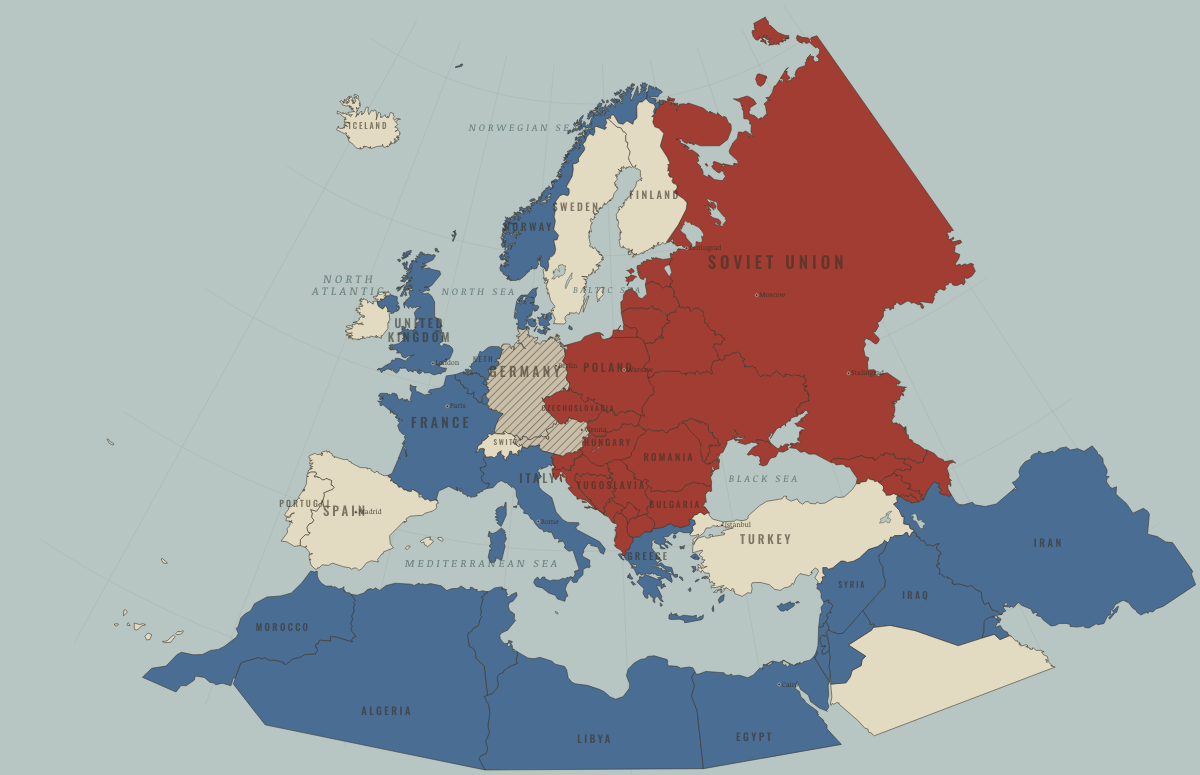
Germany moved through several roles in Soviet policy: secret military partner after the Treaty of Rapallo of 1922, mortal enemy after Hitler took power in 1933, ally of convenience in 1939–41, and invader from June 1941. After 1945 the eastern zone, shaded grey-tan, became the German Democratic Republic in October 1949. The western zones formed the Federal Republic, shown in blue. Stalin’s blockade of Berlin in 1948–49 hastened this division.
| Nazi Germany & its allies — the opening position | |
| Nazi Germany & its allies | |
| Rivals & the Western bloc |
STALIN’S SOVIET UNION: EVERY CHAPTER AND MAP →
Germany (the Reich) · Road to WW2
Conservatives handed power to Hitler believing they had hired him. Germany turns charcoal on the map in 1933, and in each following year it takes something: the Saar by ballot, the Rhineland by bluff, Austria by parade, the Sudetenland by conference, Prague by threat and Poland by war. Germany provides the chief example of this atlas's argument. Each gamble that went unpunished gave Hitler license to make another.
| The aggressors (Japan, Germany, Italy) — the opening position | |
| The aggressors (Japan, Germany, Italy) |
ROAD TO WW2: EVERY CHAPTER AND MAP →
Germany · WW2
Nazi Germany began the European war and murdered millions in the Holocaust. Its rise and fall form a central thread of this atlas: follow chapters 1–3, 6, 9 and 12–13. By the end of 1945 Germany was occupied and partitioned, and its leaders faced accountability at Nuremberg.
| Axis powers — the opening position | |
| Defeated Axis (occupied) | |
| Western Allies |
Germany · Cold War
Germany’s division gave the Cold War a center that could be seen on the ground. The country was occupied in 1945, split into two states in 1949, and separated by a wall through its old capital in 1961. West Germany became an economic miracle and a hinge of NATO; East Germany became the bloc’s showcase and its most-surveilled society. In 1990 Germany reunited inside NATO, the outcome against which every Soviet leader before Gorbachev had armed.
| NATO & core Western allies — the opening position |
COLD WAR: EVERY CHAPTER AND MAP →
Germany (West and East, 1949–90) · Feminism and the Tunisian Revolution
| Right won in law — the opening position | |
| No reform yet / outside this story | |
| Right won in law |
FEMINISM AND THE TUNISIAN REVOLUTION: EVERY CHAPTER AND MAP →
Germany · Refugee crises
Germany began the war, and at surrender in 1945 it held seven to eight million foreign displaced persons (DPs). The four occupying powers divided the country into zones, while about twelve million German expellees arrived from the east. The Federal Republic absorbed about eight million, helped by the Equalisation of Burdens and the economic boom. The GDR called its four million “resettlers”; before it built the Wall in 1961, another 2.7 million people had left the GDR for the West.
| Germany and Austria occupied — the opening position | |
| Western bloc or democracy |
REFUGEE CRISES: EVERY CHAPTER AND MAP →
Related
THE FREE PRINTABLE STUDY GUIDE
Get a printable atlas study guide of your choice free. I’ll send you a few short letters, then one when a new atlas opens. That’s all. — Paul
NO TRACKING · YOUR ADDRESS IS USED FOR THE DISPATCH AND NOTHING ELSE · UNSUBSCRIBE ANYTIME