15 ATLASES
History of Georgia in maps
Georgia as it appears in 15 interactive history atlases, from 264 BC to 2015: Colchis & Iberia, Kingdom of Georgia, Georgia, Soviet Union, Soviet Georgia. Each era below lists who ruled the land and when control changed, linked to the dated map that shows it.
WW2 is free in full, and chapter 1 of every atlas is free. A free account opens 3 more chapters a day. Starter, at $9 a month, opens all 21 with no daily limit — see the plans.
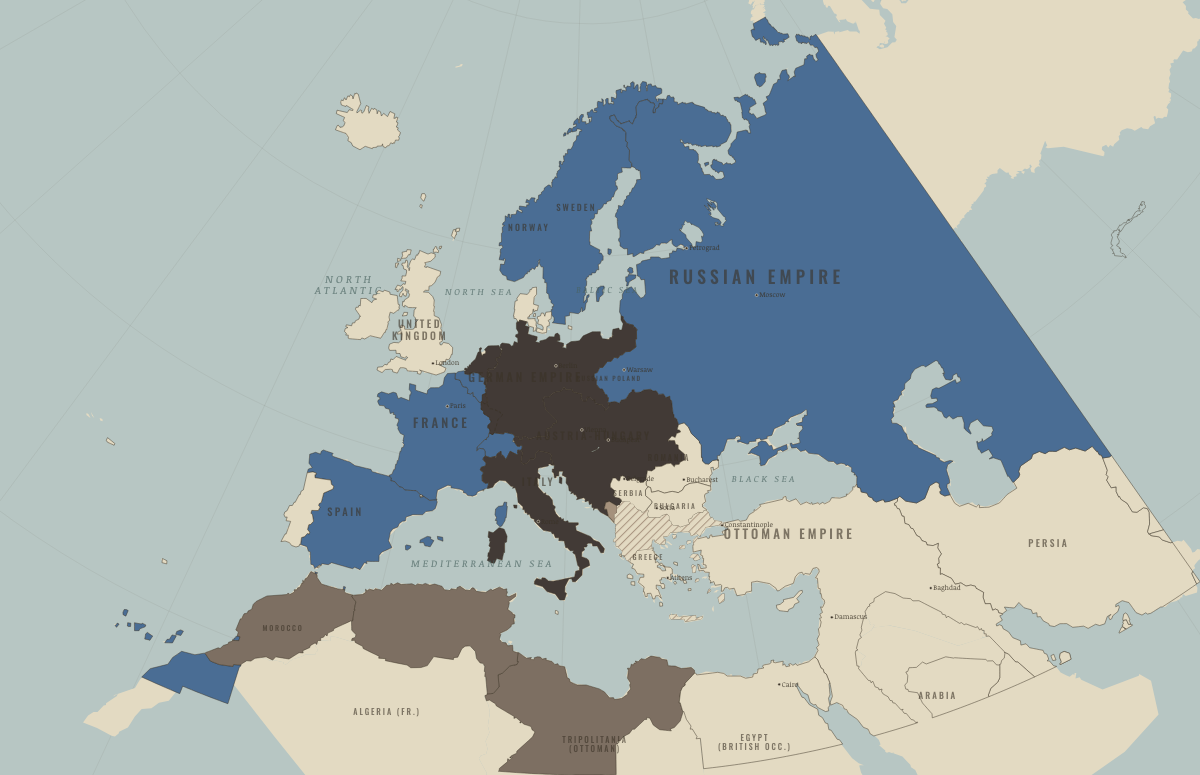
What was Georgia before it was Georgia? The sections below follow this land through every era covered by the Maps of History atlases: who ruled it, what it was called, and when control changed. Each line links to the dated map. Modern borders serve as an approximation, as each atlas says on the map itself.
Colchis & Iberia (mod. Georgia) · Ancient Rome
| 264 BC | Hellenistic kingdoms — the opening position |
| 62 BC | Roman clients & allies |
ANCIENT ROME: EVERY CHAPTER AND MAP →
Georgia · Norse and Aztecs
| Other peoples and states — the opening position |
NORSE AND AZTECS: EVERY CHAPTER AND MAP →
Georgia — the Christian Caucasus · Crusades
While the crusades unfolded, the Christian kingdom of Georgia in the Caucasus reached its golden age under Queen Tamar. The crusaders knew of this Christian great power by rumor, but never joined it. Georgia’s strength was broken by the Mongols rather than a Muslim neighbor; their thirteenth-century advance reshaped the region east of the crusaders’ world.
CRUSADES: EVERY CHAPTER AND MAP →
Kingdom of Georgia · Mongol Empire
Georgia was a Caucasus power that corresponded with crusaders. In 1221–22 the Great Raid shattered its forces twice, before Europe knew the raiders’ name. Chormaqan then subjugated the kingdom in the 1230s. Georgian heavy cavalry went on to serve in Mongol armies from Alamut to Baghdad: service was part of vassalage, which in turn offered a way to survive.
| Other settled powers (Jin China, Christendom, Delhi) — the opening position | |
| Tributaries & vassals |
MONGOL EMPIRE: EVERY CHAPTER AND MAP →
Georgia · Industrial Revolution
| Industrialising — the opening position | |
| Industrialising |
INDUSTRIAL REVOLUTION: EVERY CHAPTER AND MAP →
Georgia · Age of Revolutions
| Neutral / uncommitted — the opening position |
AGE OF REVOLUTIONS: EVERY CHAPTER AND MAP →
Georgia · Meiji Japan and post-Soviet Russia
In April 1991 Georgia declared independence, two years after Soviet troops killed 21 demonstrators in Tbilisi. The new state soon faced civil war: its first president, Zviad Gamsakhurdia, was overthrown in 1991–92. Wars in South Ossetia and Abkhazia, in which Russian forces played a part, left both regions outside Tbilisi’s control. Eduard Shevardnadze, formerly Gorbachev’s foreign minister, returned to lead Georgia from 1992.
| The USSR, then Russia — the opening position | |
| Independent neighbours |
MEIJI JAPAN AND POST-SOVIET RUSSIA: EVERY CHAPTER AND MAP →
Georgia · Russian Revolution
Georgia became an independent republic in 1918 under moderate Mensheviks, who attempted a rare experiment in democratic socialism. In February–March 1921 the Red Army invaded and sovietized it, making Georgia the last independent piece of the old empire to fall. A Georgian named Stalin had pushed for its conquest, which foreshadowed how the nationalities question would be “solved.”
| The Tsarist empire — the opening position | |
| Provisional Government, then the Whites | |
| Breakaway national states | |
| Soviet power |
RUSSIAN REVOLUTION: EVERY CHAPTER AND MAP →
Georgia (Russian Empire) · WWI
| The Entente & Allies — the opening position | |
| The Entente & Allies | |
| Russia in revolution | |
| Neutral or unaligned | |
| Russia in revolution | |
| Neutral or unaligned |
Georgia (Georgian SSR) · Stalin’s Soviet Union
Stalin came from Georgia, yet his homeland became one of his harshest battlefields. As Commissar for Nationalities, he forced its reluctant communists into the Transcaucasian federation in 1922, angering Lenin. His ally Lavrenty Beria became party chief in 1931, and Georgia’s purges were among the bloodiest. Stalin’s birthplace at Gori became a shrine. After the Secret Speech, students gathered in Tbilisi in March 1956 to defend his memory; troops fired on them.
| The Soviet Union — the opening position |
STALIN’S SOVIET UNION: EVERY CHAPTER AND MAP →
Georgia · Road to WW2
| Neutral & unaligned — the opening position | |
| Aggressor clients & partners | |
| Democracies & powers fighting them |
ROAD TO WW2: EVERY CHAPTER AND MAP →
Georgia · WW2
| Soviet Union — the opening position |
Georgia · Cold War
| USSR & Warsaw Pact — the opening position | |
| Non-aligned & neutral | |
| Non-aligned & neutral |
COLD WAR: EVERY CHAPTER AND MAP →
Soviet Union (Georgia) · Feminism and the Tunisian Revolution
| Right won in law — the opening position | |
| No reform yet / outside this story | |
| Right won in law |
FEMINISM AND THE TUNISIAN REVOLUTION: EVERY CHAPTER AND MAP →
Soviet Georgia · Refugee crises
| Soviet-occupied or communist — the opening position |
REFUGEE CRISES: EVERY CHAPTER AND MAP →
Related
THE FREE PRINTABLE STUDY GUIDE
Get a printable atlas study guide of your choice free. I’ll send you a few short letters, then one when a new atlas opens. That’s all. — Paul
NO TRACKING · YOUR ADDRESS IS USED FOR THE DISPATCH AND NOTHING ELSE · UNSUBSCRIBE ANYTIME