6 ATLASES
History of Ghana in maps
Ghana as it appears in 6 interactive history atlases, from 1890 to 2015: the Gold Coast, Ghana. Each era below lists who ruled the land and when control changed, linked to the dated map that shows it.
WW2 is free in full, and chapter 1 of every atlas is free. A free account opens 3 more chapters a day. Starter, at $9 a month, opens all 21 with no daily limit — see the plans.
Free printable Feminism and the Tunisian Revolution study guide, sent by email ↓
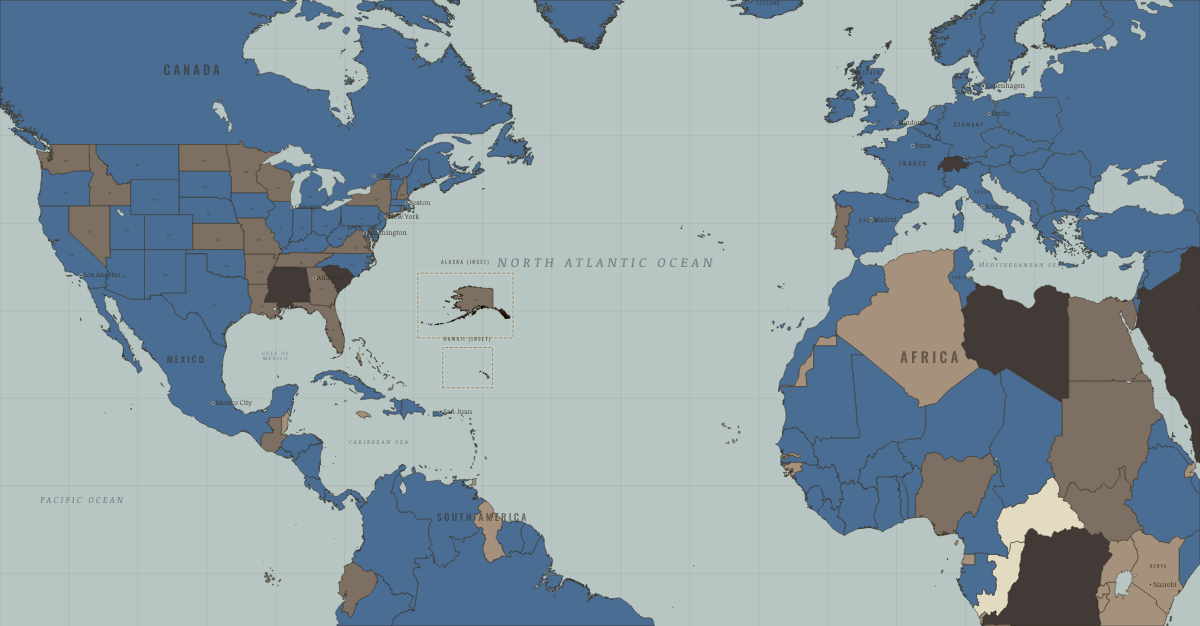
What was Ghana before it was Ghana? The sections below follow this land through every era covered by the Maps of History atlases: who ruled it, what it was called, and when control changed. Each line links to the dated map. Modern borders serve as an approximation, as each atlas says on the map itself.
The Gold Coast (mod. Ghana) · Industrial Revolution
Hundreds of thousands of captives were shipped to the Americas through European forts on the Gold Coast, including Cape Coast and Elmina. Inland, the powerful Asante kingdom traded in gold and captives and resisted British conquest until 1900–01. After the slave trade ended, the coast exported palm oil and, from the 1890s, cocoa.
| Colony or dependency — the opening position | |
| Colony or dependency |
INDUSTRIAL REVOLUTION: EVERY CHAPTER AND MAP →
Ghana · WWI
| Entente-aligned & imperial territories — the opening position |
Ghana · Road to WW2
| Colonial empires & possessions — the opening position |
ROAD TO WW2: EVERY CHAPTER AND MAP →
Ghana · Cold War
| NATO & core Western allies — the opening position | |
| Non-aligned & neutral |
COLD WAR: EVERY CHAPTER AND MAP →
Ghana (Gold Coast) · Decolonization of Africa
On 6 March 1957 the Gold Coast became Ghana, the first sub-Saharan colony to win independence. Its example opened a path others would follow. Kwame Nkrumah had risen from prison to premier; with his mass party and pan-African vision, he made Accra a headquarters of African liberation. Cocoa wealth gave the new state reason to expect a viable future. Yet the drift toward one-party rule and the 1966 coup showed how quickly that promise could sour. Ghana pioneered both the triumph and the disappointment.
| British-ruled — the opening position | |
| Independent Africa |
DECOLONIZATION OF AFRICA: EVERY CHAPTER AND MAP →
Ghana · Feminism and the Tunisian Revolution
| Authoritarian, one-party or colonial rule — the opening position | |
| Right won in law | |
| No reform yet / outside this story | |
| Partial or unequal; treaty signed only; transition |
FEMINISM AND THE TUNISIAN REVOLUTION: EVERY CHAPTER AND MAP →
Related
THE FREE PRINTABLE STUDY GUIDE
Get a printable atlas study guide of your choice free. I’ll send you a few short letters, then one when a new atlas opens. That’s all. — Paul
NO TRACKING · YOUR ADDRESS IS USED FOR THE DISPATCH AND NOTHING ELSE · UNSUBSCRIBE ANYTIME