Russian Revolution · CHAPTER 13 ·
From War Communism to the NEP
Chapter 13 of The Russian Revolution, 1855–1924: “Victors Against the People”
Once the Whites were beaten, peasants rose against War Communism’s grain requisitions in Tambov, and in March 1921 the Kronstadt sailors demanded freely elected soviets before being stormed across the ice. With famine killing perhaps five million along the Volga, Lenin introduced the New Economic Policy in March 1921.
Chapter 13 is included with every paid plan. WW2 is free in full, and chapter 1 of every atlas is free. A free account opens 3 more chapters a day. Starter, at $9 a month, opens all 21 with no daily limit — see the plans.
Free printable Russian Revolution study guide, sent by email ↓
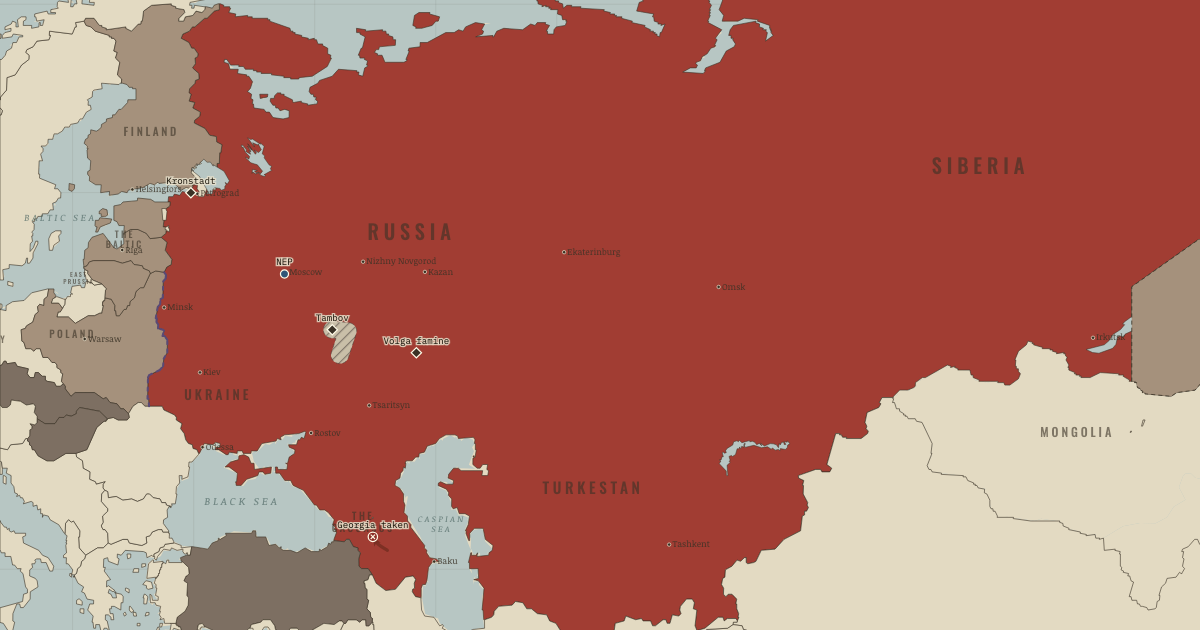
The map above is the world of Russia, 1921 — Victors against the people.
Every state on the map that year: The world in 1920 · Europe in 1920.
Part of IB History: The Russian Revolution →
SHORT EXPLANATION
Victory in the civil war did not bring peace between the Bolsheviks and the people they governed. Peasants had endured grain seizures while the White armies threatened to bring back the landlords. After that danger passed, they had less reason to surrender their crops. A peasant war spread through Tambov in 1920 and 1921; the authorities used hostages, camps and artillery to crush it, and a written order authorized poison gas. In 1921 the sailors of Kronstadt, who had helped make October, demanded freely elected soviets without Bolshevik dictatorship. Red troops crossed the ice to storm their fortress.
The famine of 1921–22 brought another crisis. Drought, requisition and the destruction left by war combined along the Volga; perhaps five million people died, and American relief fed millions. With revolt spreading and output far below its prewar level, Lenin adopted the New Economic Policy. Grain seizures ended, and small trade and private farming became legal. At the same congress, the party banned factions within its ranks. The government made room for economic recovery while closing an avenue for organized political dissent.
The full story
To win the civil war, the Bolsheviks had drawn the resources of a poor country toward the front. Under War Communism they requisitioned grain, militarized labor and nationalized production. The victory left an economy scarcely able to sustain the victors: industrial output was roughly a fifth of its 1913 level, the cities had emptied, and peasants had stopped sowing crops they expected to lose to the state. While the Whites threatened to restore the landlords, many villages endured the seizures. With that threat gone, resistance became harder to contain. At Tambov it grew into a peasant war. The Red command used collective punishment, camps for rebels’ families and poison gas in the forests where the rebels hid.
At Kronstadt, the challenge came in the language of the revolution itself. The sailors celebrated for their part in 1917 rose in March 1921 and called for freely elected soviets without Communist control. Such elections might give the soviets a claim to authority independent of the party. Trotsky and Tukhachevsky sent the Red Army across the ice to take the fortress before the thaw made it harder to reach.
Hunger was spreading as well. Drought struck a country weakened by years of war, grain seizures and damaged transport. Perhaps five million people died in the famine. The government accepted Herbert Hoover’s American Relief Administration, which fed millions; later Soviet histories wrote that rescue out of the account.
Lenin’s response combined a retreat with a determination to hold power. At the party congress in March 1921, while Kronstadt’s guns were still firing, he replaced requisitioning with a tax in kind and legalized small trade and private farming under the New Economic Policy. He described the retreat as a way to leap forward. Agriculture and light industry revived within a few years. The same congress banned factions within the party, treating organized disagreement as a danger. Economic concessions could help the government survive; independent political organization could challenge its rule. Early in 1921 the invasion of Menshevik Georgia showed the limits of another kind of independence, as Moscow brought a rival socialist government and a borderland state under its control. Peasants, sailors and socialists who had helped make the revolution now faced its weapons.
FULL EXPLANATION
How to explain the famine responsibly
A drought alone does not explain why so many people died in 1921–22. Harvests failed after years of world war and civil war had already destroyed transport and draft animals. Requisitioning removed grain and discouraged both production and concealment. Scarcity thus met a country with damaged means of coping, while government policy shaped who kept food and how quickly relief could arrive. Bolshevik delay, hostility to independent relief and coercive collection worsened a vulnerability the government had not entirely created. To call this famine wholly planned would go beyond the evidence; to call it simply natural would leave those policies out. The American Relief Administration eventually fed more than ten million people a day, an indication both of the need and of what outside logistics could accomplish. Estimates of the dead are uncertain and often cluster around five million. Explaining the mechanisms matters because each affected the suffering; the suffering itself should not become a debating token.
An opening economy and a closing party
Under NEP, a peasant could pay a tax in kind and then keep and sell the surplus. This replaced compulsory grain seizure with a reason to produce more. Legal small trade also helped restore urban supply, and agriculture and light industry revived after the damage of War Communism and near-total nationalization. At the Tenth Congress, which adopted the new policy, the party also banned factions. Leaders presented the ban as an emergency response, but it became a standing weapon against organized opposition. From Lenin’s point of view the two decisions served the same government: markets could help preserve state power, while political competition might take it away. Kronstadt had made that danger immediate by demanding soviets without a Bolshevik monopoly. The result combined economic pragmatism with authoritarian consolidation, rather than a general liberalization.
Key places on the map
Why it happened
War Communism’s exactions. The demands of victory exhausted the economy on which the government depended. War Communism put requisitioned grain, forced labor and nationalized production at the service of the war; output fell to roughly a fifth of its 1913 level, cities emptied, and peasants stopped sowing crops liable to seizure. After the Whites’ defeat, imposing those sacrifices became politically harder as well.
Revolt from below, from the regime’s own base. Tambov’s peasants and Kronstadt’s sailors presented the government with a challenge unlike a White army or foreign intervention. They came from the groups in whose name the revolution claimed to rule. Crushing their resistance exposed the distance between that claim and a “dictatorship of the proletariat” suppressing members of its own base.
Famine as the final argument. Famine on the Volga made the consequences of grain seizures painfully visible. Hunger helped force the retreat from requisition without bringing an ideological conversion. The government accepted foreign relief while exploiting and denying the hunger and suppressing the political meaning of accepting that help.
Kronstadt as the alarm bell. Lenin called Kronstadt “the flash that lit up reality.” The sailors had been revolutionary heroes, and their rebellion used the revolution’s own slogans. For Lenin, the danger was that the government itself might fall unless economic coercion eased. NEP answered that alarm as well as the crisis of famine.
THE TURNING POINT
The New Economic Policy, March 1921. Lenin called the change “retreating in order to leap”. In March 1921, revolt and famine gave him reason to end requisitioning and permit markets: the concessions bought peace with peasants, and recovery followed within a few years. The congress also banned party factions. Its economic retreat therefore preserved a government that was making organized dissent within its own ranks harder. That closure helped prepare the ground on which one man could later stand alone, although no one intended that result.
What it changed
Recovery bought by retreat. Agriculture and light industry had largely recovered by the mid-1920s, cities filled again, and a battered normality returned. The government had survived by changing course. What that course meant remained unsettled at Lenin’s death: was NEP a temporary retreat, or a path toward a mixed economy?
The Party closes ranks. The faction ban began as an emergency measure but became permanent. It restricted organized debate in the only institution where open debate still existed and shifted authority toward the leadership and its apparatus. The ban would become an instrument in the succession struggle.
The empire completed. Moscow’s sovietization of Georgia in 1921 brought back the last independent piece of the old empire. With other borderlands reconquered or settled by treaty, the future USSR’s territory was essentially fixed. The map had largely stopped moving; the struggle for power now turned inward.
DISCUSSION QUESTION — The sailors of Kronstadt had helped make the revolution; in 1921 the revolution destroyed them. What does that tell you about what the revolution had become?
The sailors asked for freely elected soviets, an institution associated with the revolution they had helped make. A free choice could also have displaced the party. The government chose to defend its monopoly, even against people claiming the revolution’s own promise. The dispersal of the Constituent Assembly in Chapter 6 had already shown a similar direction: power was exercised in a class’s name without being subject to its vote. NEP relaxed economic control, but in the same month the party barred organized factions. Kronstadt illustrates a wider danger: a party that has justified any means by its hold on the state can come to defend that state against the popular power in whose name it rules; revolutions made for popular power routinely end by suppressing it.
An interesting fact
In the summer of 1922, at the height of its work, the American Relief Administration fed some ten and a half million Soviet citizens each day. It also shipped seed, medicine and clothing across the famine zone. Maxim Gorky had helped initiate the rescue with an appeal “to all honest people,” and he told Hoover that it would “enter history as a unique, gigantic achievement.” Within a generation, official Soviet histories had recast the ARA as an espionage front, writing the kitchens that kept millions alive out of the story.
Related
THE FREE PRINTABLE STUDY GUIDE
Get the printable study guide for The Russian Revolution free. I’ll send you a few short letters, then one when a new atlas opens. That’s all. — Paul
NO TRACKING · YOUR ADDRESS IS USED FOR THE DISPATCH AND NOTHING ELSE · UNSUBSCRIBE ANYTIME