MAPS OF HISTORY · MONGOL EMPIRE · BATTLES AND EVENTS · Mongol conquest of Western XiaMongol Empire · SITE OF MEMORY · 1227
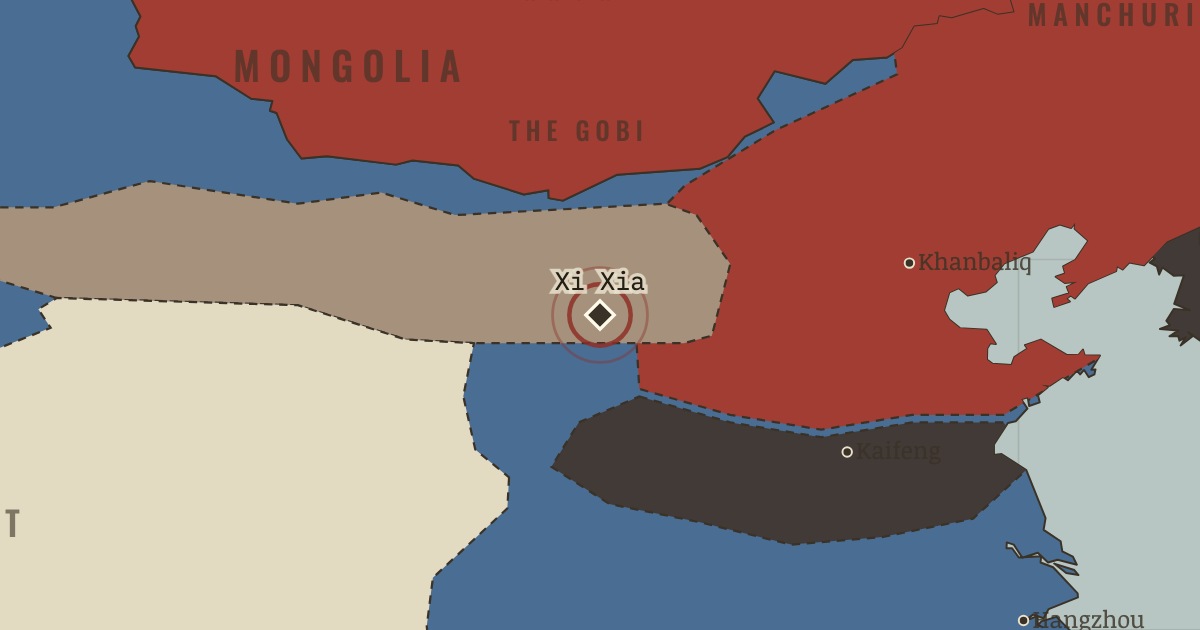
Mongol conquest of Western Xia (1227)
On the Mongol Empire map as “The end of Xi Xia”
1227 — Xi Xia, the Tangut state, had been a vassal since 1210 but refused to provide troops for the western war. Genghis returns to attack it and dies of illness or injury during the siege. His final order is carried out: Zhongxing’s people are put to the sword, and Xi Xia is erased from the registers. Other states could see the price paid for defiance.
When 1227 Type Site of memory Chapter Mongol conquest of the Jin dynasty (chapter 3 of Mongol Empire)Atlas The Mongol Empire, 1206–1294 SITE OF MEMORY · THE MONGOL EMPIRE, 1206–1294 These maps are reconstructed from published sources · Cliopatria v0.2.1 — historical political boundaries · Asia for Educators, Columbia University — Three Invasions Led by Chinggis · Natural Earth — physical reference geography
Source details Cliopatria contributors / Seshat Global History Databank. CC BY 4.0 · Selected dated polygons; documented unions, differences and shared edges for event-specific reconstructions; projected for display. Asia for Educators, Columbia University. Text consulted for historical facts; no map or prose copied Natural Earth. Public domain For the capture of Zhongdu, the 1216–1219 Mongol geometry supplies only the portion transferred from the 1206–1215 Jin outline. The remainder of Jin territory uses the closest record, dated 1216–1226.
Published polity extents are used at the date resolution available in their sources. Hatched affected regions and route arrows are educational reconstructions; the source details distinguish them from imported boundaries.
Chapter anchor 1215.5 uses the existing snapshot s1215 (1215.4). The lesson date remains separate from the source reference dates.
proxy: 1216–1226 · reconstruction: 1169–1226 · reconstruction: 1188–1235 · reconstruction: 1202–1215 · reconstruction: 1202–1219 · reconstruction: 1202–1249 · reconstruction: 1206–1226 · reconstruction: 1210–1215 · reconstruction: 1210–1219 · reconstruction: 1210–1226 · reconstruction: 1210–1235 · reconstruction: 1210–1240 · reconstruction: 1215 · reconstruction: 1216–1226 · vector: 1056–1249 · vector: 1072–1226 · vector: 1072–1235 · vector: 1072–1249 · vector: 1072–1325 · vector: 1072–1374 · vector: 1094–1235 · vector: 1099–1226 · vector: 1111–1278 · vector: 1126–1226 · vector: 1139–1215 · vector: 1139–1226 · vector: 1139–1235 · vector: 1139–1240 · vector: 1139–1259 · vector: 1152–1235 · vector: 1169–1226 · vector: 1169–1235 · vector: 1177–1215 · vector: 1188–1219 · vector: 1188–1240 · vector: 1188–1259 · vector: 1188–1271 · vector: 1188–1284 · vector: 1188–1304 · vector: 1192–1235 · vector: 1192–1325 · vector: 1192–1362 · vector: 1202–1219 · vector: 1202–1235 · vector: 1202–1240 · vector: 1202–1249 · vector: 1202–1259 · vector: 1202–1374 · vector: 1202–1743 · vector: 1206–1215 · vector: 1206–1219 · vector: 1206–1235 · vector: 1206–1240 · vector: 1210–1215 · vector: 1210–1219 · vector: 1210–1226 · vector: 1210–1249 · vector: 1210–1304 · vector: 602–1501 · vector: 936–1271
Layer records and reconstruction methods
In the same chapter
Related
THE FREE PRINTABLE STUDY GUIDE
Get the printable study guide for The Mongol Empire free. I’ll send you a few short letters, then one when a new atlas opens. That’s all. — Paul
NO TRACKING · YOUR ADDRESS IS USED FOR THE DISPATCH AND NOTHING ELSE ·
UNSUBSCRIBE ANYTIME