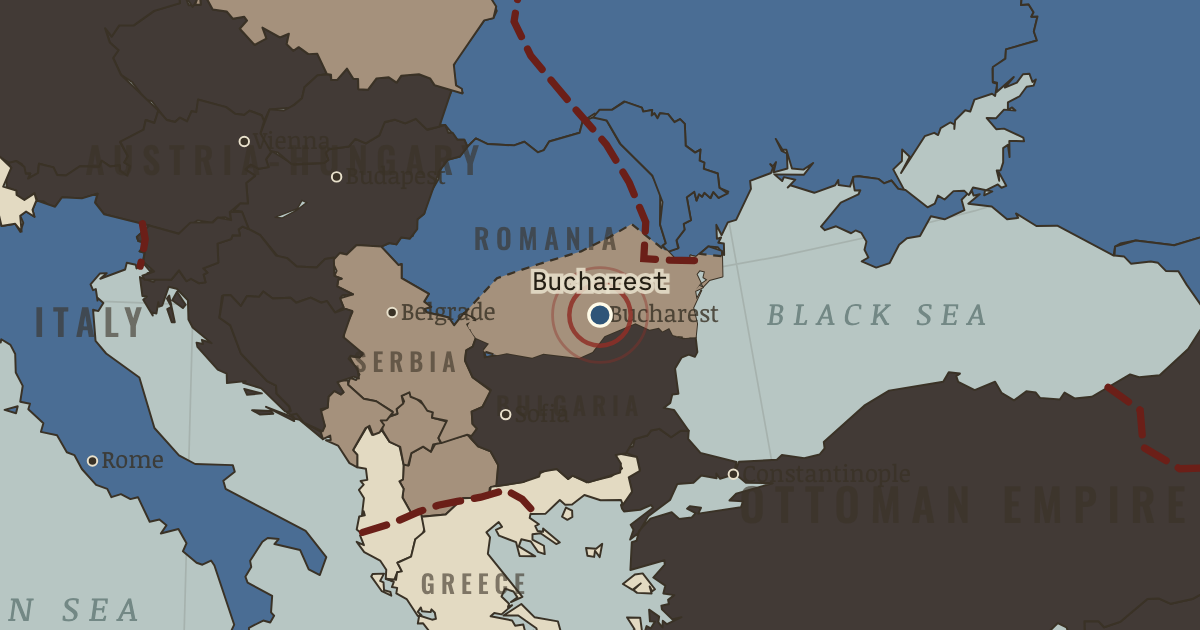
6 Dec 1916 — Romania has been an Allied belligerent for three months when Falkenhayn and Mackensen converge on Bucharest from north and south. The remaining Romanian army spends the winter in Moldavia. For the rest of the war, Germany sends Romanian grain and oil west.
WW2 is free in full, and chapter 1 of every atlas is free. A free account opens 3 more chapters a day. Starter, at $9 a month, opens all 21 with no daily limit — see the plans.
Why did Germany choose Verdun? The fortress city had political and emotional importance for France, and Falkenhayn expected the French to fight for it. His later memorandum described an intention to drain French manpower, although historians dispute the document and its relation to his original plan. The French did defend Verdun, but German losses mounted too. Pétain kept supplies moving along the road to the city and rotated divisions through the battle, spreading its burden across much of the French army.
Why it happened — The bargain at Verdun. The attritional interpretation of Verdun depended on France losing men faster than Germany. That exchange was difficult to secure when German troops…
The turn — Verdun holds; German command changes. By July the fighting at Verdun had failed to produce the favorable exchange associated with Falkenhayn's later account. He was dismissed in August.…
What it changed — Losses and resources. The estimated losses are staggering: roughly 300,000 dead at Verdun, another 300,000 on the Somme, and perhaps a million Austro-Hungarian and…