MAPS OF HISTORY · ON THIS DAY · December 18 · 1916
ON THIS DAY · 18 DECEMBER 1916
Verdun
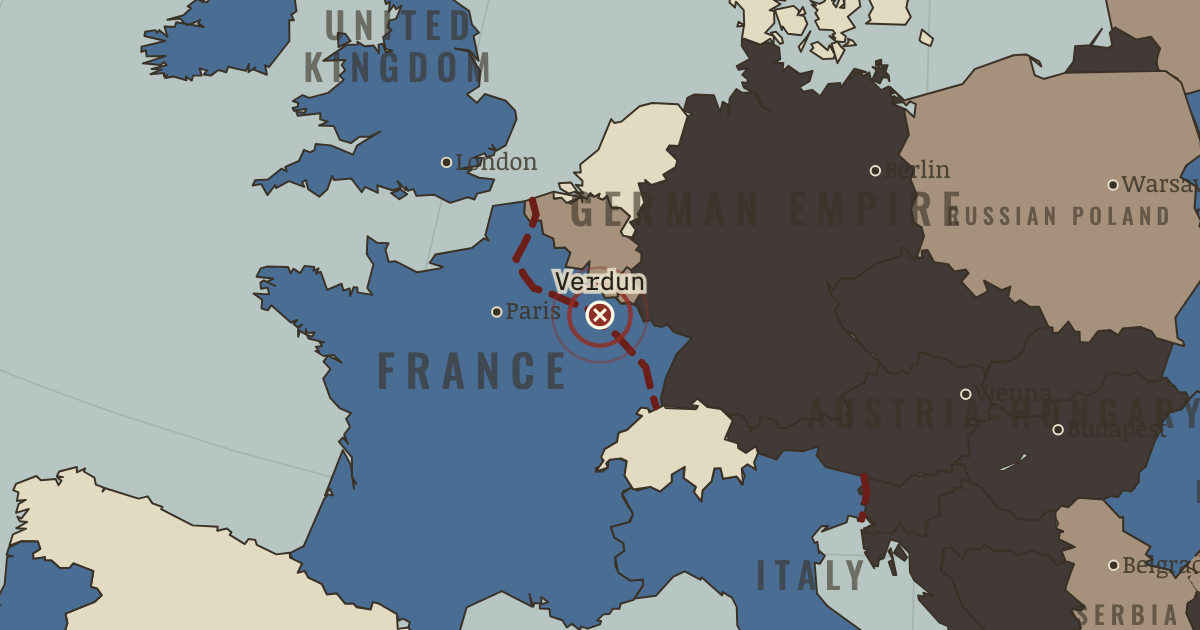
21 Feb-18 Dec 1916 — Falkenhayn attacks a fortress France cannot abandon, intending attrition itself as the goal. Ten months, ~300,000 dead on the two sides, nine villages erased forever — and the recoil bleeds Germany white too. “Ils ne passeront pas.”
THE MOMENT IN CONTEXT
Germany attacked Verdun because France felt bound to defend the fortress city whatever the cost. Falkenhayn, the German commander, intended to drain French manpower there, though historians still debate exactly what his later memorandum claimed. The battle instead exhausted both armies almost equally. Pétain kept the French defence working by rotating divisions through the fighting quickly and by improving the single supply road into the city.
From Chapter 5 — The Furnaces of The Great War, 1914–1918 (NOV 1916).
OPEN THE INTERACTIVE MAP →New here? Chapters 1–2 of every atlas are free to sample, and the WW2 atlas is free in full. One membership opens all thirteen — the Cartographer’s Circle.
TEACH THIS IN 5 MINUTES
- Why it happened — Attrition chosen, not stumbled into. Verdun is the war’s clearest case of attrition as designed strategy rather than accepted byproduct. Its logic required the exchange rate to favor…
- The turn — Verdun holds — and consumes its designer. By July, Falkenhayn’s offensive had failed by its own metric and he was dismissed in August — replaced by Hindenburg and Ludendorff, the eastern…
- What it changed — The arithmetic, honestly. 1916’s ledger: ~300,000 dead at Verdun, ~300,000 more on the Somme, perhaps a million Austro-Hungarian and Russian casualties in the east, Romania…
Then ask the room: Was attrition ever a rational strategy — or a euphemism for having none? The argued answer is on the chapter page →
THE ATLAS THAT SHOWS IT
THE DISPATCH
One short letter when a new atlas opens — and the printable study guide for WWI is yours now, free.
NO TRACKING · YOUR ADDRESS IS USED FOR THE DISPATCH AND NOTHING ELSE · UNSUBSCRIBE ANYTIME