Industrial Revolution · CHAPTER 2 ·
Cotton and the factory system
Chapter 2 of The Industrial Revolution, 1750–1914: “Cotton and the Factory”
Between the 1760s and the 1780s Hargreaves’ spinning jenny, Arkwright’s water frame and Crompton’s mule mechanised cotton spinning. In 1771 Arkwright installed his machines in a mill at Cromford in Derbyshire and ran it in shifts, creating the factory, where workers tended powered machines under a manager’s rules.
WW2 is free in full, and chapter 1 of every atlas is free. A free account opens 3 more chapters a day. Starter, at $9 a month, opens all 21 with no daily limit — see the plans.
Free printable Industrial Revolution study guide, sent by email ↓
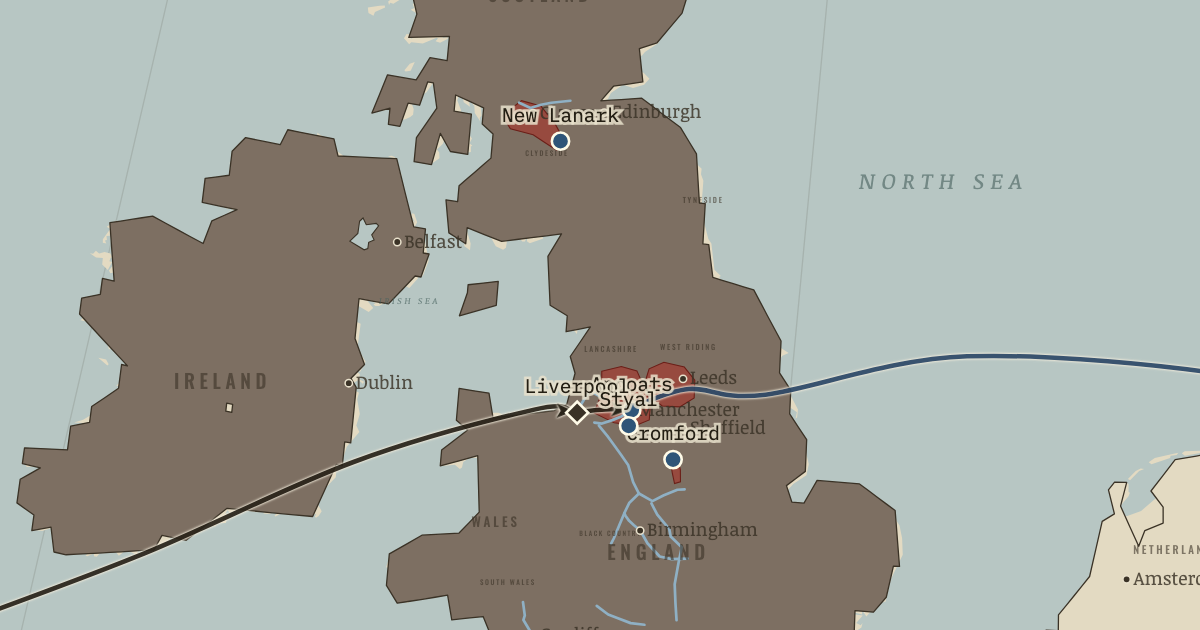
The map above is the world of The Industrial Revolution in Europe, 1800 — The cotton towns.
Every state on the map that year: The world in 1800 · Europe in 1800.
Part of IB History: The Industrial Revolution →
SHORT EXPLANATION
Europeans wanted the bright, light and washable cottons made in India, but British hand spinners and weavers struggled to match them. Between the 1760s and 1780s, Lancashire weaver James Hargreaves made a jenny that spun many threads at once; former wigmaker Richard Arkwright used a water wheel to drive his strong-threaded water frame; and Bolton spinner Samuel Crompton combined their principles in a mule capable of making yarn as fine as India's. Arkwright installed machines at Cromford in Derbyshire in 1771 and ran them in shifts. Workers tended machinery driven by one power source under a manager's rules: like a modern assembly plant, the factory set a common pace of work.
Cheap machine-made cloth found a vast market. By 1830 cotton goods accounted for about half of British exports. Its raw material came from plantations worked by enslaved people, first in the Caribbean and then, especially after the 1793 cotton gin made seed removal much faster than hand-picking, in the American South. Red patches mark Lancashire, Derbyshire's Derwent valley and Scotland's Clyde valley. A black arrow carries slave-grown cotton to Liverpool, formerly Britain's leading slave-trade port, and onward to Manchester. Women and children in mills and enslaved Africans and their descendants in fields sustained the industry together.
The full story
Indian calicoes gave British manufacturers a model and a problem. These light printed cloths filled English shops in the late seventeenth century, and customers wanted more. Parliament banned imports of printed calicoes in 1700 and their wearing in 1721. The Calico Acts sheltered British producers, but protection could not itself supply the cheap, strong thread they needed: hand spinning was too slow, and its thread too weak.
The inventions that followed attacked different parts of that difficulty. Around 1764 the weaver James Hargreaves devised a jenny on which one person could spin many threads at once. Richard Arkwright, a former wigmaker, patented a water frame in 1769 that made thread strong enough for the lengthwise warp. Samuel Crompton, a spinner, produced fine yarn with his mule in 1779. Robert Allen's figures show how much work machinery could save. To spin 100 pounds of cotton an Indian hand spinner took about 50,000 hours; Crompton's mule took about 2,000, and the automatic self-acting mule of the 1820s just 135. The reduction exceeded 99 percent. Hand spinners could not compete on those terms.
The machinery also changed where and how people worked. Arkwright put his frames beside the River Derwent at Cromford, ran them day and night and built cottages to keep workers near his remote mill. They tended powered machinery under a manager's rules. At Styal, Samuel Greg's mill, founded in 1784, relied heavily on pauper children bound as apprentices. Robert Owen later used New Lanark on the Clyde to argue that a mill could profit without overworking children.
Water tied the first mills to valleys. Steam made another location possible: towns with workers and coal. Manchester's great Ancoats mills were built beside the Rochdale Canal between 1798 and 1806. Manchester grew from about 70,000 people in 1801 to over 300,000 in 1851; the factory was becoming a force shaping the city itself.
The cotton arrived from much farther away. British imports rose from about 2.5 million pounds in 1760 to 264 million in 1830, and by the late 1820s over 70 percent came from the United States. Eli Whitney's cotton gin of 1793 removed seeds many times faster than hand-picking, making southern upland cotton profitable. Cultivation and slavery spread west; the US enslaved population rose from about 700,000 in 1790 to two million in 1830. Cotton entered through Liverpool, whose ships had transported 1.3 to 1.5 million enslaved Africans before Britain abolished the trade in 1807. The connection was also one of ownership: the Gregs of Styal were among mill owners who held Caribbean plantations. Lancashire's factories formed one end of an Atlantic system of coerced labor.
FULL EXPLANATION
Why cotton mechanised first
Cotton had advantages over wool and linen for early mechanization. Its short, even fibers suited rollers and spindles, the rods that twist fiber into thread. Indian imports had already shown that buyers wanted the cloth, and lower prices could bring more buyers. Robert Allen calculates that the hand-turned jenny and water-powered frame paid in England before they paid in France or India, helping explain why producers there did not adopt them in the 1770s. An initial breakthrough, however, was not enough. Joel Mokyr calls inventions such as the water frame macroinventions and distinguishes them from the many microinventions that make a new process work. In cotton, improved gearing, carding engines to comb fiber, iron frames and steam drive from the 1790s mattered most. Weaving followed a different timetable. Clergyman Edmund Cartwright patented a power loom in 1785, but reliable mechanized looms spread only after the 1820s. Meanwhile the new supply of yarn created work for handloom weavers, whose cotton workforce peaked around 1820 at perhaps 250,000. The change that first enriched them would later ruin many of them.
The factory as a system of discipline
Bringing machinery together also brought workers under a common schedule. In The Genesis of Modern Management (1965), Sidney Pollard described the unfamiliar problem of coordinating hundreds of people through the same twelve-hour day. Men accustomed to independent craft resisted bells, clocks and overseers. Mills drew heavily on women and children, who were cheaper and easier to command, and on pauper apprentices: destitute children sent by poor-relief officials to work for their keep. In cotton mills surveyed by government reports in 1835, about 43 percent of workers were under eighteen. Owners enforced rules with fines for lateness or talking, locked gates and dismissal. E. P. Thompson's 1967 essay on time and work-discipline traced the move from irregular farm and workshop rhythms toward time measured by the clock. Stephen Marglin argued in 1974 that factories spread chiefly because they increased employers' control, regardless of efficiency. David Landes replied that powered machinery produced large, real efficiency gains. They dispute the reason for the factory's spread, while recognizing the change it made to working life.
Slave cotton and the second slavery
Industrial demand helped expand plantation slavery in the nineteenth century. Dale Tomich calls this the second slavery: its reach included the cotton South, Cuba's sugar estates and Brazil's coffee farms. Sven Beckert's Empire of Cotton (2014) describes an earlier war capitalism based on seizing land and labor by force, followed by factory production. By the late 1850s the United States supplied about 77 percent of the cotton Britain consumed, and raw cotton accounted for about 61 percent of American exports. How did plantations raise output? In The Half Has Never Been Told (2014), Edward Baptist argues that quotas enforced by torture raised picking rates. Alan Olmstead and Paul Rhode criticize his figures and attribute much of the increase to cotton varieties easier to pick. Both accounts place violent coercion at the center of slavery; the dispute concerns its share in the increase in output.
Key places on the map
Why it happened
Indian cloth set the standard. Indian calicoes showed buyers a light, washable and inexpensive cotton printed in colors that did not run. To protect English wool, Parliament banned printed imports in 1700 and their wearing in 1721. British producers had an opening if they could match Indian quality and prices. Making at home what had previously been bought abroad is called import substitution; protection gave inventors room to attempt it.
Machines that suited the fibre. Drawing and twisting cotton fibers requires repeated movements. Rollers, gears and spindles, the rods that spin thread, could perform them. The jenny multiplied spindles; the water frame made thread stronger; the mule made it finer; and carding engines prepared the fiber. Imported cotton did not compete for English farmland, so its supply could grow with the machines' output.
Water power and modest capital. A stream, a building and a few thousand pounds could establish an early mill. A successful wigmaker, merchant or hosier, a stockings dealer, could seek that money from partners and local banks. Former wigmaker Richard Arkwright joined the Derby hosier Jedediah Strutt; Samuel Greg drew on his family's merchant and plantation wealth for Styal. Fast streams in the Pennine valleys of Derbyshire and Lancashire lay within reach of ports and markets. Those conditions drew the first factories to remote, steep valleys.
Slave-grown cotton without limit. Eli Whitney's 1793 gin separated seeds from short-fibered cotton grown inland. Planters could expand cultivation in Georgia, Alabama and Mississippi, carrying slavery onto new land. The American South became the main source of cotton after 1793, and supply grew with Lancashire's demand. Unpaid enslaved labor kept it cheap; the enslaved population in the United States nearly tripled between 1790 and 1830.
THE TURNING POINT
Cromford Mill, 1771. Richard Arkwright's Cromford mill on the River Derwent brought powered machines, shift workers, a manager's rules and nearby housing together. Earlier silk mills and workshops had used some of these elements. Cromford offered a model that could be financed, licensed and copied as a whole. Within twenty years dozens of mills in Derbyshire, Lancashire and Scotland had followed it. Manufacturers now debated how fast to mechanize.
What it changed
Steam moves the mills to the towns. The first mills needed streams, so they stood in remote valleys. From the 1790s steam made locations supplied with coal practical. Manchester's mills gathered beside coal-bearing canals, and the district spread across south Lancashire near workers and Liverpool's port. Chapter 3 explains the engine; chapter 5 follows the towns it helped create.
Child labour becomes a public question. The working lives of Styal's pauper apprentices, destitute children sent to work for their keep, and Manchester children on twelve-hour shifts came before parliamentary inquiries from 1816. Robert Owen offered his model mill at New Lanark as evidence of another approach. Michael Sadler's 1832 committee heard workers themselves, and the Factory Act of 1833 used paid inspectors to enforce limits on children's hours. Chapter 5 follows the struggle in mills and Parliament, including the testimony that helped change the law.
The handloom weavers’ boom and ruin. At first machine-spun yarn gave handloom weavers more work and good pay, lasting until about 1805. More people entered the trade and rates fell. Then power looms spread in the 1820s and 1830s, and piece rates—the pay for each length of cloth—collapsed. Many families became poor; their anger fed the protests and machine-breaking of chapter 6. A skilled occupation could be destroyed within a working life, faster than families could retrain or move.
Lancashire depends on the plantation South. Lancashire obtained about three-quarters of its cotton from the American South's slave states by the late 1850s. This tied Britain's largest industry to one region and its system of slavery. When the American Civil War cut supplies in 1861, mills fell silent and the trade turned toward India and Egypt. Chapter 11 follows the resulting crisis.
DISCUSSION QUESTION — Was the factory system more a revolution in machines or a revolution in the control of work?
Machinery changed the amount a worker could produce. The automatic self-acting mule spun in 135 hours what took an Indian hand spinner 50,000 hours; discipline alone could not deliver that gain. Yet owners also sought control over the pace of work. Under the domestic system, spinners and weavers worked at home for merchants. Arkwright's and Samuel Greg's rules and child apprentices, and the bells and fines of Manchester's mills, brought workers under a more regular schedule. Sidney Pollard and E. P. Thompson emphasize control; Stephen Marglin takes that argument furthest, while David Landes and Robert Allen stress technology. The strongest account connects them. Expensive machines paid when they ran without pause, and workers had to tend them steadily. The machinery and the organization of work developed together.
An interesting fact
Samuel Crompton's 1779 spinning mule made fine yarn, but he could not afford to patent it. Manufacturers promised a subscription, a fund of voluntary contributions, in return for the design; he received less than £70. To support a claim for public reward, he toured the cotton districts in 1811 and counted an estimated 4.6 million spindles, the rods that twist thread, working on mules. Parliament awarded him £5,000 in 1812, a fraction of Richard Arkwright's fortune from the water-powered frame. Crompton died in modest circumstances in Bolton in 1827. His mule remained the standard spinning machine for a century, making fortunes for others.
Related
THE FREE PRINTABLE STUDY GUIDE
Get the printable study guide for The Industrial Revolution free. I’ll send you a few short letters, then one when a new atlas opens. That’s all. — Paul
NO TRACKING · YOUR ADDRESS IS USED FOR THE DISPATCH AND NOTHING ELSE · UNSUBSCRIBE ANYTIME