Industrial Revolution · CHAPTER 8 ·
Second Industrial Revolution
Chapter 8 of The Industrial Revolution, 1750–1914: “The Second Industrial Revolution”
After 1870 steel, chemicals, electricity and the internal combustion engine created a second industrial revolution led by science, big business and Germany. The basic process of 1878 made Lorraine’s phosphoric ores usable, German steel output passed Britain’s in about 1893, and BASF, Bayer, Siemens and AEG led new industries.
Chapter 8 is included with every paid plan. WW2 is free in full, and chapter 1 of every atlas is free. A free account opens 3 more chapters a day. Starter, at $9 a month, opens all 21 with no daily limit — see the plans.
Free printable Industrial Revolution study guide, sent by email ↓
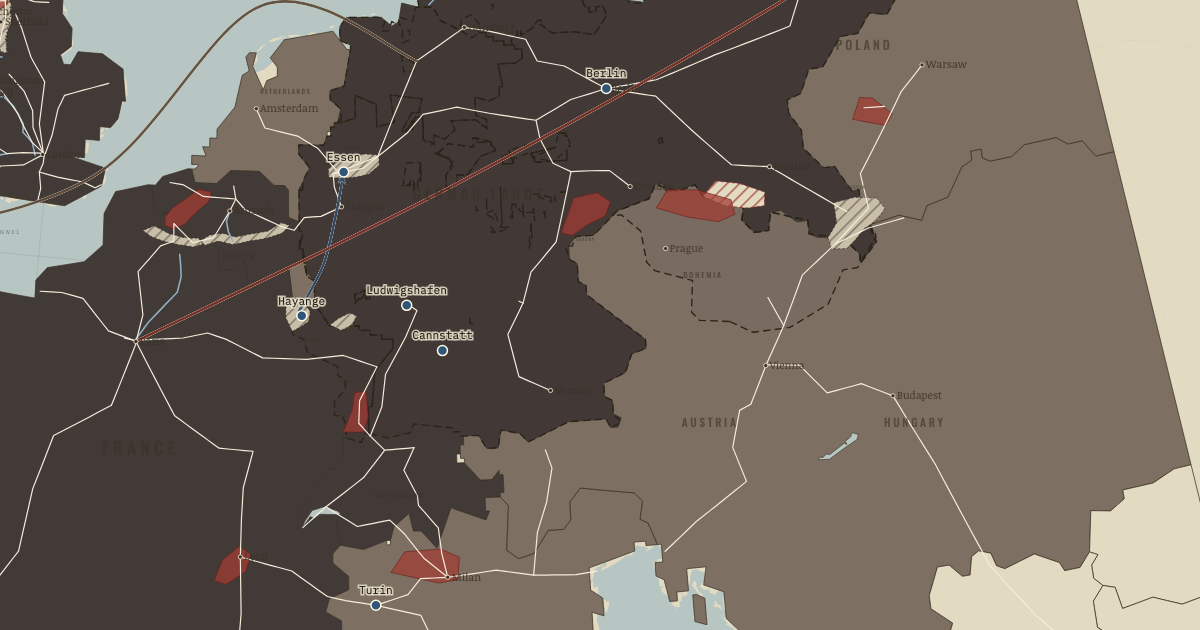
The map above is the world of The Industrial Revolution in Europe, 1913 — Europe on the eve of war.
Every state on the map that year: The world in 1914 · Europe in 1914.
Part of IB History: The Industrial Revolution →
SHORT EXPLANATION
After 1870, industrial leadership came to depend on a new set of skills and resources. Steel, chemicals, electricity and the internal combustion engine—which burns fuel inside a cylinder, as in a car today—opened new industries. Practical craftsmen had made much of the first industrial revolution; the second relied more heavily on trained scientists, laboratories and firms able to pay for research, much like today’s pharmaceutical and technology giants. Germany and big business moved to the front.
Cheap steel took the place of iron in rails, ships and machines. At Ludwigshafen, BASF turned chemistry into dyes and later fertilizer; Bayer made medicines including aspirin. Siemens and AEG helped make Berlin the world’s electrical capital. In 1885–86 Carl Benz at Mannheim and Gottlieb Daimler at Cannstatt built the first motor cars. Invention had acquired a new home alongside the workshop: the laboratory.
A discovery in 1878 changed the value of a whole ore field. British cousins Sidney Gilchrist Thomas and Percy Gilchrist found a way to make steel from phosphorus-rich ore, opening Lorraine’s deposits around Hayange as Europe’s largest ore field. The arrow carries its ore to Ruhr coal. German steel output passed Britain’s by about 1893, and by the early 1900s Germany made about 85 per cent of the world’s synthetic dyes.
On the map Germany, Belgium, Switzerland and finally France turn charcoal; Italy, Hungary and Russia’s western provinces begin to industrialize. Britain’s output was still growing, but by 1913 both Germany and the United States produced more manufactured goods. The first industrial pioneer had become a follower in the second revolution.
The full story
A deposit of iron ore does not become useful for steel simply because it is large. In Lorraine, phosphorus in the ore made the resulting steel brittle. Two major innovations had made steel cheaper without solving this problem: English inventor Henry Bessemer’s 1856 converter blew air through molten iron, while the Siemens–Martin open-hearth furnace of the 1860s produced larger, more controllable batches.
In 1878 two cousins found a way to remove the phosphorus. Sidney Gilchrist Thomas was a London police-court clerk who studied chemistry in his spare time; Percy Gilchrist was a chemist at the Blaenavon ironworks in Wales. They lined the converter with limestone, which absorbed the impurity. The chemically basic, or alkaline, lining gave the basic process its name.
The consequences reached well beyond the works where the idea was tested. Much of Lorraine had been annexed by Germany in 1871; now its phosphoric ores became Europe’s largest ore field, worked by firms including the de Wendel family’s ironworks at Hayange. Follow the arrow north to the Ruhr: Lorraine ore could meet Ruhr coal. Krupp at Essen employed about 70,000 people by 1912, and German steel output had passed Britain’s by about 1893. A chemical discovery tested in Wales had helped connect two regions into a European steel power.
Chemistry made trained researchers valuable to business in another way. German universities and technical colleges produced chemists by the thousand, and BASF at Ludwigshafen, Bayer and Hoechst organized laboratory teams to make synthetic dyes from coal by-products. In 1897 BASF began selling synthetic indigo, a blue dye; the competition ruined indigo planters in Bengal and Bihar in India. At nearby Oppau in 1913, BASF began using the Haber–Bosch process to fix nitrogen from air and turn it into ammonia, the basis of modern fertilizers and explosives.
Electricity likewise connected scientific knowledge with large-scale enterprise. Werner von Siemens’ dynamo of 1866 converted motion into electric current. Industrialist Emil Rathenau’s firm, renamed AEG in 1887, built power stations, trams and motors; Berlin became Europe’s Elektropolis, or electric city. Such undertakings required enormous capital. Giant firms and banks consequently became powerful, as did cartels, agreements among firms to fix prices or output.
The new technologies could open industry where coal was scarce. Northern Italy drew on hydroelectric power from the Alps; FIAT, founded at Turin in 1899, joined the textile mills of Lombardy. Meanwhile petrol engines built in 1885–86 by Gottlieb Daimler and Wilhelm Maybach at Cannstatt and Carl Benz at Mannheim created a new kind of transport.
Further east, Russian industry grew about 8 per cent a year in the 1890s under finance minister Sergei Witte, largely with French loans. The map marks the empire’s western provinces as industrializing. Britain remained rich and its output grew, but its share of world manufacturing fell from about 23 per cent in 1880 to about 14 per cent in 1913 as the United States and Germany overtook it. Historians still debate how much of that relative decline was British failure and how much was the expected result of larger countries catching up.
FULL EXPLANATION
Science, schools and the giant firm
Why did German firms have an advantage in industries built on science? Economic historian David Landes made the systematic use of science central to the second industrial revolution in The Unbound Prometheus (1969). Germany had built institutions that could supply the necessary people. Justus von Liebig’s teaching laboratory at Giessen, founded in the 1820s, trained a generation of chemists; technical colleges, the Technische Hochschulen, trained engineers in large numbers. Dye firms then brought research inside the company, paying chemists to find and patent products. The organization of firms mattered too. In Scale and Scope (1990), business historian Alfred Chandler argued that successful firms invested in three connected things: plants large enough to cut costs, national and international sales networks, and professional managers. He held that German and American firms made these investments more often than British family firms. German cartels, agreements to fix prices or share output, were legal. By 1893 the Rhenish-Westphalian Coal Syndicate, a cartel of mine owners, controlled most Ruhr coal sales. Critics argue that Chandler gave too little weight to small specialized firms that prospered in Britain and elsewhere. Their success limits the general scheme, although research and scale remain closely linked to success in chemicals and electricity.
Did Britain fail? The climacteric debate
After about 1870 British growth slowed at the turning point economists call the climacteric. Was this a failure of British choices? For half a century historians have argued over the answer. Economic historian David Landes and historian Martin Wiener, in English Culture and the Decline of the Industrial Spirit (1981), pointed to family firms content with old methods, elite boarding schools—called public schools in Britain—that favored Latin and Greek over science, and capital sent abroad by the City of London, Britain’s financial district, much like Wall Street today. Economic historian Deirdre McCloskey replied in the 1970s that managers generally chose rationally given their costs, and that British productivity compared well with American firms in many industries. Cotton spinning puts the disagreement in concrete form. British mills kept the mule, an older machine worked by skilled men, after American mills adopted the simpler ring spindle, which less-skilled workers could tend. Economic historian Lars Sandberg argued that mules suited Britain’s fine yarns and skilled spinners. Economists William Lazonick and Bernard Elbaum instead held that the fragmented industry blocked modernization. Most historians now accept that some relative decline was inevitable as larger countries with more resources caught up, while continuing to debate whether particular industries could have performed better. As American economist Thorstein Veblen observed in 1915, taking the lead can carry a penalty.
Synthetic chemistry and the colonial economy
The effects of a European chemical plant could reach a farmer on another continent. Natural indigo, a blue dye produced by Bengal and Bihar peasants under pressure from European planters, was a valuable Indian export. BASF began selling synthetic indigo made from coal by-products at Ludwigshafen in 1897. Within about two decades the natural dye had lost most of its market. Another synthetic product threatened a still larger trade. Chile’s nitrate deserts, seized from Peru and Bolivia in the War of the Pacific (1879–84), supplied the world’s principal source of nitrogen for fertilizers and explosives. Taxes on this nitrogen-rich mineral provided about half of Chilean state revenue. The Haber–Bosch process made ammonia from nitrogen in the air; production at Oppau began in 1913 and would undermine Chile’s nitrate trade after the First World War. Industrial demand could also draw places into extraction. Electrical and motor industries needed copper, rubber and oil, bringing regions such as the Congo, Malaya (now Malaysia) and Persia (now Iran) into the world economy, often by force. Historians call these extraction zones commodity frontiers. Their movement created and destroyed livelihoods far from Europe.
Key places on the map
Why it happened
Science became a source of invention. By the 1860s, chemistry and physics had produced knowledge that practical tinkering alone could not reach, including the structure of carbon-based molecules and the laws of electromagnetism. Firms could turn that knowledge into goods if they employed people trained to use it. BASF, Bayer and Siemens hired university-trained researchers to develop synthetic dyes, drugs, electric generators called dynamos, and electric light. Invention increasingly entered the laboratory, and Germany, with more universities and technical colleges than any rival, gained most from the shift.
Cheap steel replaced iron. Making steel cheaper gave manufacturers a stronger alternative to iron. Bessemer’s 1856 converter blew air through molten iron, the open-hearth furnace of the 1860s produced larger batches, and the basic process of 1878 made phosphorus-rich ore usable. Steel rails lasted many times longer than iron rails; steel ships could be lighter and larger. Steel spread into rails, ships, bridges and machines. Germany and the United States possessed coal and suitable ores and built the largest steel industries, so geology helped determine the leaders of heavy industry.
Unification, tariffs and banks. German unification in 1871 brought together the market of the Zollverein, the customs union founded in 1834, a single currency and a dense railway network run by individual states. The empire also had access to Ruhr and Lorraine coal and ore. From 1879 Chancellor Otto von Bismarck’s tariffs protected industry and agriculture, while great banks financed mergers and cartels, agreements among firms to fix prices or output. Protected firms with finance and large markets could invest in research and plants bigger than any in Britain. Critics then and since have also argued that their price fixing came at consumers’ expense.
Followers started with the newest technology. A late starter building a power station or steelworks could install the newest design from the beginning. Britain had older industries still using machinery and methods from the 1850s. American economist Thorstein Veblen called this disadvantage the penalty of taking the lead. The followers also had larger or faster-growing populations; their eventual lead in total output was partly a matter of arithmetic. First place brought costs along with its advantages.
THE TURNING POINT
The basic process reaches Lorraine, 1878–79. The phosphorus in Lorraine’s iron ore made it almost useless for steel until a change in the furnace made removal possible. In 1878 Sidney Gilchrist Thomas, an amateur chemist and London police-court clerk, and his cousin Percy Gilchrist, a works chemist in Wales, devised a process using burnt dolomite as a lining. Chemically basic, or alkaline, the lining drew the phosphorus out of molten iron. The process was proved at Middlesbrough in 1879. Lorraine then became Europe’s largest source of iron ore; Germany had annexed much of the field in 1871. Its ore and Ruhr coal together supported German steel production, which passed Britain’s about 1893. The discovery had made a borderland enormously valuable and sharpened Franco-German rivalry for decades.
What it changed
An arms race of steel and chemistry. Factories became part of military competition. Krupp made guns, steel went into battleships, and chemistry supplied explosives. The Haber–Bosch process made ammonia from nitrogen captured from the air, freeing Germany from imported Chilean nitrate, a nitrogen-rich mineral. During the First World War this later allowed Germany to keep producing explosives despite the British blockade. Industrial capacity had become a source of military power.
Commodity frontiers move. A synthetic blue dye could destroy a crop’s market: indigo planting in Bengal and Bihar in India was ruined by factory-made indigo. Nitrogen captured from air would later undermine Chile’s exports of mined nitrate fertilizer. At the same time, electrical and motor industries drew new sources of rubber, copper and oil into the world economy, often by force. Historians call these extraction zones commodity frontiers; they stretched from the Congo to Persia, today Iran. Laboratory discoveries could make or break economies far from Europe.
America takes the lead. The United States had a continental market on which to apply the new technologies. It built the largest steel industry, the first great electric power systems and mass-produced cars; Carnegie Steel and General Electric matched German giants in scale. By 1913 America produced about a third of the world’s manufactured goods, more than Germany and Britain combined. Market size had become as important in the new industries as being first.
DISCUSSION QUESTION — Why did Germany, and not Britain, lead the second industrial revolution?
Germany had institutions and resources suited to the new industries. Universities and technical colleges trained chemists and engineers by the thousand; banks financed huge plants; and after 1871 a protected market grew alongside access to Ruhr and Lorraine coal and ore. In science-based dyes, these institutions gave Germany a real advantage. A second explanation looks at Britain. David Landes and Martin Wiener emphasized family firms content with old methods, education that prized Latin and Greek, and capital sent abroad. Deirdre McCloskey and others questioned whether these choices amounted to failure: an older machine could remain profitable, and a larger country starting later was bound to catch up. The evidence supports elements of all three accounts. German institutions mattered especially in science-based industry; in steel and cotton, differences in resources, markets and timing mainly accounted for the gap. Institutions successful in one technological era were seldom best suited to the next.
An interesting fact
In August 1891 visitors to the International Electrotechnical Exhibition in Frankfurt could see a thousand lamps and an artificial waterfall powered from 175 kilometres away. The electricity came from a cement works beside the River Neckar at Lauffen. Sending it that distance was the achievement on display. Engineers from Germany’s AEG and Switzerland’s Oerlikon, including Mikhail Dolivo-Dobrovolsky and Charles Brown, transmitted power over overhead wires at high voltage. They used three-phase alternating current, a new system in which three linked currents rise and fall in turn. The demonstration settled a fierce argument about long-distance transmission. The same system still carries power in almost every grid on earth.
Related
THE FREE PRINTABLE STUDY GUIDE
Get the printable study guide for The Industrial Revolution free. I’ll send you a few short letters, then one when a new atlas opens. That’s all. — Paul
NO TRACKING · YOUR ADDRESS IS USED FOR THE DISPATCH AND NOTHING ELSE · UNSUBSCRIBE ANYTIME