Industrial Revolution · CHAPTER 7 ·
Industrial Revolution in Europe
Chapter 7 of The Industrial Revolution, 1750–1914: “The Continent Follows”
Belgium led the continent: John Cockerill opened an ironworks at Seraing in 1817, and in 1835 the Brussels–Mechelen line became the continent’s first state-built steam railway. In the German states the Zollverein customs union of 1834 created one market, and from the 1840s railways and Ruhr coal powered a boom.
Chapter 7 is included with every paid plan. WW2 is free in full, and chapter 1 of every atlas is free. A free account opens 3 more chapters a day. Starter, at $9 a month, opens all 21 with no daily limit — see the plans.
Free printable Industrial Revolution study guide, sent by email ↓
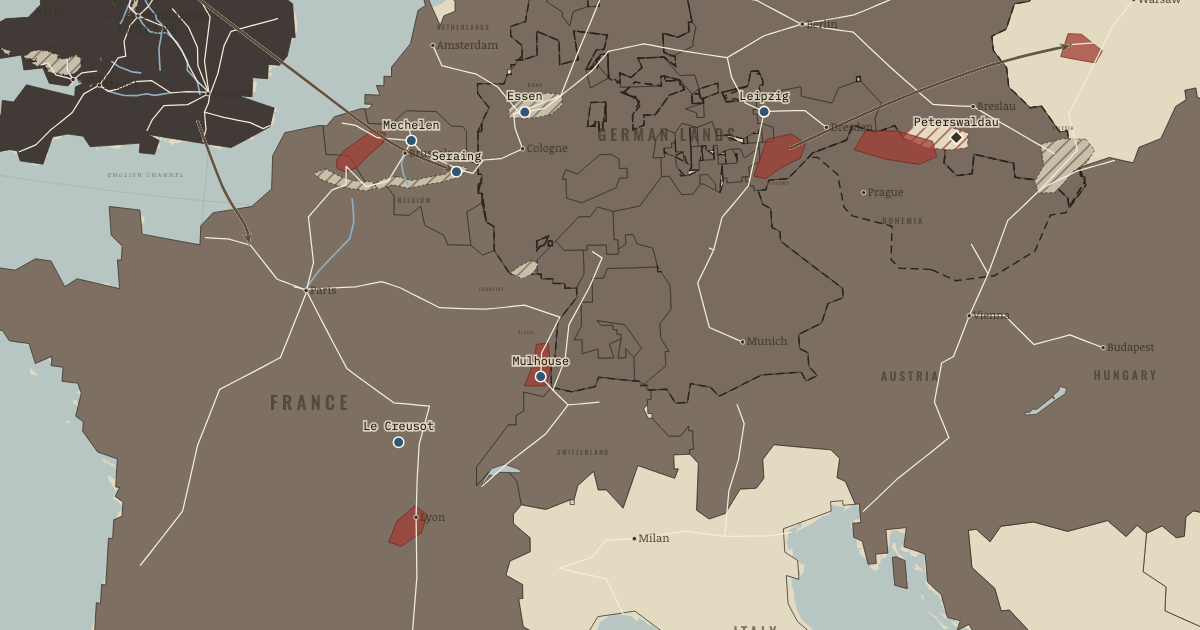
The map above is the world of The Industrial Revolution in Europe, 1870 — The Continent follows.
Every state on the map that year: The world in 1871 · Europe in 1871.
Part of IB History: The Industrial Revolution →
SHORT EXPLANATION
Britain’s industrial lead did not remain confined to Britain. Belgium had coal, iron and skilled workers, and it could put British knowledge to use. John Cockerill, the son of a Lancashire mechanic, opened a vast machine works and ironworks at Seraing near Liège in 1817. The Belgian government added a national railway, beginning with the continent’s first state-built steam line, from Brussels to Mechelen in 1835.
The German states first had to overcome divisions between their markets. The Zollverein, founded in 1834, removed tariffs among its members, much like today’s European single market. From the 1840s, railway construction and coal from the Ruhr around Essen fed an industrial boom. France took a slower, steadier course, with fewer giant factories and much skilled, high-quality work, although its cotton district around Mulhouse in Alsace and ironworks like Le Creusot matched Britain’s best. Alexander Gerschenkron argued that later starters depended more heavily on banks and the state to catch up.
The map shows the places behind these national accounts: hatched coalfields in Belgium, northern France, the Ruhr and Silesia; the Zollverein’s expanding dashed outline; and white railway lines. The red-striped linen district in Silesia shows another side of the change. Competition from machine-spun yarn ruined weavers who rose at Peterswaldau in 1844. Industrial expansion could provide work in one district while destroying it in another.
The full story
The coal belt from Mons through Charleroi to Liège gave Belgium a foundation for industry. Coal had been worked there for centuries, and Liège already possessed a metalworking tradition. When British machinery arrived, it entered a region with fuel and people whose skills could be put to new uses.
Britain tried to keep those techniques at home. It prohibited skilled artisans from emigrating until 1824 and textile machinery exports until 1843. Yet William Cockerill, a Lancashire mechanic, had begun building spinning machines at Verviers in 1799. His son John established a machine works and ironworks at Seraing in 1817. It soon became one of the world’s largest industrial plants: knowledge had crossed the border despite the restrictions.
Belgian independence from the Netherlands in 1830 brought another source of investment. The new state planned and paid for a national railway network, opening its first line from Brussels to Mechelen on 5 May 1835. Relative to its size, Belgium became the continent’s most industrialized country. Its experience showed that Britain’s lead could be copied, with public railway building helping to carry the process forward.
In the German states, internal borders presented a different problem. Tariffs separated potential customers and producers. Prussia, the largest German state, led eighteen states with about 23 million people into the Zollverein in 1834; the customs union removed tariffs between them. Its dashed outline on the map expands until it covers almost all of the future German Empire.
Friedrich List wanted German industry to acquire the strength to compete with Britain. In National System of Political Economy (1841), he argued for tariffs: by making imports dearer, these could give young industries time to develop. List also promoted the railway from Leipzig to Dresden, opened in 1839. His argument for protection would find followers from the United States to Japan.
Railways gave the enlarged market a powerful stimulus from the 1840s. Building them required coal, iron and machinery together, creating customers for each. Deep shafts opened the Ruhr coalfield, and the Krupp works at Essen grew from a struggling family steel foundry into one of Europe’s largest firms. Political decisions had joined markets; railway orders helped industrial firms grow to serve them.
France had less coal and a large peasant population that remained on the land. Its industrialization was more gradual, combining high-quality goods such as Lyon silk with major centers including the Schneider brothers’ ironworks at Le Creusot and the cotton mills of Mulhouse in Alsace. Nor did industry elsewhere spread evenly across countries. Textile districts arose in Saxony, Bohemia, Catalonia and the Polish city of Łódź amid largely agricultural surroundings.
The arrival of machinery could also strip existing workers of their earnings. In June 1844, after competition from machine-spun yarn had brought the income of Silesian linen weavers crashing down, weavers at Peterswaldau and Langenbielau wrecked a merchant’s house. Troops fired on the crowd and killed eleven. The continent had borrowed British machines, but its governments and regions shaped their use, and the benefits and losses fell in different places.
FULL EXPLANATION
Gerschenkron and the advantages of backwardness
Britain’s successors did not begin where Britain had begun. They could borrow machinery that already existed, but they also faced shortages of capital and skills. In Economic Backwardness in Historical Perspective (1962), economic historian Alexander Gerschenkron made this difference the basis of a theory: the further behind a country was at the start, the faster it could grow once industrialization began, and the more it needed institutions to supply what was missing. In Britain, private savings and partnerships financed industry. Germany’s great investment banks financed mines, railways and heavy industry: the Darmstädter Bank was founded in 1853, and Deutsche Bank followed later. In Russia, the most backward of the three, the state itself became the chief investor, as chapter 8 explains. Gerschenkron expected late starters to favor heavy industry and very large plants as well. The comparison is illuminating, though later research complicates the scale. Studies edited by economic historians Richard Sylla and Gianni Toniolo found that banks and states played roles too varied to fit a simple ranking of backwardness. Sidney Pollard placed the emphasis on regions rather than nations. The enduring point is that a pioneer changes the choices available to its followers; copying the pioneer’s entire route is therefore unnecessary.
Industrial regions and national averages
Look within a country and the national average can conceal striking differences. In Peaceful Conquest (1981), economic historian Sidney Pollard argued that industrialization spread by regions. The Sambre–Meuse coal belt, Ruhr, Saxony, Upper Silesia, northern France and Catalonia shared mines, mills and crowded towns with Lancashire, even while rural provinces in their own countries looked very different. Coal deposits help explain where many of these regions appeared. The atlas draws coalfields and textile districts as shapes across borders. Country colors give a broader, simpler picture. Grey-tan indicates an industrializing country, where factories and railways are spreading: roughly the point at which economic historian Paul Bairoch’s index of industrialization per person passes 15, with Britain in 1900 set at 100. Charcoal indicates an industrial economy at about 40, approximately Britain’s level in the 1840s. The stages are approximate. Bairoch reconstructed figures from fragmentary evidence, economist W. W. Rostow’s idea of a sudden take-off has been heavily criticized, and choosing thresholds requires judgment. The regional shapes help interpret the country colors by showing the differences a single average cannot display.
Was France a failure?
Was France’s slower industrialization a failure? Older histories often judged it against Britain and Germany. Economic historians Patrick O’Brien and Caglar Keyder proposed a different reading in Economic Growth in Britain and France 1780–1914 (1978). France had less coal, slower population growth and many peasant landowners; skilled, high-value production suited these resources, they argued, while output per industrial worker grew at a respectable rate. Paul Bairoch’s index of industrialization per person placed France at about 20 in 1860 and Britain at 64. Yet French income per head rose steadily through the century. France had strengths in silk, luxury goods and engineering, later adding cars and electricity; French banks financed railways across Europe. The Cobden–Chevalier treaty of 1860 cut tariffs between Britain and France. British competition encouraged modernization in some French trades and hurt others. The comparison changes the question. Britain’s coal, cotton and giant factories produced one path to growth. France’s experience asks whether that path should be treated as the normal one or as one among several.
Key places on the map
On this day
Why it happened
Coal and old industrial skills. British techniques could take root quickly where several resources met. The Sambre–Meuse valley had mined coal and worked iron since the Middle Ages; Flanders, Saxony and Alsace already had textile trades. Coal or fast water supplied power, established crafts supplied skills, and water transport connected producers to customers. The map places hatched coalfields close to red districts. Where one of these advantages was absent, industry arrived later.
Borrowed machines and migrant experts. Britain tried to guard its lead by prohibiting artisan emigration until 1824 and textile machinery exports until 1843. Neither rule stopped knowledge from traveling: machines were smuggled, men moved, and continental entrepreneurs visited Lancashire to see what they could copy. British mechanics, engineers and navvies—the laborers who dug canals and railways—built mills and railways from Liège to Rouen. The Cockerills, a Lancashire family of mechanics, made Belgium’s first spinning machines and built the Seraing ironworks. Irish mining engineer William Mulvany worked in the Ruhr; English contractor Thomas Brassey’s railway gangs worked in Normandy. Their experience enabled followers to avoid some of the costly experiments the pioneers had already made.
Governments built markets and railways. Private investors were not always ready to bear the first risks. Governments could create markets and transport before industry had fully developed. Belgium planned its railways; Prussia, the largest German state, led the Zollverein, which removed taxes on goods moving among its German members, much as the European Union does today. Prussia also operated state mines in the Saar and Silesia. France laid out its main railway lines in an 1842 law, then leased them to private companies. Friedrich List gave intervention an economic argument. Infant industries, he held, needed protection while they were too young to compete. State action could give them the conditions and time to grow.
Peace and new borders after 1815. Europe’s great powers made peace at Vienna in 1815, after Napoleon’s defeat, ending a generation of war, blockade and occupation. Capital, goods and people could cross borders again. But the borders themselves had changed, placing industrial resources under different governments. Prussia, the largest German state, gained the Rhineland and Westphalia, including the Ruhr and the Saar. The new Kingdom of the Netherlands gained the coal and iron of Liège and Hainaut; Belgium broke away in 1830. The diplomats at Vienna had, largely without realizing it, helped decide which states would possess coal for the industrial age.
THE TURNING POINT
Cockerill at Seraing, 1817. At Seraing, British knowledge met Belgian resources. John Cockerill, born in Lancashire and trained in his father’s Verviers workshop, secured the backing of William I, king of the Netherlands when it still included Belgium. He made a factory from the former summer palace of the prince-bishops of Liège, the churchmen who had ruled the city until 1795. Using local coal, local workers trained in British methods produced iron, steam engines, locomotives and ships. The works also trained engineers who carried what they learned across the continent. Seraing shows why Britain’s restrictions on exporting machinery and skilled workers could not keep industrial knowledge within its borders: engineers carried it with them. Industrialization had become a European process.
What it changed
Germany overtakes. By joining markets before political unification, the Zollverein tied smaller German states to Prussia, the largest. Ruhr coal and railway orders supplied the industrial foundations on which a united Germany, created in 1871, overtook Britain in steel and chemicals by the 1890s. Economic unification contributed to political unification; the new empire’s strength would depend on science and big business as well as coal.
The workers’ question crosses borders. The Silesian weavers’ revolt of 1844 gave the suffering of industrial workers a lasting public voice. German writer Heinrich Heine turned it into a poem, and half a century later Gerhart Hauptmann wrote the play The Weavers (1892). Governments faced the workers’ question too. In the 1880s Germany’s chancellor Otto von Bismarck introduced insurance against sickness, accidents and old age, partly to undercut socialists. Protecting workers had become a European political question, shared by workers and feared by governments.
A model for late developers. Later industrializers could draw on List’s argument for sheltering infant industries—those too young to face foreign competition—and on Germany’s partnership of banks and state. The United States raised tariffs to protect its factories. Japan’s Meiji leaders, in power from 1868, studied Germany and used the state to found industries, though Western unequal treaties barred Japan from raising tariffs until 1911. Both pursued active policies rather than relying on the free market recommended by Britain from its secure lead. List compared that advice to kicking away a ladder after climbing it.
DISCUSSION QUESTION — Did continental Europe industrialise by imitating Britain, or by finding its own path?
The first continental steam engines, spinning mills and railways were British in design, often British-built and sometimes British-run. The Cockerills’ Seraing ironworks and English contractor Thomas Brassey’s railways in Normandy show how people carried this knowledge; entrepreneurs looked to Lancashire as a standard. Imitation was central to the beginning. The machines, however, entered societies with different resources and institutions. Belgium and Prussia, the largest German kingdom, used governments to plan railways and run mines. German banks financed heavy industry on a scale British banks never attempted. Friedrich List defended protectionism—sheltering young industries behind tariffs—against Britain’s recommended free trade. France developed more gradually around skilled work, a path economic historians Patrick O’Brien and Caglar Keyder argue suited its resources. Alexander Gerschenkron helps explain why a later start could produce different methods. Followers could borrow established technology while creating institutions suited to their own circumstances. They copied British patents and joint-stock companies, firms owned by many shareholders, selectively as well. Continental Europe combined borrowed technology with institutions of its own, a combination later industrializers from the United States to Japan would repeat.
An interesting fact
Germany’s first railway locomotive arrived in pieces from Newcastle. Robert Stephenson & Co. built the Adler, or Eagle, and shipped it to Bavaria for the six-kilometre Nuremberg–Fürth line, which opened on 7 December 1835. The company sent an English driver, William Wilson, because nobody in Bavaria knew how to drive a locomotive. It paid him more than its own director. Wilson trained German drivers and stayed in Nuremberg until his death in 1862. A locomotive did not immediately make every train steam-powered. Coal was expensive, so horses pulled most trains on the line for years. Germany could import a railway before it could fuel one cheaply.
Related
THE FREE PRINTABLE STUDY GUIDE
Get the printable study guide for The Industrial Revolution free. I’ll send you a few short letters, then one when a new atlas opens. That’s all. — Paul
NO TRACKING · YOUR ADDRESS IS USED FOR THE DISPATCH AND NOTHING ELSE · UNSUBSCRIBE ANYTIME