Industrial Revolution · CHAPTER 4 ·
Early railways and Railway Mania
Chapter 4 of The Industrial Revolution, 1750–1914: “The Railway Age”
Railways grew out of the coalfields: the Stockton & Darlington line opened in 1825 to carry coal. After the Stephensons’ Rocket won the Rainhill trials in October 1829, the Liverpool & Manchester Railway opened in 1830 as the first line between two cities worked entirely by steam to a timetable.
Chapter 4 is included with every paid plan. WW2 is free in full, and chapter 1 of every atlas is free. A free account opens 3 more chapters a day. Starter, at $9 a month, opens all 21 with no daily limit — see the plans.
Free printable Industrial Revolution study guide, sent by email ↓
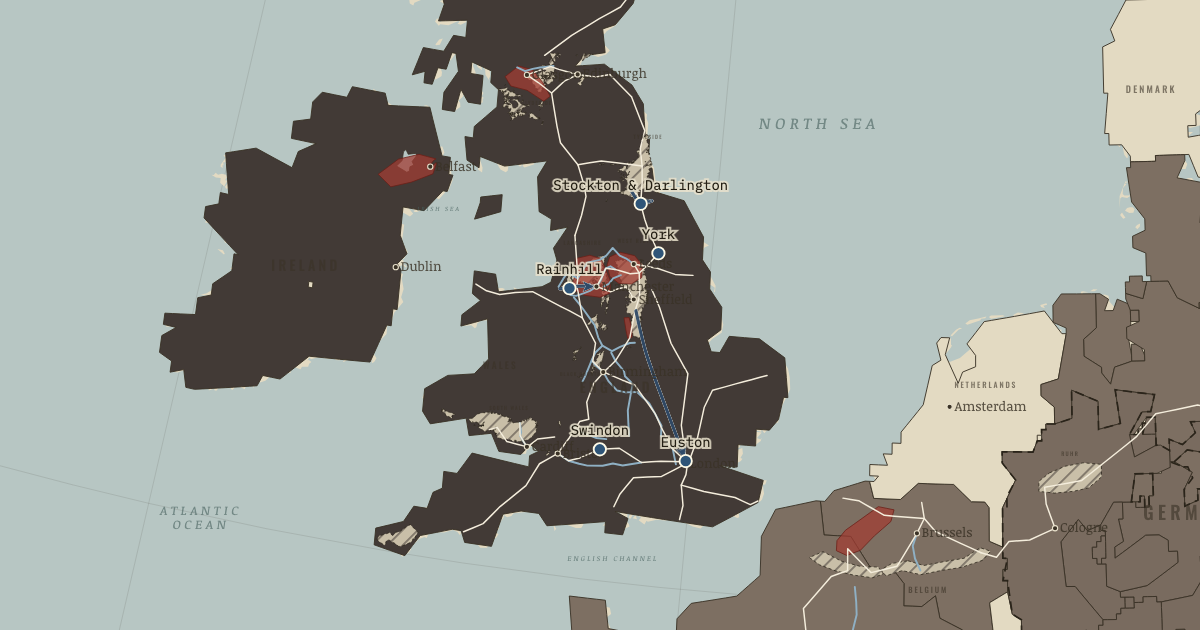
The map above is the world of The Industrial Revolution in Europe, 1850 — The first industrial nation.
Every state on the map that year: The world in 1850 · Europe in 1850.
Part of IB History: The Industrial Revolution →
SHORT EXPLANATION
The first railways grew from a problem at the coal mines: how could a heavy, cheap fuel reach a river without costing too much to carry? For two centuries horses pulled wagons along wooden and then iron rails. After 1800 coalfield engineers developed steam locomotives to replace them. The Stockton & Darlington line of 1825 carried passengers as well as coal.
The Liverpool & Manchester Railway showed how much more the arrangement could do. Rocket, built by George Stephenson and his son Robert, won the trials at Rainhill in 1829. Opening in 1830, the line joined two great cities with trains running entirely by steam to a timetable. Its stations, signals and tickets resembled a modern intercity service, and far more passengers came than its promoters expected.
Private investors financed a rapid expansion: Britain had about 100 miles of railway in 1830, 1,500 in 1840 and 6,000 in 1850. Much was promoted during the railway mania of 1845–47, a speculative frenzy comparable to the late-1990s rush for internet shares. On the map white lines spread from Euston and London’s other main stations to Bristol, Manchester, Leeds, Newcastle and Glasgow; Britain turns charcoal as the first industrial economy.
Cheap carriage moved coal and goods farther, while railway timetables encouraged a common national time. Railway towns such as Swindon grew, and millions entered a national market. By 1850 the lines had linked scattered industrial districts into one economy.
The full story
A coal owner could sell fuel cheaply at the pit and still face a large transport bill. Tyneside mines had dealt with the problem since the seventeenth century by sending wagons to the river on wooden rails. Iron rails improved the wagonway; steam offered a way to move the wagons themselves. Richard Trevithick ran a high-pressure locomotive at Penydarren in South Wales in 1804, and in the 1810s colliery engineers including George Stephenson built locomotives at Killingworth near Newcastle.
The Stockton & Darlington Railway opened on 27 September 1825 to carry Durham coal to the River Tees. Steam locomotives hauled freight, while horses carried most passengers. It was a public railway: anyone who paid could use it. Its success showed that such a line could earn money. Liverpool and Manchester merchants, meanwhile, wanted an alternative to slow and expensive canal carriage between the port and the manufacturing city.
Their railway needed a decision about power. At the Rainhill trials in October 1829 Rocket, built by George Stephenson and his son Robert, reached about 30 miles an hour. Hot gas from the fire passed through tubes in its boiler, raising steam quickly. The Liverpool & Manchester opened on 15 September 1830 with two tracks, steam traction throughout and a timetable. Passengers arrived in unexpected numbers, showing that a railway built with freight in mind could also be a major passenger business. The opening day brought a tragedy too: Rocket struck and killed the politician William Huskisson, the first famous railway death.
Other lines connected the major cities. These main routes were called trunk lines. The London & Birmingham opened throughout in 1838 from Euston station, and Isambard Kingdom Brunel’s Great Western Railway reached Bristol in 1841. London was connected with Birmingham, Manchester and Liverpool; a device developed for carrying coal was becoming a national means of transport.
Investors supplied much of the money, especially during the railway mania, a speculative boom in railway shares. Parliament passed about 270 railway acts in 1846 alone, authorizing some 4,500 miles. George Hudson, the York businessman known as the Railway King, controlled over a thousand miles before his frauds were exposed. Many schemes collapsed. Yet by 1850 Britain had about 6,000 miles of track. At the 1847 peak, some 250,000 navvies dug cuttings and raised embankments by hand.
The map’s white lines now join coalfields and ports. Cheaper carriage brought coal and other goods, fresh food and newspapers to towns across the country. Trains also needed a common timetable: railway time, set by the Royal Observatory at Greenwich, displaced local times. By 1850 railways had connected coal, iron and machinery in a growing system, helping make Britain the world’s first industrial economy.
FULL EXPLANATION
How much did railways matter? The social-savings debate
Railways plainly carried enormous quantities of goods and people. How much of that traffic could have moved without them? In Railroads and American Economic Growth (1964), Robert Fogel compared the cost of American railway freight in 1890 with the cost of carrying it by canal and road. His estimated ‘social saving’ was about 2.7 per cent of national income. The implication was provocative: the United States might have grown almost as fast using other transport. G. R. Hawke applied the method to England and Wales in 1865. Including passengers as well as freight, he estimated a saving of perhaps 7 to 11 per cent of national income. Tim Leunig later valued passengers’ time savings and put the gain around 14 per cent by 1912. The results make the choice of traffic and costs matter to the answer. Critics question whether a comparison at one date can capture changes that accumulated over time. Railways helped create national markets, larger firms, cheap coal in towns, engineering industries and stock markets that financed lines. Most historians regard them as an accelerator of an industrial economy already under way in Britain. In vast countries with few navigable rivers, such as Russia and India, they see railways as closer to a precondition.
The railway mania as a financial bubble
The railway mania of 1845–47 was Britain’s largest investment boom so far. Its network emerged from competing projects rather than a government plan. Each company needed an Act of Parliament, passed as a private bill for its line; promoters competed for routes, duplicated them and disputed standards. Government did set some conditions. As minister for trade, William Gladstone passed the Railway Regulation Act in 1844, requiring every company to run a cheap daily train at a penny a mile. Track gauge, the distance between the rails, presented another problem. Isambard Kingdom Brunel’s Great Western used seven feet, while most lines followed George Stephenson’s 4 feet 8½ inches. Trains could not pass directly from one gauge to the other, much as a plug cannot fit a foreign socket. The Gauge Act of 1846 required the narrower standard for new lines, although broad gauge survived until 1892. A share could cost its buyer more than the initial payment. Many shares were partly paid, leaving investors liable for later calls for the balance. Interest rates rose in 1847 and many were ruined. In 1849 George Hudson, the ‘Railway King’, was exposed for paying dividends, or profit payments, from new investors’ money—the device behind a modern pyramid scheme. Private investment built the network faster than any plan could have delivered it, at a cost that included duplicate routes, incompatible gauges and ruined investors.
Time, space and the railway town
A trip that had taken days by stagecoach could take hours by train. The cultural historian Wolfgang Schivelbusch described this change as an annihilation of space and time. Timetables also required agreement on the hour: the Great Western adopted London time in 1840, and in 1847 the Railway Clearing House, which settled accounts between companies, recommended Greenwich time to them all. Faster travel supported new excursions. The future travel agent Thomas Cook organized his first, from Leicester to Loughborough, in 1841. Cheap trains brought many of the roughly six million visits to London’s Great Exhibition of 1851, a large show of industry. Swindon, Crewe and Wolverton grew around locomotive works into communities of skilled engineers, with company housing, schools and institutes. The builders’ experience was different. Tens of thousands of English, Irish and Scottish navvies moved between contracts, living in temporary camps and digging the lines by hand. Many died in dangerous work. During construction of the first Woodhead tunnel through the Pennine hills in 1838–45, about thirty men died; estimates range from 22 to 32. The speed passengers gained depended on routes these workers had made at considerable human cost.
Key places on the map
On this day
Why it happened
Coal needed cheaper carriage. Coal’s low price made carriage a large part of its cost; moving it often cost more than mining it. For two centuries collieries, or coal mines, had used horse-drawn wagons on rails. Engines already pumped their pits and offered a way to haul wagons too. Local Quakers, members of a small Christian movement led by Darlington wool merchant Edward Pease, promoted the Stockton & Darlington, opened in 1825 to take Durham coal to the sea.
High-pressure steam made engines mobile. James Watt’s low-pressure engines were too heavy and large to move themselves. Around 1800 Richard Trevithick’s high-pressure engines produced more power from a smaller boiler. Rocket combined later improvements: fire-tubes carried hot gas through the boiler, and a blast pipe used spent steam to fan the fire. Together they raised steam quickly enough to haul trains at speed. Robert Stephenson & Co., founded in Newcastle in 1823, was the first works built to make locomotives, turning improvements into a reliable product.
Merchants frustrated by the canals. Liverpool’s port and Manchester’s mills needed to exchange raw cotton and finished cloth quickly. By the 1820s canals between them were busy and slow, and merchants regarded charges as excessive; carriers had grown complacent without competition. Merchants backed the Liverpool & Manchester Railway as a rival. Across a large cotton trade, even a saving on each load could add up. The first great railway grew from a challenge to a transport monopoly.
Savings looking for a home. Middle-class savings helped pay for the lines. In 1825 Parliament repealed the Bubble Act of 1720, which had restricted share-selling firms, making joint-stock companies that sold shares to the public easier to form. Government bonds, loans to the state, paid modest interest. Railway shares promised higher returns to clergymen, widows, merchants and manufacturers. Cheap credit in the mid-1840s helped turn this interest into a share-buying mania, financing a network faster than any government plan could have done.
THE TURNING POINT
Rainhill, October 1829. The Liverpool & Manchester directors considered two ways to haul their trains: fixed engines pulling cables, or locomotives traveling with the carriages. The Rainhill trials in October 1829 tested the latter. Rocket, built by George Stephenson and his son Robert, ran reliably and reached about 30 miles an hour, persuading the directors to use locomotives. When the line opened in 1830 it demonstrated that steam could carry passengers and freight between great cities at speed and to a timetable. Main lines in Britain and abroad followed that pattern.
What it changed
A national market and national time. A railway could take coal, cloth, fish, milk and newspapers across the country overnight. Goods could reach more buyers, prices converged and local monopolies collapsed. To coordinate trains, companies adopted Greenwich time, set by the Royal Observatory at Greenwich, from the 1840s; towns followed, decades before the law confirmed one clock in 1880. After 1850 cheap transport also let industrial cities grow by bringing food and fuel from beyond the reach of canals and carts.
The continent builds its own lines. Railway construction created demand for coal, iron and machinery at once, making it a leading industry of continental industrialization. Belgium opened the continent’s first state-built steam railway in 1835; German states and France followed within a few years, often with British locomotives and engineers. Continental governments frequently planned routes themselves, so networks served national strategy as well as private profit.
Railways across the world. British capital and engineers helped build railways from India to Argentina. Transcontinental lines in the United States, Canada and Russia opened vast regions to settlement and trade, connecting distant land to industrial markets. Chapters 9 and 11 follow the grain, cotton and migrants carried into a world economy, and the costs borne by people living in the railways’ path.
DISCUSSION QUESTION — Did railways create Britain’s industrial economy, or did an industrial economy create the railways?
Britain’s industrial economy came first. Cotton, coal, iron and steam were already changing production when railways emerged. Mine owners wanted cheaper carriage, and savings from industry and commerce helped finance the lines. G. R. Hawke’s social-savings measure estimates the extra cost of moving the same traffic without railways. His result suggests a substantial gain of several per cent of national income, although canals and roads could have supplied part of the service. The railway then changed the economy that had paid for it. Its demand created a mass market for coal and iron; engineering became a leading industry, towns grew, time was standardized and ordinary investors entered a national market for shares. The system after 1850 differed in kind from the one before it. An industrial economy created railways, and railways helped create a fully industrial society. The innovation that completes a process need not be the one that began it.
An interesting fact
A timetable linking towns had to deal with clocks that disagreed. Before railways, British towns kept local time by the sun; Bristol, about 170 kilometres west of London, ran roughly ten minutes behind the capital. The Great Western Railway began using London time in 1840, leaving Bristol’s citizens with two times to reckon with. The compromise remains visible on the clock of the Corn Exchange, the eighteenth-century trading hall in Corn Street. Its two minute hands, ten minutes apart, show London and Bristol time. Greenwich Mean Time, kept by the Royal Observatory at Greenwich, became Great Britain’s legal time only in 1880, long after railway timetables had made it the time most Britons lived by.
Related
THE FREE PRINTABLE STUDY GUIDE
Get the printable study guide for The Industrial Revolution free. I’ll send you a few short letters, then one when a new atlas opens. That’s all. — Paul
NO TRACKING · YOUR ADDRESS IS USED FOR THE DISPATCH AND NOTHING ELSE · UNSUBSCRIBE ANYTIME