Feminism and the Tunisian Revolution · 2011
Why did the 2010–11 protests topple Ben Ali?
The seminar question: “Why did the protests that failed in the Gafsa mining basin in 2008 succeed in bringing down Ben Ali in 2010–11?”
On 17 December 2010 the street vendor Mohamed Bouazizi set himself on fire in Sidi Bouzid after officials confiscated his scales, and protests spread from the interior to Tunis, Sfax and Sousse. Police killed protesters in Kasserine, Thala and Regueb, and after twenty-eight days the 23-year rule of President Ben Ali fell.
Chapter 9 is included with every paid plan. WW2 is free in full, and chapter 1 of every atlas is free. A free account opens 3 more chapters a day. Starter, at $9 a month, opens all 21 with no daily limit — see the plans.
Free printable Feminism and the Tunisian Revolution study guide, sent by email ↓
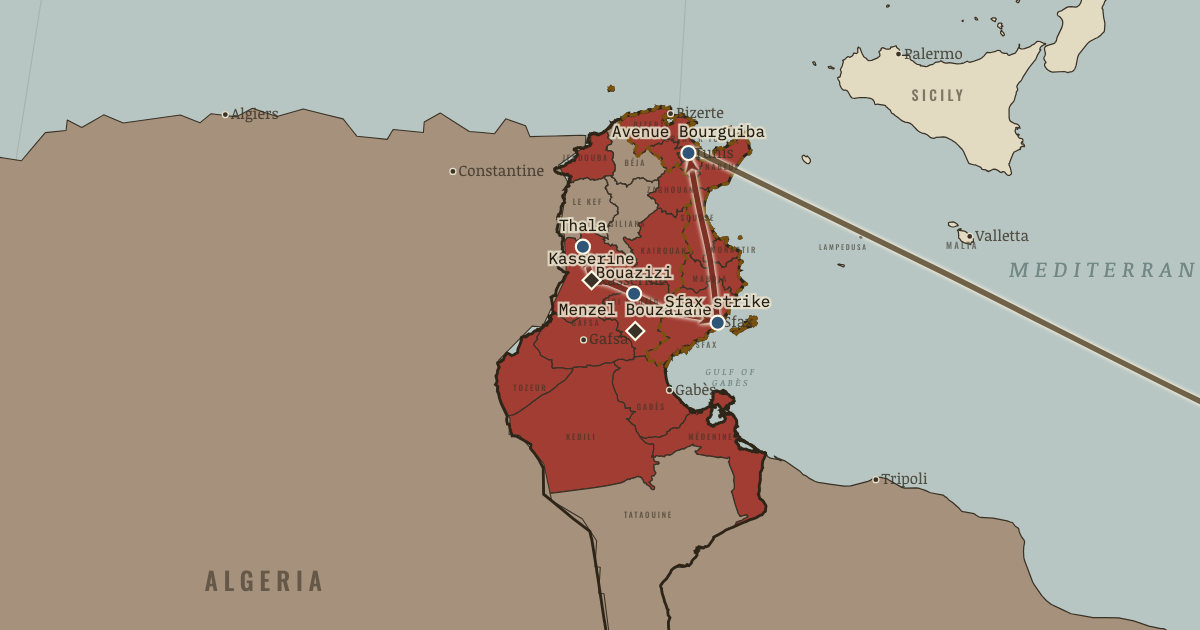
The revolt began in the Centre-West, where the regime’s unwritten bargain had failed conspicuously. Tunisians were expected to accept political silence in return for jobs and order. For a street vendor in Sidi Bouzid, even the attempt to earn a living could end in a confrontation with officials. On 17 December 2010 Mohamed Bouazizi set himself on fire after his scales were confiscated and his complaint went unheard.
The short answer
- Blocked hopes in the interior. In Sidi Bouzid, Kasserine and Gafsa unemployment stood far above the national rate of 13 per cent, while poverty was about four times that of the coast. Education had raised hopes of jobs that did not exist. Those seeking informal work could encounter humiliation from police and officials instead. The interior had revolted in 1984 and 2008; in 2010 familiar grievances spread with a different speed and reach.
- Dignity as the demand. Poverty alone does not capture the meaning many Tunisians found in Bouazizi’s act. It spoke to humiliation by officials, an experience that crossed class lines and helped draw the coastal middle class into protest. Many Tunisians call the uprising the “Revolution of Freedom and Dignity” and dislike the foreign label “Jasmine Revolution”.
- Networks ready to mobilise. Under Ben Ali, union branches, the lawyers’ bar, teachers’ unions and human-rights activists survived in weakened form. Defending the Gafsa prisoners gave them experience they could use again. In December 2010 they organized marches, documented killings and called strikes. Their connections gave local protesters a means of acting across the country; in 2008 the UGTT’s national leadership had held back.
- New media against an old blackout. A state television blackout could leave each town unaware of protests elsewhere. Phone cameras, Facebook and Al Jazeera made that isolation harder to maintain: footage from Thala in the afternoon could be watched in Sfax that evening. WikiLeaks’ publication of US diplomatic cables in December 2010 also confirmed what many suspected about corruption in the ruling family.
THE TURNING POINT
The Sfax general strike, 12 January 2011. Sfax showed that a revolt from the interior could interrupt life in the coastal heartland. Tunisia’s second city and industrial center lies within the coastal outline on the map, and its regional union was the country’s strongest. After the UGTT authorized regional strikes on 11 January, tens of thousands marched in Sfax; strikes followed in Kairouan and Tozeur, and Tunis’s suburbs rose that night. Bouazizi’s act had begun the uprising. Now organized workers could stop the economy, presenting Ben Ali with a wider threat than scattered riots. He fled two days later.
What it changed
A dictator falls in four weeks. On 14 January Ben Ali’s departure ended his 23 years in power and 55 years of one-party government. Old-regime figures initially led the interim authorities, but protesters demanded a deeper break. Young people came from the interior in the Caravan of Liberation, and sit-ins took place in Kasbah square outside the prime minister’s offices. A lasting change was that Tunisians no longer feared to speak in public.
The Arab uprisings. Tunisia’s rapid success encouraged people elsewhere to believe their rulers could fall quickly. Protest began in Egypt on 25 January, and Hosni Mubarak fell on 11 February; demonstrations began in Libya from 17 February and also spread to Yemen, Bahrain and Syria. The slogan “the people want the fall of the regime” traveled with them. That expectation of quick change cost many lives in Libya and Syria. Tunisia alone produced a democratic transition, lasting a decade before President Kaïs Saïed suspended parliament in 2021.
A revolution without leaders. No single leader, party or program directed the uprising. The authorities therefore had no single leadership to suppress, but the revolution also lacked an agreed direction after Ben Ali fled. Old-regime officials, the UGTT, returning exiles such as Rached Ghannouchi and new parties entered the resulting political space. Who would inherit the revolution became the central conflict of the next three years.
The dead and the wounded. Families of the dead and wounded pressed for recognition, compensation and trials of police officers. Their campaigns kept Kasserine and Thala in public memory. The official list of martyrs appeared only in 2021, and the slow delivery of justice remained a grievance through later crises.
The full answer, argued
Both uprisings grew from unemployment, corruption, regional neglect and police abuse. In 2008 the Gafsa revolt stayed within an isolated mining basin. Few images reached the rest of Tunisia, the national union leadership held back, and police could cordon off the area and jail its leaders. In 2010–11 the same grievances reached many governorates within two weeks. Videos on Facebook and Al Jazeera crossed the blackout; regional unions pushed the UGTT to authorize strikes; and the killings in Kasserine produced national outrage. The army, with little stake in Ben Ali’s survival, finally stood aside. Historians differ over the weight of media and unions, but neither spread nor defection alone explains the outcome. The earlier failure also supplied experienced organizers for the later movement.
An interesting fact
A poem written in 1933 supplied some of the revolution’s most famous lines. Abu al-Qasim al-Shabbi, its young Tunisian author, died of heart disease the following year, aged 25. The opening couplet of “The Will to Live” promises that if a people one day wills to live, fate must answer and the chains must break. The couplet had entered Tunisia’s national anthem in 1987 and was sung at Ben Ali’s official ceremonies. In January 2011 crowds chanted it against his regime in Tunis; demonstrators in Cairo and other Arab cities soon took it up. Words the government had made official became an anthem of its overthrow.
This is the study layer of Tunisian Revolution, chapter 9 of Protest and Change: Second-Wave Feminism and Tunisia, 1945–2015; the full index of the atlas is here.
Related questions
THE FREE PRINTABLE STUDY GUIDE
Get the printable study guide for Protest and Change free. I’ll send you a few short letters, then one when a new atlas opens. That’s all. — Paul
NO TRACKING · YOUR ADDRESS IS USED FOR THE DISPATCH AND NOTHING ELSE · UNSUBSCRIBE ANYTIME