Feminism and the Tunisian Revolution · 1982
Why did the Equal Rights Amendment fail?
The seminar question: “Did the ERA fail because of Phyllis Schlafly, or because of the rules for amending the Constitution?”
Congress passed the Equal Rights Amendment on 22 March 1972, and 22 states ratified it that year, reaching 30 by March 1973, with 38 needed. In autumn 1972 Phyllis Schlafly founded STOP ERA, and a counter-movement organised largely by women stalled ratification until the amendment failed.
Chapter 5 is included with every paid plan. WW2 is free in full, and chapter 1 of every atlas is free. A free account opens 3 more chapters a day. Starter, at $9 a month, opens all 21 with no daily limit — see the plans.
Free printable Feminism and the Tunisian Revolution study guide, sent by email ↓
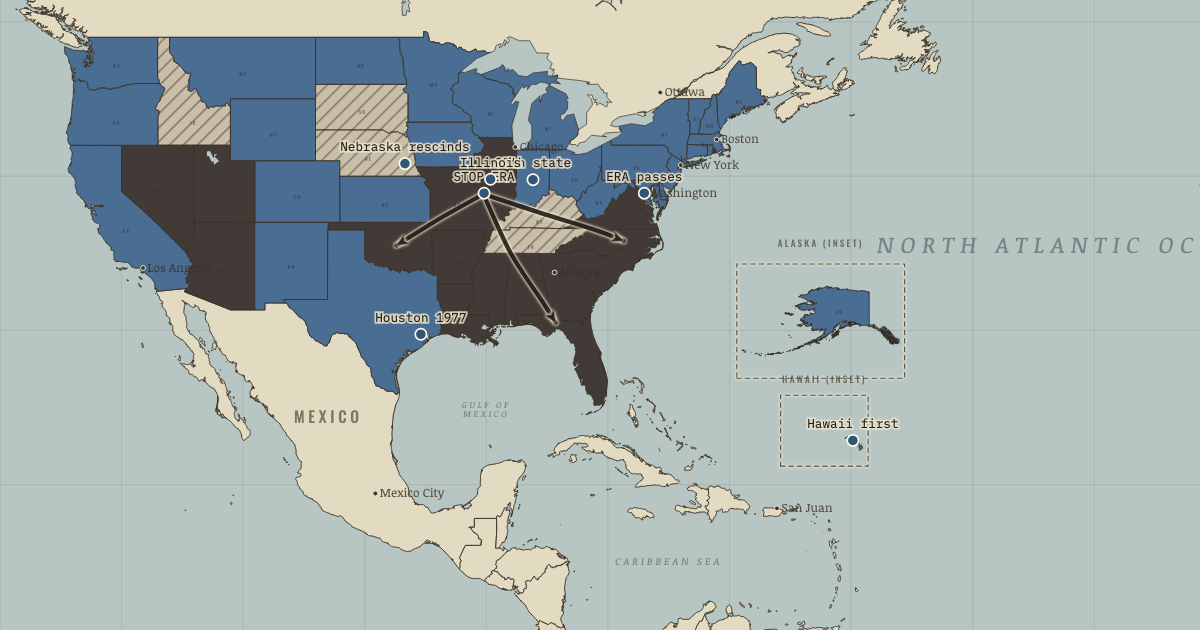
The ERA had been waiting a long time for the reception it received in 1972. Alice Paul of the National Woman’s Party first drafted an amendment in 1923, and both major parties had endorsed it in their platforms for decades. President Nixon, a growing number of trade unions and new women’s organizations now supported it. The Senate approved it by 84 votes to 8.
The short answer
- A supermajority rule. The requirement of 38 ratifications gave opponents a smaller task: hold 13 states, by persuading one chamber in each. Support spread widely across the country could therefore lose to opposition concentrated in particular legislatures. The South and the Mormon West provided favorable ground for that opposition: conservative churches were strong there, and the amendment could be presented as a threat to local values.
- A counter-movement of women. Women speaking for STOP ERA presented themselves as homemakers protecting the respect and security they believed the law afforded them. Their presence made it harder to dismiss the campaign as men defending privilege. Schlafly gave followers a positive identity as wives and mothers when many felt feminism looked down on them. Like the women’s movement it opposed, the backlash could mobilize people around a shared identity.
- Abortion and the culture war. The argument over the ERA widened after Roe v. Wade in 1973. Opponents said the amendment would protect abortion and, later, gay rights, making it a question about the family as well as legal equality. Catholic, evangelical and Mormon churches joined the campaign, and by the late 1970s congregations had supplied many of STOP ERA’s most active volunteers. A victory for one movement could give another reason to organize.
- The decision lay with legislators. National polls showed majority support, but ratification depended on a few thousand state legislators, mostly men. Many served in part-time assemblies where personal lobbying mattered enormously. They heard especially from intensely committed citizens, and by the late 1970s opponents were the most intense. In Illinois, Florida and North Carolina, only a handful of legislators separated the sides in decisive votes.
THE TURNING POINT
STOP ERA, autumn 1972. In 1972, 22 states ratified; in 1973, eight did. The number fell to three in 1974, one in 1975, none in 1976 and one in 1977. Nebraska’s attempted withdrawal in March 1973 gave another sign of changing momentum. STOP ERA had turned a measure often passed with little debate into a controversy over the future of the family. Cautious legislators now had reasons to hesitate where they had once seen consensus.
What it changed
Equality by other routes. Legal change continued without the amendment. In Reed v. Reed (1971) and Craig v. Boren (1976), the Supreme Court applied stricter review to sex discrimination, asking for a strong justification for laws treating men and women differently. Congress passed the Equal Credit Opportunity Act (1974) and the Pregnancy Discrimination Act (1978). These courts and statutes supplied much of what the ERA had promised.
The rise of the New Right. The women organized through STOP ERA helped build a conservative coalition with churches and other grassroots activists. Its political setting changed in 1980: the Republican Party abandoned its ERA endorsement, held since 1940, and Ronald Reagan won the presidency. A “gender gap” also appeared in that election, with women voting less Republican than men; it has persisted since.
An amendment that never quite died. The ERA returned in almost every Congress after 1982. Ratifications by Nevada, Illinois and Virginia between 2017 and 2020 brought the total to 38, but the expired deadline and five rescissions left its legal status disputed. The amendment remained a symbol even as much of its practical purpose had been met through other laws.
The full answer, argued
Schlafly made the opposition effective. STOP ERA provided arguments, volunteers and pressure on wavering legislators in Illinois, Florida, North Carolina and elsewhere, while ratifications slowed sharply after it formed. Mansbridge also assigns a part to supporters who overstated the amendment’s effects and supplied opponents with useful arguments. The rules determined how that pressure could win. A national poll majority could not overcome opposition in 13 states; Illinois required three-fifths of its legislature; and the deadline gave opponents a date until which they needed to hold their ground. Without the supermajority rule Schlafly’s campaign could only have delayed the ERA, while without her campaign the rule would probably not have mattered. She turned an institutional possibility into an actual defeat.
An interesting fact
Schlafly’s own career gave both sides an argument. She had run unsuccessfully for Congress in Illinois more than once, beginning in 1952. Her 1964 book A Choice Not an Echo, supporting Barry Goldwater’s presidential campaign, sold about three million copies. Amid the ERA struggle she earned a law degree from Washington University in St. Louis, graduating in 1978 in her fifties. Opponents saw irony in her success while she fought an amendment designed to open careers to women; supporters saw proof of her argument that women could achieve their aims without it.
This is the study layer of Equal Rights Amendment, chapter 5 of Protest and Change: Second-Wave Feminism and Tunisia, 1945–2015; the full index of the atlas is here.
Related questions
THE FREE PRINTABLE STUDY GUIDE
Get the printable study guide for Protest and Change free. I’ll send you a few short letters, then one when a new atlas opens. That’s all. — Paul
NO TRACKING · YOUR ADDRESS IS USED FOR THE DISPATCH AND NOTHING ELSE · UNSUBSCRIBE ANYTIME