Feminism and the Tunisian Revolution · 1970
Did the law or the movement do more for 1960s US women?
The seminar question: “Which did more to create change for American women in the 1960s: the law, or the movement that formed to enforce it?”
In 1964 Title VII of the Civil Rights Act banned sex discrimination in employment, but the agency created to enforce it, the EEOC, at first treated the word “sex” as a joke. In 1966 Betty Friedan, Pauli Murray and others founded the National Organization for Women (NOW) to make the government keep its promise.
WW2 is free in full, and chapter 1 of every atlas is free. A free account opens 3 more chapters a day. Starter, at $9 a month, opens all 21 with no daily limit — see the plans.
Free printable Feminism and the Tunisian Revolution study guide, sent by email ↓
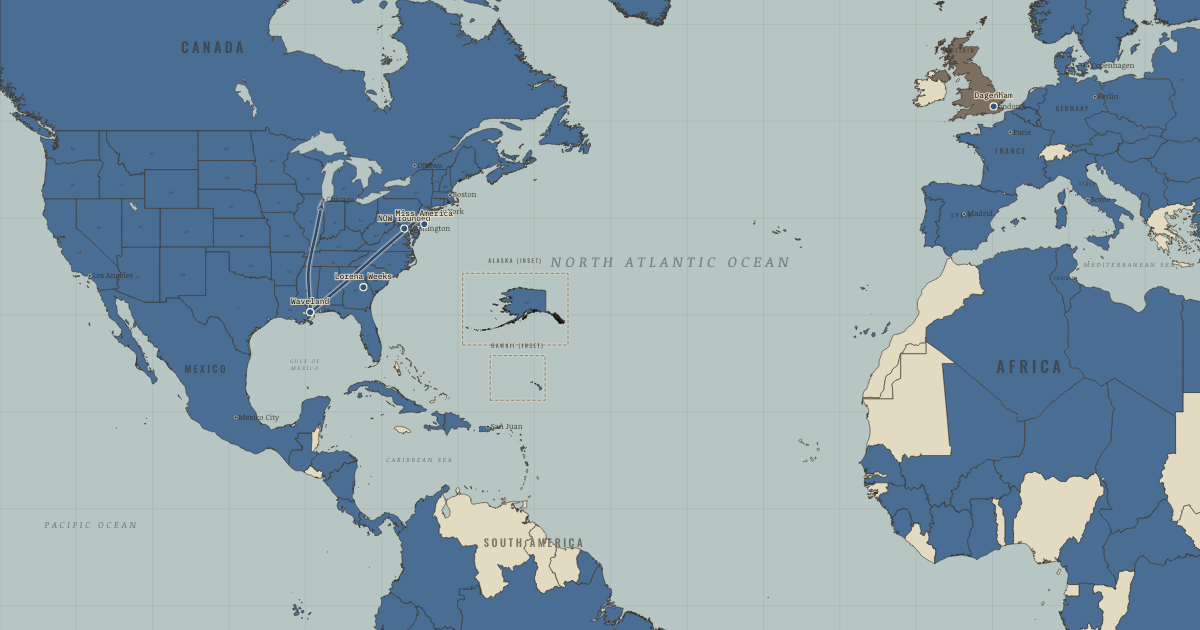
Title VII’s prohibition of sex discrimination began with a contested political maneuver. On 8 February 1964 Howard Smith, a Virginia congressman opposed to the civil-rights bill, proposed adding “sex” to its forbidden grounds of employment discrimination. Smith had long supported the Equal Rights Amendment (ERA), a proposed constitutional guarantee of equal rights regardless of sex, and historians still debate his motives. Martha Griffiths and other congresswomen seized the opportunity, and the amendment passed.
The short answer
- A civil-rights law with a sex clause. Once Title VII prohibited sex discrimination, a job advertisement marked “male” or a lower pay scale could be presented as evidence that the law was not being enforced. The sex clause had entered the law almost accidentally, yet it supplied women with a specific legal tool and a demand around which to organize.
- Experienced women with nowhere to take their anger. The state commissions had given hundreds of women experience in law, research and lobbying. At their third national conference in June 1966, they discovered the limits of those bodies: the commissions could pass no resolutions and had no power to press the EEOC. On the last day, women who knew how institutions worked founded NOW so they could act outside them.
- The civil-rights and anti-war movements as schools. Registering voters in Mississippi and organizing against the Vietnam War taught young women to run meetings, write leaflets and confront authority. The same movements exposed them to sexism. SNCC women’s papers in 1964 and 1965 described exclusion from leadership. Women’s liberation drew on their skills, anger and language of oppression, liberation and solidarity. In Britain and France it likewise grew from student and anti-war protests in 1968.
- Women workers who could stop production. The 187 Dagenham machinists made seat covers needed before cars could leave the factory. A strike by this small group could therefore stop one of Britain’s largest plants, giving the women bargaining power of a kind middle-class lobbyists lacked. Their success showed working women across Britain the possibilities of industrial action. Their union, the National Union of Vehicle Builders, backed them and helped turn a grading dispute into a national argument about women’s pay.
THE TURNING POINT
The founding of NOW, 30 June 1966. Books and commissions had supplied ideas and contacts. NOW, founded on 30 June 1966, added a permanent national organization with a program, membership and legal strategy. Within a few years it had chapters across the country, sued employers and petitioned the EEOC; from 1967 it also campaigned for the Equal Rights Amendment and repeal of abortion laws. Its liberal reformism helped define the movement’s mainstream, against which later radical, Black and working-class feminists partly defined themselves.
What it changed
The EEOC is forced to act. NOW’s pressure and thousands of complaints helped push the EEOC to rule in 1968 that sex-segregated job advertisements were illegal. From 1969 courts began striking down “protective” laws that had excluded women from better-paid work. Legal rules shifted within five years, though the pay gap barely moved. A local NOW chapter’s complaint led to the Pittsburgh Press case, in which the Supreme Court upheld a ban on sex-segregated newspaper advertisements in 1973.
A movement split by method and goal. The movement’s branches disagreed about what equality required. Liberals sought access to institutions, radicals wanted to transform marriage, sexuality and culture, and labor feminists pressed for pay, childcare and protection. These differences produced both energy and bitter disputes. NOW fought internally over abortion and lesbian members, whom Friedan called a “lavender menace” in 1969. The argument over representation reflected a movement encompassing many different women.
Equal pay becomes law in Britain. Britain’s Equal Pay Act passed on 29 May 1970 but gave employers five years to remove separate rates for women. It came into force in December 1975 alongside the Sex Discrimination Act. That delay explains Britain’s grey-tan color on the 1970 map. The Dagenham women struck again in 1984 because their work still lacked a skilled grading.
The full answer, argued
Title VII came first. The politics of race, a congressman’s motives and lobbying by veteran feminists produced a federal ban on sex discrimination at work before a mass movement existed. It gave women a tool they could invoke. But the EEOC’s early treatment of the sex clause as a fluke shows why the tool needed users and advocates. NOW, thousands of complaints from working women and cases such as Weeks pressed for enforcement. The movement also changed expectations about women’s lives in ways a statute could not. Law and movement thus depended on each other: Title VII supplied a target and a means of action, while women’s efforts gave its promise practical meaning. A new right can become the starting point for another campaign.
An interesting fact
Long before the Dagenham strike, the European Economic Community’s founding treaty of 1957 had included an equal-pay principle. Article 119 required member states to ensure equal pay for equal work. France had insisted on the clause partly because French law already required equal pay and its industries feared cheaper female labor elsewhere would undercut them. The provision remained largely unenforced until Belgian air hostess Gabrielle Defrenne sued Sabena, which had forced her to retire at 40 while male stewards continued flying. In 1976 the European Court of Justice ruled that Article 119 gave individuals rights enforceable in national courts.
This is the study layer of Title VII and the founding of NOW, chapter 2 of Protest and Change: Second-Wave Feminism and Tunisia, 1945–2015; the full index of the atlas is here.
Related questions
THE FREE PRINTABLE STUDY GUIDE
Get the printable study guide for Protest and Change free. I’ll send you a few short letters, then one when a new atlas opens. That’s all. — Paul
NO TRACKING · YOUR ADDRESS IS USED FOR THE DISPATCH AND NOTHING ELSE · UNSUBSCRIBE ANYTIME