Feminism and the Tunisian Revolution · 1963
Did The Feminine Mystique cause second-wave feminism?
The seminar question: “Was The Feminine Mystique a cause of second-wave feminism, or a symptom of changes that were already under way?”
By 1945 women in the United States, Britain and France could vote, yet the law still treated them as second-class citizens: in 1961 three Southern states barred women from juries. Married women entered paid work in growing numbers while the suburban homemaker became the ideal, and The Feminine Mystique appeared in February 1963.
WW2 is free in full, and chapter 1 of every atlas is free. A free account opens 3 more chapters a day. Starter, at $9 a month, opens all 21 with no daily limit — see the plans.
Free printable Feminism and the Tunisian Revolution study guide, sent by email ↓
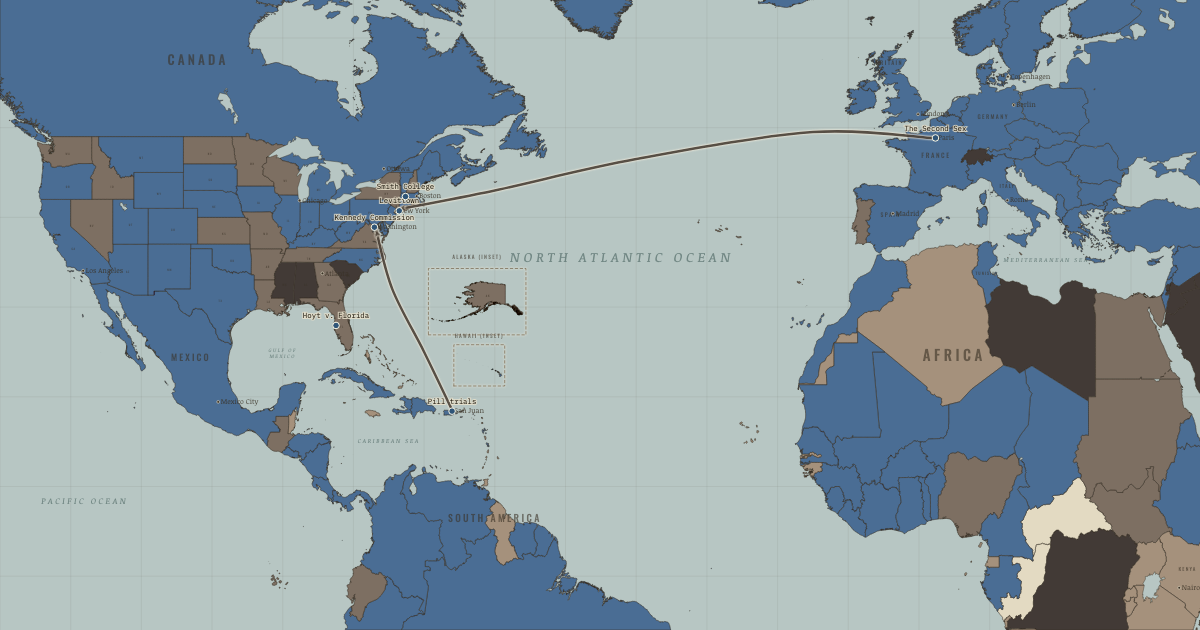
In 1957 Gwendolyn Hoyt struck her husband with a baseball bat during a quarrel in Tampa, Florida. He died, and an all-male jury convicted her of murder. Florida placed women on jury lists only if they registered to serve. Few did so, and the Supreme Court upheld the arrangement in Hoyt v. Florida (1961). Woman, the Court reasoned, was “still regarded as the center of home and family life.”
The short answer
- The vote without equality. The Nineteenth Amendment secured women’s vote in 1920, but the expectation that political power would bring legal equality was left unfulfilled. Older rules survived: in some states married women needed a court’s or a husband’s permission to run a business or manage property, jury rules excluded women, and pay scales openly assigned them lower rates. These everyday restrictions supplied grievances for a movement that would look beyond the ballot.
- A contradiction inside the suburban ideal. Offices, shops and services were expanding and needed women’s labor. By 1960 about a third of married women had paid jobs, usually low-paid work segregated by sex. Yet magazines, advertising and television celebrated the full-time homemaker and presented domesticity as women’s natural destiny. Women who encountered both expectations could see the distance between the ideal and the conditions in which they worked.
- Education without outlets. College offered more women an education, but graduates were widely expected to marry, leave work and devote themselves to family. Friedan’s Smith classmates had studied economics, literature and science; many were now running suburban households. Their education shaped their expectations and gave them skills and social confidence to recognize discrimination, write, organize and lobby. The movement’s first leaders came disproportionately from this group.
- Ideas that crossed the Atlantic. Why might inequality survive the vote? Beauvoir’s account of women as “the Other”, defined in relation to men, suggested an answer in institutions and upbringing. The Vatican condemned her book, but an abridged English translation reached American and British readers from 1953. Her argument gave feminists a way to understand inequality as socially constructed and therefore open to political change.
THE TURNING POINT
The Feminine Mystique, 19 February 1963. A 1957 questionnaire for Friedan’s Smith College reunion began an inquiry that grew through five years of interviews. Her book appeared on 19 February 1963 and sold more than a million copies within a few years; thousands wrote to her saying they had thought themselves alone. The Commission and Equal Pay Act were already under way. Friedan gave readers who might never attend a conference a way to recognize their disappointments as shared, and so to discuss and organize around them.
What it changed
A language for consciousness-raising. Women in the small “consciousness-raising” groups of the late 1960s compared experiences and found political roots in personal problems. Friedan’s account had helped make that connection available: “the problem that has no name” entered the language, and housework, marriage and ambition became subjects for public discussion.
A network ready to act. State commissions had brought together hundreds of experienced women from law, unions, universities and government. At their Washington meeting in June 1966, they could not pass a resolution urging enforcement of Title VII of the Civil Rights Act of 1964, the new law against sex discrimination at work. Some participants founded the National Organization for Women on the spot. The connections made through the commissions now supported an independent organization.
Equal pay in law, unequal pay in fact. The Equal Pay Act addressed unequal pay for the same job, while leaving the division of jobs by sex untouched. Most jobs in 1963 were segregated in that way, and women’s earnings stayed at about 60 percent of men’s for the next fifteen years. Activists pursued strikes and lawsuits and pressed for enforcement of Title VII of the Civil Rights Act of 1964, which banned sex discrimination in hiring and promotion.
A movement defined by one group of women. The early texts centered educated, married, middle-class women, and their concerns with careers, professional schools and escape from home shaped the agenda. Women who had always worked, or who faced racism, poverty or forced sterilization, could find their own problems missing. Their differing experiences would become a deep argument within the movement over whom its demands should serve.
The full answer, argued
The book appeared amid changes already in progress. Married women were entering paid work in large numbers, the Pill was on sale, Kennedy’s Commission was gathering evidence, and the Equal Pay Act passed four months after publication. Meyerowitz and Horowitz show, too, that Friedan described one group and drew on a decade of earlier writing about women and work. In these respects her book was a symptom of conditions that preceded it. But conditions alone do not explain how people come to act together. The flood of letters suggests that Friedan gave readers who might never join a commission a way to recognize their troubles as common and political. The book was a catalyst: it acted on pressures already present. Structural change can make protest possible; naming a grievance, whether by a writer, a martyr or an event, often helps turn that possibility into mobilization.
An interesting fact
Howard Parshley, who translated The Second Sex into English in 1953, was a zoology professor at Smith College, where Friedan surveyed graduates in 1957. Knopf hired him, reportedly expecting a scientific study of sex. He cut between a tenth and a sixth of the text, and scholars later criticized his rendering of several philosophical terms. English readers encountered the book that launched a generation of feminism in this abridged form for more than fifty years. Constance Borde and Sheila Malovany-Chevallier produced a complete translation in 2009.
This is the study layer of Origins of second-wave feminism, chapter 1 of Protest and Change: Second-Wave Feminism and Tunisia, 1945–2015; the full index of the atlas is here.
Related questions
THE FREE PRINTABLE STUDY GUIDE
Get the printable study guide for Protest and Change free. I’ll send you a few short letters, then one when a new atlas opens. That’s all. — Paul
NO TRACKING · YOUR ADDRESS IS USED FOR THE DISPATCH AND NOTHING ELSE · UNSUBSCRIBE ANYTIME