Feminism and the Tunisian Revolution · 1977
Did second-wave feminism leave out women of colour?
The seminar question: “Were Black, Chicana and working-class women “left out” of second-wave feminism, or did they build a different feminism of their own?”
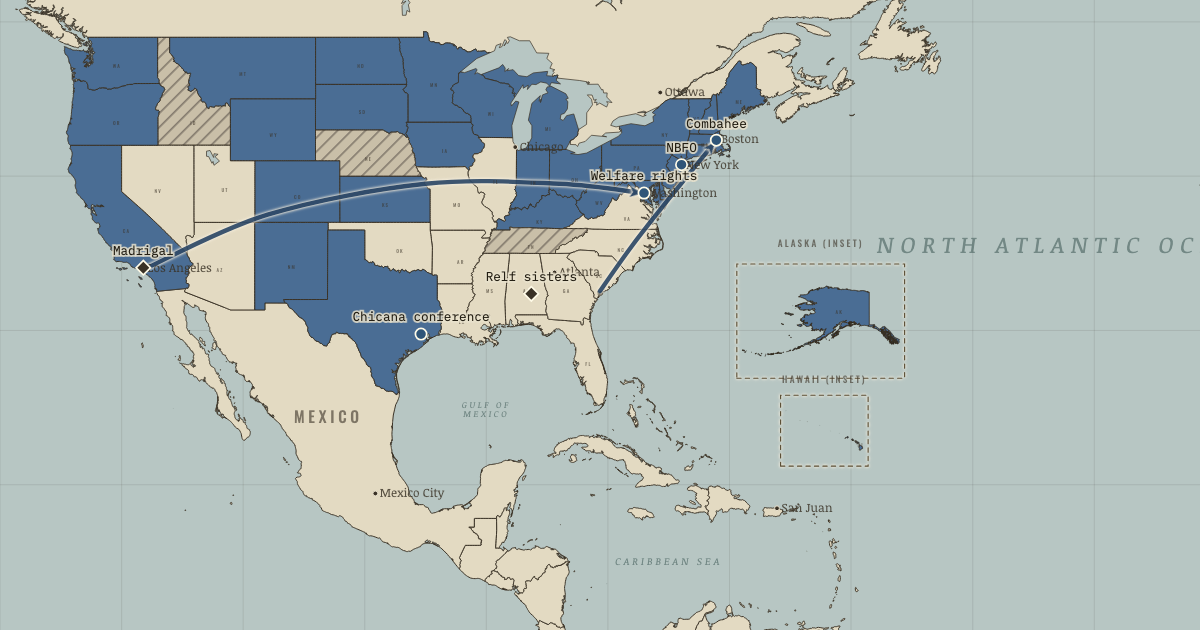
The largest feminist organisations reflected the priorities of mostly white, middle-class leaders. Black women, Chicanas, women on welfare and lesbians built their own groups, among them the National Black Feminist Organization (1973) and Boston’s Combahee River Collective, whose April 1977 statement linked race, sex and class.
Chapter 4 is included with every paid plan. WW2 is free in full, and chapter 1 of every atlas is free. A free account opens 3 more chapters a day. Starter, at $9 a month, opens all 21 with no daily limit — see the plans.
Free printable Feminism and the Tunisian Revolution study guide, sent by email ↓
Frances Beal asked feminists to look at the lives behind their general claims about women. A veteran of the student civil-rights group SNCC, she argued in her 1969 essay “Double Jeopardy” that Black women faced racism and sexism together. Housework might be described as a prison for women confined to their own homes. That description left out Black women who had long cleaned other people's houses for wages.
The short answer
- A movement built in the image of its founders. The second wave's early texts and organizations grew from the experience of educated white women: suburban isolation, exclusion from professions and unwanted pregnancy. Other experiences received less attention. Friedan's book, for example, said almost nothing about the millions of women already working for wages; women facing racism, poverty or coerced sterilization also found their concerns missing. A movement must hear such experiences before it can make them part of its agenda.
- The pull of other loyalties. Many Black and Chicana women participated in civil-rights, Black Power and Chicano movements. Leaders of both sexes in those movements often called feminism a white middle-class luxury that would divide their communities. Women could face pressure both when joining white-led groups and when organizing as feminists within their own movements. Many also feared that criticizing Black or Chicano men publicly would give ammunition to racists who already depicted their communities as disordered. Separate groups gave them another place to pursue their concerns.
- The same issue meant different things. The same demand could mean different things in different lives. Mainstream feminists made abortion central to reproductive rights because unwanted pregnancy was the principal risk their leaders faced. Poor women of color also faced doctors and welfare officials who wanted them to have fewer children. Paid work might promise a suburban housewife freedom while bringing hardship to a domestic worker. Treating one experience as universal could conceal the needs of another group.
- Exclusion inside the organisations. The problem appeared inside organizations as well as in their agendas. Lesbians were pushed to NOW's margins in 1969 and 1970, while women of color reported being ignored or treated as tokens at meetings and marches. Many concluded that reform from within was impossible and built autonomous organizations led by those most affected. Aileen Hernandez, elected NOW's first Black president in 1970, later left, criticizing its failure to address minority women's concerns.
THE TURNING POINT
The Combahee River Collective Statement, April 1977. In April 1977 Barbara Smith, Beverly Smith and Demita Frazier gave the Combahee River Collective's grievances a lasting formulation. Race, sex, class and sexuality, they argued, were interlocking oppressions; fighting them separately could leave the same women exposed to the others. They rooted their politics in their identity as Black women, in the first known use of “identity politics”. Their claim that freedom for the most oppressed would require freedom for everyone reversed the mainstream's logic of starting with the most privileged. The collective was tiny and ended in 1980, but its ideas became a basis of intersectional feminism.
What it changed
From reproductive rights to reproductive justice. The Committee to End Sterilization Abuse and other groups pressed for safeguards against coercion. Federal rules in 1978 required a 30-day waiting period and consent in the patient's language, and banned sterilizing people under 21. In 1994 Black women activists coined “reproductive justice” for an account descended from the 1970s arguments: the rights to have children, not to have them, and to raise them safely.
Houston, 1977: inclusion in the official agenda. The federally funded National Women's Conference in Houston in November 1977 adopted a “minority women” plank drafted by Black, Latina, Asian American and Native American women. Coretta Scott King was among its champions. The gathering was the most diverse in the movement's history; conservative women also organized a counter-rally, defining the backlash taken up in the next chapter.
A literature that changed feminist theory. The criticism developed by women at the margins entered feminist thought through writing. Audre Lorde, bell hooks, Cherríe Moraga and Gloria Anzaldúa helped make the critique of white feminism central to it; Moraga and Anzaldúa's anthology This Bridge Called My Back appeared in 1981. In 1989 Kimberlé Crenshaw gave the concept the name “intersectionality,” which spread worldwide. The writers' essays became among the movement's most widely taught texts.
Fragile institutions. The organizations themselves had brief lives. The NWRO went bankrupt in 1975, the NBFO dissolved by the late 1970s and Combahee ended in 1980. They were small and poorly funded, and practical demands such as adequate income for mothers were largely defeated, culminating in welfare cuts in the 1990s. Their ideas nonetheless continued through books and later movements, giving them an influence that outlasted their institutions.
The full answer, argued
The answer changes with what we mean by the movement. In the national organizations and legal campaigns that dominated the press, these women were largely excluded from power. NOW and the mainstream offered welfare rights little support, ignored coerced sterilization until activists forced the issue, and treated lesbians and women of color as embarrassments or tokens. But the Third World Women's Alliance, the 1971 Chicana conference, the NWRO and Combahee show women building organizations and developing theory themselves. They also won changes, including the 1978 sterilization rules. Historians such as Thompson and Roth therefore describe second-wave feminism as plural: the picture of one movement reflects choices made by those who wrote its history. These women could be excluded from mainstream power and still be central to feminism's ideas.
An interesting fact
The name Combahee River Collective recalled an American Civil War operation. On the night of 1–2 June 1863 Harriet Tubman, who had escaped slavery and was working as a Union army scout, guided Union steamboats up the Combahee River in South Carolina. The raid destroyed plantations and freed more than 700 enslaved people, who ran to the boats as the steam whistles sounded. Tubman is widely credited as the first woman to lead an armed military operation in American history. More than a century later, the Boston collective chose the name to place its politics in a long tradition of Black women's collective action.
This is the study layer of Black and Chicana feminism, chapter 4 of Protest and Change: Second-Wave Feminism and Tunisia, 1945–2015; the full index of the atlas is here.
Related questions
THE FREE PRINTABLE STUDY GUIDE
Get the printable study guide for Protest and Change free. I’ll send you a few short letters, then one when a new atlas opens. That’s all. — Paul
NO TRACKING · YOUR ADDRESS IS USED FOR THE DISPATCH AND NOTHING ELSE · UNSUBSCRIBE ANYTIME