Feminism and the Tunisian Revolution · 1972
Was consciousness-raising politics or therapy?
The seminar question: “Was consciousness-raising a political method, or a form of therapy that distracted women from politics?”
Second-wave feminists argued that problems women experienced as private, in marriage, housework and pregnancy, were produced by social power. Consciousness-raising groups spread through the United States, Britain and France between 1968 and 1972, and the campaign to repeal abortion laws led to Roe v. Wade on 22 January 1973.
Chapter 3 is included with every paid plan. WW2 is free in full, and chapter 1 of every atlas is free. A free account opens 3 more chapters a day. Starter, at $9 a month, opens all 21 with no daily limit — see the plans.
Free printable Feminism and the Tunisian Revolution study guide, sent by email ↓
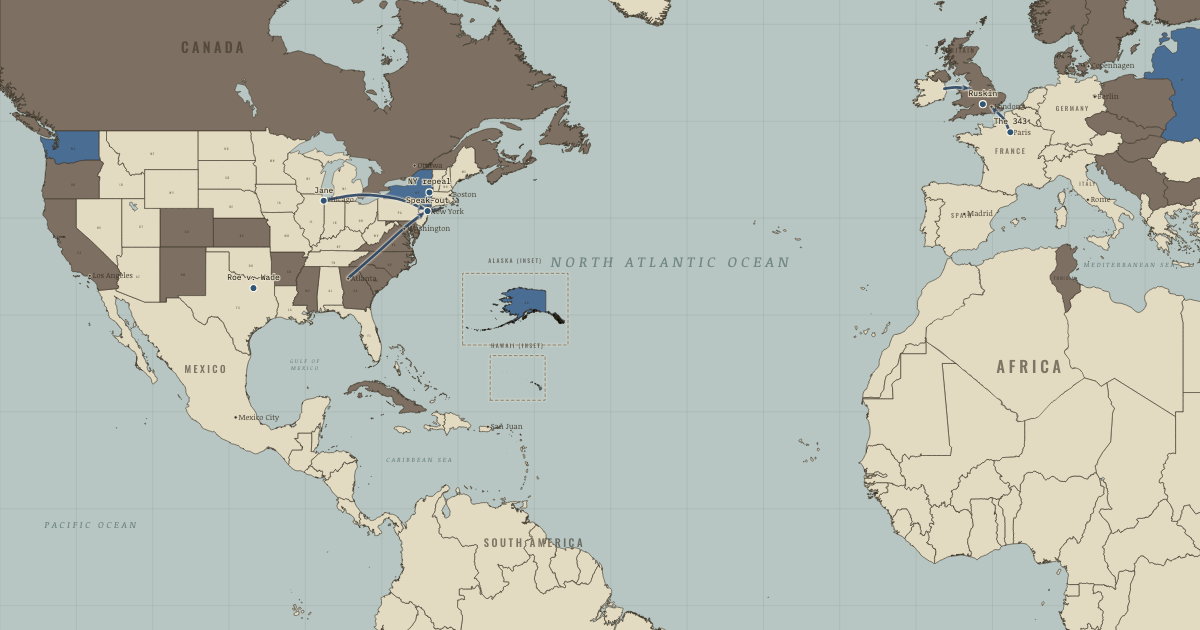
In 1968 Kathie Sarachild of New York Radical Women described a way for women to investigate their own lives. A small group would take one question at a time—about mothers, jobs or first sexual experiences—and compare the answers. One woman's account might sound like a private complaint. Several accounts together could reveal a pattern that none had been able to see alone.
The short answer
- A method that turned experience into evidence. Consciousness-raising gave women a way to compare housework, sexual coercion and other experiences that each might have taken as a personal problem. Repeated patterns invited a further question: what institutions and laws sustained them? The answer could turn private sorrow into a political grievance. Groups were inexpensive, needed no leaders and could be copied anywhere, allowing the method to spread faster than an organization could recruit. Discovering common experiences also gave women confidence to speak for others, a precondition for public protest.
- An injustice that fell hardest on the poor. Money affected both the choices available under the old law and the dangers women faced. A wealthier woman might travel abroad, pay a sympathetic doctor or persuade a hospital committee to approve a “therapeutic” abortion. Most poor women lacked those options. Wards treating septic abortion filled with poor women, and Black and Puerto Rican women bore a disproportionate share of maternal deaths. The inequality made repeal a question of fairness as well as abortion, drawing support beyond the women's movement.
- Doctors, lawyers and clergy changed sides. Some professionals who had encountered the consequences of criminal abortion became allies of reform. From the early 1960s the American Law Institute, an influential body of lawyers, proposed permitting abortion on limited medical grounds; many doctors supported reform after seeing the results of illegal procedures. In 1967 Protestant and Jewish clergy in New York began referring women to safe providers. These allies could draft legislation and testify with professional authority, giving reform a hearing among legislators unlikely to listen to radical feminists.
- Public confession as a weapon. Speak-outs, manifestos and courtroom protests made concealed acts visible and collective. When respected figures including Beauvoir and Catherine Deneuve admitted breaking the law, prosecutors faced the prospect of enforcing it against them or acknowledging its unenforceability. Gay liberation's contemporary call to “come out” used a related tactic; decades later, #MeToo testimonies appeared online. Public disclosure could weaken a law whose operation depended on people keeping quiet.
THE TURNING POINT
Roe v. Wade, 22 January 1973. Norma McCorvey could not afford to travel to a state where abortion was legal. In 1970 two young lawyers, Sarah Weddington and Linda Coffee, filed a case on her behalf in Dallas. The Supreme Court's decision on 22 January 1973 made Roe a turning point: instead of waiting for separate state campaigns, women in the parchment and grey-tan states gained protection under a national right. The Court grounded that protection in privacy, without requiring government to provide care. That distinction shaped almost fifty years of conflict, until the Court overturned the ruling in 2022.
What it changed
A national right and a national opposition. The national right recognized in 1973 was accompanied by a national campaign to reverse it. Catholic organizations and, from the late 1970s, evangelical Protestants made abortion opposition central to a new conservative politics, alongside resistance to the Equal Rights Amendment. The issue remained among the most divisive in American politics for half a century.
Rights without access. The Court protected a woman's decision from state interference; it did not require the state to finance care. The Hyde Amendment of 1976 stopped Medicaid, public health insurance for people on low incomes, from paying for most abortions. Poor women retained the right but increasingly could not afford to use it. Feminists of color argued that a movement centered on “choice” had neglected the material conditions and abuses, including forced sterilization, that shaped their reproductive lives.
Europe follows a similar path. France's health minister Simone Veil carried the January 1975 law through parliament despite fierce hostility in her own majority; it legalized abortion in the first ten weeks. Italy followed in 1978 after a long campaign of civil disobedience. Confession, trial and reform thus shaped change in Western Europe, although Ireland and Northern Ireland held out for decades. Public confession could change law only where religious authority no longer dominated politics.
The full answer, argued
Some socialist feminists and many men on the left regarded talk about personal experience as self-absorbed. For them, real politics meant organizing workers or opposing the Vietnam War. Yet the groups did more than offer consolation. They developed an account of shared power that could guide action: the Redstockings speak-out grew from consciousness-raising, and the move from private experience to public claim also drove the Manifesto of the 343 and the Bobigny trial, both of which helped change national laws. The method reached women who might never have joined a party or union. Its evidence had limits, however. Groups were often homogeneous, mostly white and middle-class, and could miss experiences absent from the room. Consciousness-raising was a political method; what it revealed depended on whose lives were included.
An interesting fact
The Manifesto of the 343 acquired an enduring name from an insult. A week after it appeared, the satirical weekly Charlie Hebdo asked on its cover: “Who got the 343 sluts from the abortion manifesto pregnant?” A cartoon showed defense minister Michel Debré, a champion of a higher birth rate, replying “It was for France!” The phrase “the 343 sluts” (les 343 salopes) stuck. Some signatories later wore it as a badge of defiance; others rejected it. The women targeted included admired French figures: novelists Marguerite Duras and Françoise Sagan, actresses Catherine Deneuve and Jeanne Moreau, filmmaker Agnès Varda and lawyer Gisèle Halimi, who defended the Bobigny accused the following year.
This is the study layer of The personal is political, chapter 3 of Protest and Change: Second-Wave Feminism and Tunisia, 1945–2015; the full index of the atlas is here.
Related questions
THE FREE PRINTABLE STUDY GUIDE
Get the printable study guide for Protest and Change free. I’ll send you a few short letters, then one when a new atlas opens. That’s all. — Paul
NO TRACKING · YOUR ADDRESS IS USED FOR THE DISPATCH AND NOTHING ELSE · UNSUBSCRIBE ANYTIME