Feminism and the Tunisian Revolution · 2014
Did civil society or parties build Tunisia’s democracy?
The seminar question: “How far was Tunisia’s democratic transition the achievement of civil society rather than of political parties?”
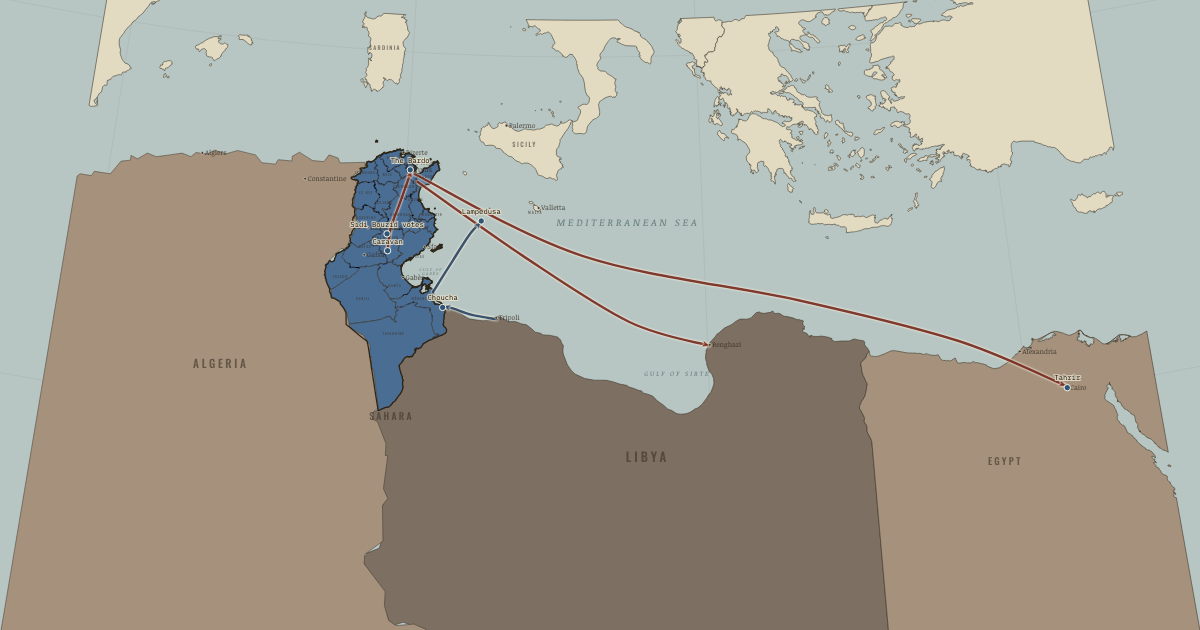
After Ben Ali fled, sit-ins in the Kasbah forced the old ruling party out, and on 23 October 2011 Ennahda won 89 of 217 seats in the Constituent Assembly elections. It governed in coalition with two secular parties, and after a crisis at the Bardo from July 2013 Tunisia adopted a democratic constitution in January 2014.
Chapter 10 is included with every paid plan. WW2 is free in full, and chapter 1 of every atlas is free. A free account opens 3 more chapters a day. Starter, at $9 a month, opens all 21 with no daily limit — see the plans.
Free printable Feminism and the Tunisian Revolution study guide, sent by email ↓
Ben Ali’s prime minister, Mohamed Ghannouchi, led the first interim government after the president fled. Ministers of the old ruling party, the RCD, remained in office. For people who had risked their lives against that government, a change at the top left too much of the old order in place.
The short answer
- Pressure from the streets did not stop. The departure of the dictator did not end the protests. Young people from the interior towns that began the revolt joined trade unionists and students in occupying squares during the Kasbah sit-ins. They stayed until old ruling-party ministers resigned and a constituent assembly was promised. Their pressure prevented the old elite from managing a merely cosmetic change, as happened in several other Arab countries in 2011.
- A union with national reach. The UGTT survived Bourguiba and Ben Ali as the only mass organization not wholly controlled by the regime. It had branches in every governorate and members in every profession. Its leadership had been compromised under Ben Ali, but siding with protesters in January 2011 rebuilt credibility. The union could call strikes and threaten the government, yet it could also negotiate. Those resources made it a natural convener of the National Dialogue.
- An Islamist party that chose compromise. Ennahda’s leaders had experienced twenty years of persecution and knew the party could be crushed again. They accepted the Personal Status Code and dropped demands to cite Islamic law as a source of legislation. In 2014 they handed power to technocrats and accepted electoral defeat. Conviction, internal divisions and fear after Egypt’s example shaped these choices; the settlement depended on them.
- Fear of the Egyptian outcome. Egypt’s army overthrew elected president Mohamed Morsi on 3 July 2013, and hundreds of his supporters were killed in August. Both Tunisian camps watched. Secular opponents of Ennahda could see that a military solution might destroy democracy, while Ennahda could see what might happen to an Islamist party unwilling to bend.
THE TURNING POINT
The Bardo: from crisis to constitution, July 2013 – January 2014. After Brahmi’s assassination, an elected Islamist government faced a mass movement demanding its departure. Politicians on both sides could escalate; Egypt had faced a similar confrontation only weeks earlier. The National Dialogue instead brought Tunisian rivals into negotiations with deadlines. On 26 January 2014 the Assembly at the Bardo adopted a constitution both camps could accept. Future election losers would have rules to appeal to, giving the transition a practical foundation.
What it changed
A democratic constitution. The 2014 constitution created a parliamentary system with a directly elected president. It guaranteed civil liberties, equality between women and men and parity in elected assemblies, and promised to favor poorer regions. Free legislative and presidential elections followed late that year. For most of the following decade Freedom House rated Tunisia the only “free” Arab country. The required constitutional court was never created, however, later leaving a president able to interpret the constitution alone.
The old elite returns by election. A new election could return familiar people to power. Nidaa Tounes (“Call of Tunisia”), the secular party founded in 2012 by 85-year-old Béji Caïd Essebsi, a former minister under Bourguiba, won 86 seats in October 2014 to Ennahda’s 69. Essebsi became president in December. Many revolutionaries concluded that political rules had changed while many of the same people remained in charge.
A region that went the other way. Tunisia’s neighbors followed different paths. Egypt returned to military rule in 2013, Libya had fragmented into rival governments and militias by 2014, and Syria descended into civil war. Libya’s collapse brought weapons, training camps and jihadist recruitment to Tunisia’s border. Foreign governments and donors invested heavily in Tunisia as evidence that democracy was possible in the region.
Women’s rights defended from below. Women’s campaigns against the “complementarity” clause and for parity showed them organizing freely on a mass scale for the first time. Women held about a third of the seats in the parliament elected in 2014. Their associations continued to win laws, including a comprehensive law against violence against women in 2017. Rights first granted from above could be defended and extended from below.
The full answer, argued
Civil society consists of unions, associations and professional bodies between citizens and the state. Its contribution was decisive at two moments. In early 2011 young protesters and trade unionists forced the old ruling party out of government and won a constituent assembly. In 2013 the Quartet of the UGTT, employers, Human Rights League and lawyers turned a confrontation resembling Egypt’s into negotiation. The Nobel Committee later recognized that work. The mediators could set deadlines and bring rivals together, but they could not make the parties’ decisions for them. Ennahda agreed to hand over power and drop contested clauses; secular leaders such as Essebsi agreed to share the state with Islamists; Assembly deputies wrote and passed the constitution. Stepan stresses long negotiations between party leaders, while other historians emphasize the union’s distinctive weight. Civil society created conditions for compromise, and the parties made the compromises. Neither could have succeeded alone. Organizations between state and parties can apply pressure without seeking power themselves, a capacity on which democratic transitions usually depend.
An interesting fact
The 2011 Constituent Assembly included eighteen members elected by Tunisians abroad, from six overseas constituencies. Ten seats represented the large community in France; others covered Italy, Germany, the Americas and the rest of Europe, and the Arab world. Polling stations opened from Paris to Montreal days before the vote at home. People who had left because of unemployment or repression could therefore help choose the writers of Tunisia’s constitution. Some deputies they elected had themselves spent decades in exile, sentenced in absentia by the regime that had just fallen.
This is the study layer of Tunisia’s transition to democracy, chapter 10 of Protest and Change: Second-Wave Feminism and Tunisia, 1945–2015; the full index of the atlas is here.
Related questions
THE FREE PRINTABLE STUDY GUIDE
Get the printable study guide for Protest and Change free. I’ll send you a few short letters, then one when a new atlas opens. That’s all. — Paul
NO TRACKING · YOUR ADDRESS IS USED FOR THE DISPATCH AND NOTHING ELSE · UNSUBSCRIBE ANYTIME