Libya as it appears in 13 interactive history atlases, from 264 BC to 2015: Cyrenaica & Tripolitania, Barqa & Tripolitania, Libya. Each era below lists who ruled the land and when control changed, linked to the dated map that shows it.
What was Libya before it was Libya? The sections below follow this
land through every era covered by the Maps of History atlases: who ruled it, what it was
called, and when control changed. Each line links to the dated map. Modern borders serve
as an approximation, as each atlas says on the map itself.
Cyrenaica & Tripolitania (mod. Libya) · Ancient Rome
Cyrenaica was a Greek pentapolis bequeathed to Rome in 96 BC; neighboring Tripolitania had Punic ports that supplied olive oil. Lepcis Magna was the birthplace of Septimius Severus, founder of the Severan dynasty. The division of imperial administration in 395 placed Tripolitania in the West and Cyrenaica in the East. Tripolitania later came under Vandal control, while Cyrenaica remained linked to Constantinople.
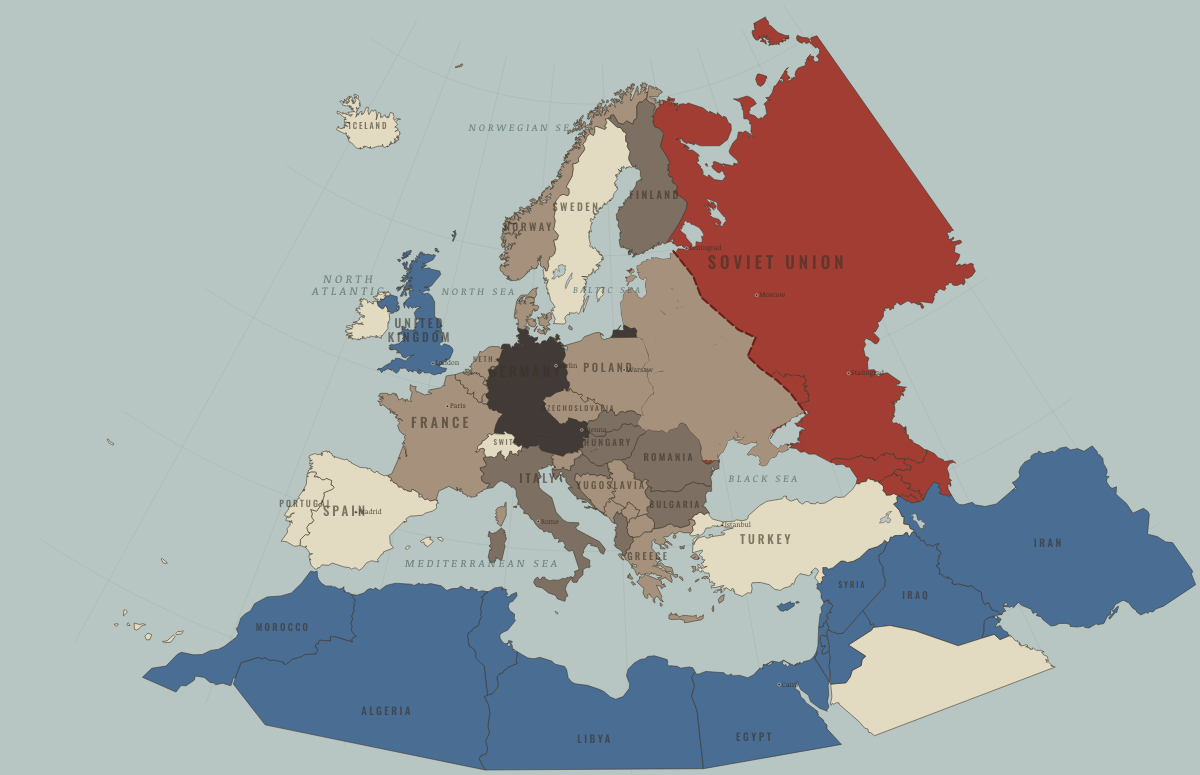
Tripolitania and Cyrenaica were Ottoman provinces until Italy invaded Libya in 1911 (Ch. 2). The war showed the Balkan states how weak the Ottomans had become and saw the first bombs ever dropped from an aeroplane in combat. Italy held the coast, but the Sanusi brotherhood and Ottoman officers, including a young Mustafa Kemal, continued fighting inland. Libyan resistance lasted until 1931.
Germany and its allies — the Central Powers — the opening position
Libya’s independence began with a vote. The former Italian colony became the first African state to reach independence on 24 December 1951, after the United Nations could not agree who else should hold it. Under Idris it was a poor desert kingdom, until oil transformed it. In 1969 a young officer named Gaddafi seized power. Independence by international committee made Libya an exception at the start of the story.
Portuguese, Belgian, Spanish & Italian-ruled — the opening position
A month after Tunisia, Libya rose on 17 February 2011. NATO intervened in the ensuing civil war; Muammar Gaddafi’s regime fell in August, and he was killed in October. Hundreds of thousands of people fled into Tunisia during 2011. By 2014 rival governments and militias divided Libya, and Islamic State camps near Sabratha trained Tunisian recruits.
Authoritarian, one-party or colonial rule — the opening position
Refused: women excluded; ERA never ratified
Right won in law
No reform yet / outside this story
No reform yet / outside this story
Authoritarian, one-party or colonial rule
In revolt: protest, uprising, civil war
Partial or unequal; treaty signed only; transition