15 ATLASES
History of Hungary in maps
Hungary as it appears in 15 interactive history atlases, from 264 BC to 2015: Pannonia, the Kingdom of Hungary, Kingdom of Hungary, Hungary, Austria-Hungary. Each era below lists who ruled the land and when control changed, linked to the dated map that shows it.
WW2 is free — every chapter. No sign-up.
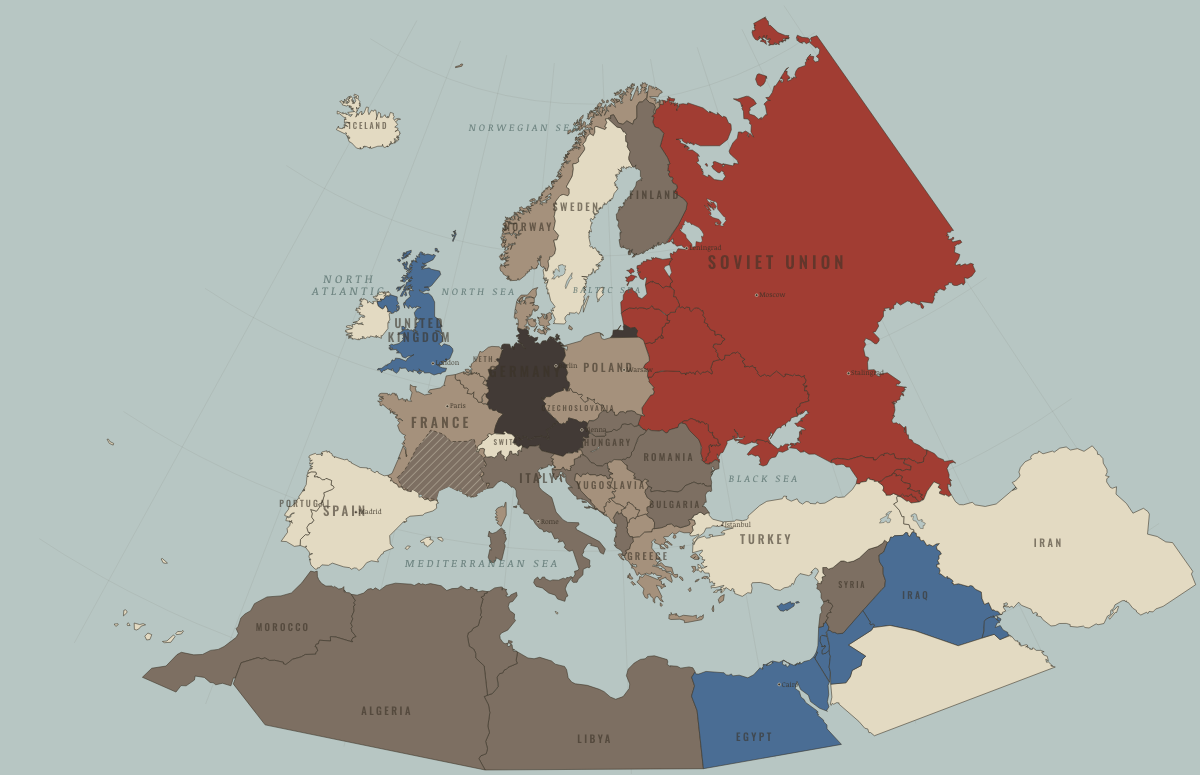
What was Hungary before it was Hungary? The sections below follow this land through every era covered by the Maps of History atlases: who ruled it, what it was called, and when control changed. Each line links to the dated map. Modern borders serve as an approximation, as each atlas says on the map itself.
Pannonia (mod. Hungary) · Ancient Rome
Pannonia came under Roman rule under Augustus, whose hold was tested by the great provincial revolt of AD 6–9. The region then served as a legionary heartland for centuries. Territory ceded to the Huns in the 430s became part of Attila’s power base, shown by the dashed sphere on the 451 map. After his death, other peoples used the region as a staging ground toward Italy.
| 264 BC | Tribal peoples & confederations — the opening position |
| Roman territory | |
| Tribal peoples & confederations |
ANCIENT ROME: EVERY CHAPTER AND MAP →
Hungary · Norse and Aztecs
| Other peoples and states — the opening position |
NORSE AND AZTECS: EVERY CHAPTER AND MAP →
The Kingdom of Hungary · Crusades
The Catholic Kingdom of Hungary guarded the land route east, where armed pilgrims could be guests or a danger. In 1096 King Coloman provisioned the disciplined princely armies but destroyed plundering bands of the People’s Crusade at his frontier. Béla III feasted Barbarossa’s vast host as it passed through in 1189. Andrew II led a listless Fifth Crusade contingent to Acre in 1217–18 and returned with relics rather than victories. Hungary’s own catastrophe came from the steppe: the Mongols annihilated its army at Muhi in 1241 and burned half the kingdom. The crusaders’ century was also Eurasia’s.
| Latin Christendom — the opening position |
CRUSADES: EVERY CHAPTER AND MAP →
Kingdom of Hungary · Mongol Empire
King Béla IV sheltered 40,000 fleeing Qipchaq tents, and Batu cited this as a cause for invasion. The royal army was destroyed at Mohi on 11 April 1241; perhaps a fifth of the kingdom died during the year of occupation that followed. Then the Mongols withdrew, relinquishing the only conquest on this map ever given back. Béla rebuilt Hungary in stone, and his castle program measurably blunted the Horde’s return in 1285.
| Other settled powers (Jin China, Christendom, Delhi) — the opening position | |
| The Mongol Empire | |
| Other settled powers (Jin China, Christendom, Delhi) |
MONGOL EMPIRE: EVERY CHAPTER AND MAP →
Hungary (Habsburg Empire) · Industrial Revolution
| Industrialising — the opening position | |
| Industrialising | |
| Industrialising |
INDUSTRIAL REVOLUTION: EVERY CHAPTER AND MAP →
Hungary · Age of Revolutions
| The conservative monarchies — the opening position |
AGE OF REVOLUTIONS: EVERY CHAPTER AND MAP →
Hungary · Meiji Japan and post-Soviet Russia
Hungary’s communist leaders introduced limited markets after 1968. In 1989 they opened the border with Austria, allowing thousands of East Germans to escape west along the route shown by the arrow. Their decision helped bring down the Berlin Wall. Hungary held free elections in 1990 and joined NATO in 1999.
| Soviet-bloc states — the opening position | |
| Independent neighbours | |
| Western powers and allies |
MEIJI JAPAN AND POST-SOVIET RUSSIA: EVERY CHAPTER AND MAP →
Austria-Hungary (mod. Hungary) · Russian Revolution
| Foreign powers & intervention — the opening position |
RUSSIAN REVOLUTION: EVERY CHAPTER AND MAP →
Hungary (Austria-Hungary) · WWI
Shown here within Austria-Hungary, Hungary was the other half of the Dual Monarchy. The Treaty of Trianon in 1920 left it with a third of its old kingdom and three million Magyars beyond its borders. The loss governed its politics for the century and drove Hungary into the revisionist camp in the next war.
| Germany and its allies — the Central Powers — the opening position | |
| Germany and its allies — the Central Powers | |
| Empires in collapse (1918–22) | |
| Neutral or unaligned | |
| Empires in collapse (1918–22) |
Hungary · Stalin’s Soviet Union
Hungary fought with Germany against the Soviet Union from 1941, and the Red Army occupied it in 1944–45. The communists won only 17 per cent in free elections in November 1945. With Soviet backing and “salami tactics”, they nevertheless took full power by 1948–49. László Rajk’s trial in 1949 followed Tito’s break. Soviet tanks crushed the 1956 revolution against Stalinist rule.
| Nazi Germany & its allies — the opening position | |
| Nazi Germany & its allies | |
| Other states | |
| Satellites & communist allies |
STALIN’S SOVIET UNION: EVERY CHAPTER AND MAP →
Hungary · Road to WW2
| Neutral & unaligned — the opening position | |
| Aggressor clients & partners |
ROAD TO WW2: EVERY CHAPTER AND MAP →
Hungary · WW2
Hungary joined the Axis in the hope of recovering territory lost after Versailles. An army it sent to the Don near Stalingrad perished there. When Hungary sought to leave the war in 1944, Germany occupied it and, with local fascist help, deported 437,000 Jews to Auschwitz in eight weeks. The Red Army’s siege of Budapest ended the war on Hungarian soil.
| Axis allies & puppets — the opening position | |
| Axis allies & puppets | |
| Soviet Union |
Hungary · Cold War
Hungary rose in 1956 and paid heavily for the attempt: some 2,700 died, 200,000 went into exile, and its premier was hanged (Ch. 5). “Goulash communism” followed, buying decades of resigned quiet. In 1989 Hungary opened its Austrian border to East Germans. By cutting the first hole in the curtain, it showed how much the wall system depended on every part holding.
| Soviet-aligned states — the opening position | |
| In upheaval / changing sides | |
| Non-aligned & neutral | |
| In upheaval / changing sides | |
| Non-aligned & neutral |
COLD WAR: EVERY CHAPTER AND MAP →
Hungary · Feminism and the Tunisian Revolution
| Partial or unequal; treaty signed only; transition — the opening position | |
| Right won in law | |
| Partial or unequal; treaty signed only; transition | |
| No reform yet / outside this story | |
| Right won in law |
FEMINISM AND THE TUNISIAN REVOLUTION: EVERY CHAPTER AND MAP →
Hungary · Refugee crises
Hungary sent out refugees in two very different episodes. In 1946–48 it deported more than 200,000 Germans, known as Danube Swabians, to occupied Germany, beginning at Budaörs in January 1946. A decade later the crushing of the 1956 revolution drove about 200,000 Hungarians—one in fifty—across the borders to Austria and Yugoslavia. Their rapid resettlement became a model of a generous Western response.
| Soviet-occupied or communist — the opening position | |
| Western bloc or democracy |
REFUGEE CRISES: EVERY CHAPTER AND MAP →
Related
THE FREE PRINTABLE STUDY GUIDE
Get a printable atlas study guide of your choice free. I’ll send you a few short letters, then one when a new atlas opens. That’s all. — Paul
NO TRACKING · YOUR ADDRESS IS USED FOR THE DISPATCH AND NOTHING ELSE · UNSUBSCRIBE ANYTIME