7 ATLASES
History of Hong Kong in maps
Hong Kong as it appears in 7 interactive history atlases, from 1840 to 2000: Hong Kong. Each era below lists who ruled the land and when control changed, linked to the dated map that shows it.
WW2 is free in full, and chapter 1 of every atlas is free. A free account opens 3 more chapters a day. Starter, at $9 a month, opens all 21 with no daily limit — see the plans.
What was Hong Kong before it was Hong Kong? The sections below follow this land through every era covered by the Maps of History atlases: who ruled it, what it was called, and when control changed. Each line links to the dated map. Modern borders serve as an approximation, as each atlas says on the map itself.
Hong Kong · Industrial Revolution
| Colony or dependency — the opening position | |
| Colony or dependency |
INDUSTRIAL REVOLUTION: EVERY CHAPTER AND MAP →
Hong Kong (British from 1842) · Meiji Japan and post-Soviet Russia
Hong Kong island became British under the Treaty of Nanking in 1842, the first blue territory on China’s coast on the Japan map. Kowloon followed in 1860 and the New Territories in 1898. The territory became a model of a treaty-port economy governed under foreign law. Japanese officials studied it to see what might happen to their own ports if Japan lost control over the terms on which it opened them.
| Independent neighbours — the opening position | |
| Western powers and allies |
MEIJI JAPAN AND POST-SOVIET RUSSIA: EVERY CHAPTER AND MAP →
Hong Kong · WWI
Hong Kong (British) · Chinese Revolution
Hong Kong stood at the door of the Chinese revolution. The British colony sheltered exiles throughout the period—Sun Yat-sen was schooled and radicalized there—and held capital fleeing China. It was also the target of the era’s greatest labor action: the Canton–Hong Kong strike and boycott of 1925–26 emptied its docks for sixteen months and showed the National Revolution its strength. Japan took the colony in December 1941; Britain recovered it in 1945 over Chiang’s objection. At the end of the atlas, Hong Kong was an opening between red China and the world, a role it would retain for forty years.
| Foreign empires — British, French, Russian, American — the opening position | |
| The Empire of Japan & its puppets | |
| Foreign empires — British, French, Russian, American |
CHINESE REVOLUTION: EVERY CHAPTER AND MAP →
Hong Kong · Cold War
COLD WAR: EVERY CHAPTER AND MAP →
Hong Kong (British) · Refugee crises
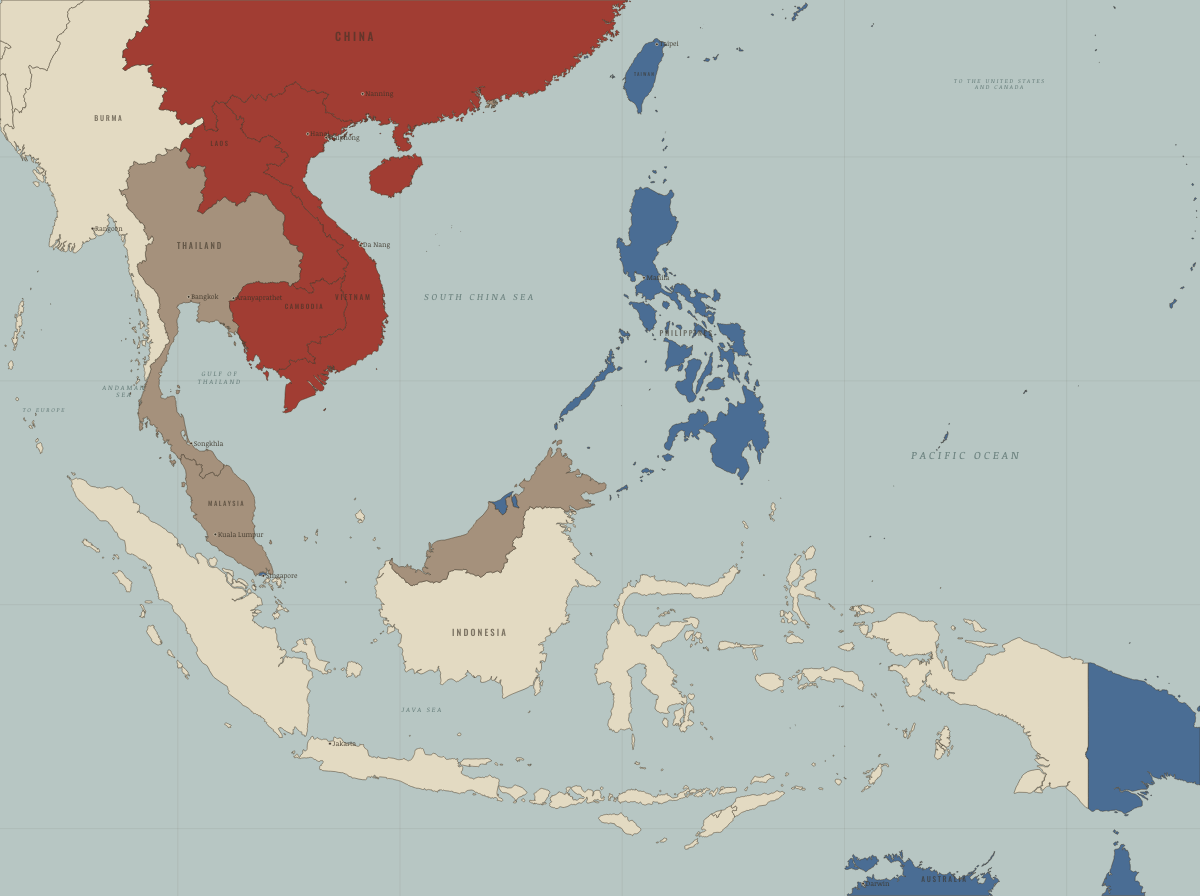
British Hong Kong received the crisis’s first boat people in May 1975. In 1979 alone about 68,700 arrived, many of them Hoa from northern Vietnam. Hong Kong maintained first asylum longer than its neighbors, but detained new arrivals in closed camps from 1982 and began screening in 1988. It forcibly returned 51 people on 12 December 1989. Its last Vietnamese camp, Pillar Point, closed in 2000.
| Western bloc or democracy — the opening position | |
| First asylum open | |
| First asylum restricted | |
| First asylum open | |
| First asylum restricted |
REFUGEE CRISES: EVERY CHAPTER AND MAP →
Hong Kong (British colony) · Mao’s China
Mao left Hong Kong a British colony because he considered it more useful as China’s window on the world and source of foreign currency than as a conquest. Hundreds of thousands of refugees reached it from the mainland. In May 1962 some 60,000 hungry people crossed in a few weeks; most were caught and sent back. The Cultural Revolution spilled into the colony in 1967 in riots and bombings, which the British authorities suppressed.
| Neutral, non-aligned or colonial — the opening position |
MAO’S CHINA: EVERY CHAPTER AND MAP →
Related
THE FREE PRINTABLE STUDY GUIDE
Get a printable atlas study guide of your choice free. I’ll send you a few short letters, then one when a new atlas opens. That’s all. — Paul
NO TRACKING · YOUR ADDRESS IS USED FOR THE DISPATCH AND NOTHING ELSE · UNSUBSCRIBE ANYTIME