MAPS OF HISTORY · THE QUESTIONS · Was the Balkan campaign a fatal distraction…
The War Room — WW2, 1936–1945 · MAY 1941
Was the Balkan campaign a fatal distraction from Barbarossa, or a convenient excuse for its failure?
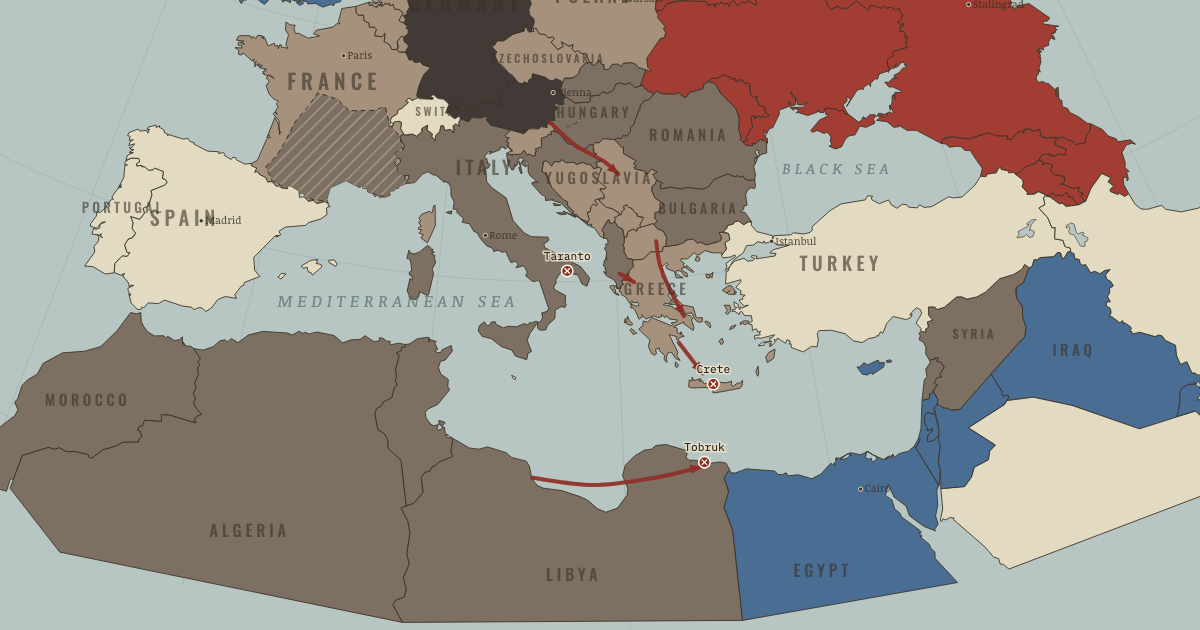
Mussolini wanted victories that owed nothing to Germany, and his regime called this ambition a “parallel war,” in which Italy would build a Mediterranean empire and negotiate as an equal partner. The means never matched the goal. The invasion of Greece launched from Albania was badly supplied and soon thrown back across the border. In North Africa a much larger Italian army was routed by a small British force. At Taranto in November 1940, twenty-one British biplanes flying from an aircraft carrier disabled the Italian battle fleet in harbour, a result that Japanese naval planners studied closely before Pearl Harbor.
THE SHORT ANSWER
- Fascist prestige economics. Mussolini’s regime ran on spectacle. With Hitler devouring Europe, Italy “needed a few thousand dead” to claim a share of the new order — wars chosen for headlines, not strategy, against Greece and a British Empire he assumed was finished.
- Britain’s imperial artery. Suez was the pipe through which India, Persian oil and the Dominions reached the war. Britain would fight for the Mediterranean with everything spare — which is why tiny garrisons like Malta and Tobruk mattered wildly beyond their size.
- A coup in Belgrade. Yugoslavia signed with the Axis; two days later its officers overthrew the government to cheering crowds. Hitler, enraged, ordered the country destroyed — an improvised campaign wedged in weeks before his Russian invasion.
THE TURN
Crete, May 1941 — a pyrrhic first. Airborne invasion succeeds, but a third of the paratroopers are killed or wounded in ten days. Hitler concludes big airborne operations are finished; the Allies conclude the opposite. Remember both conclusions on D-Day.
WHAT IT CHANGED
Barbarossa loses five weeks — maybe. The Balkan detour and a late spring push the Russian invasion from May to 22 June. Whether those weeks cost Germany Moscow in December is one of the war’s great debated what-ifs — hold the question until Chapter 6.
A guerrilla war ignites. Occupied Yugoslavia and Greece never pacify. Tito’s partisans will tie down dozens of Axis divisions for four years — Europe’s largest resistance war, and the seed of postwar Yugoslavia.
The desert seesaw. Rommel’s Afrika Korps and the British 8th Army will chase each other across this coastline for two years. The finale comes at a rail halt called El Alamein.
THE FULL ANSWER, ARGUED
It contributed delay, equipment wear, and losses, but it does not explain the whole failure. Wet ground also constrained the start, while logistics, Soviet reserves, strategic depth, and intelligence errors remained decisive. The strongest judgment is “contributing factor, not primary cause.”
AN INTERESTING FACT
Greece keeps the anniversary as a national holiday: every 28 October is Ohi Day — “No Day” — marking the pre-dawn moment Prime Minister Metaxas rejected Mussolini’s ultimatum in 1940. Legend compresses his answer to a single defiant “Ochi!”; by the Italian ambassador’s own account, what he actually said, in the French of diplomacy, was “Alors, c’est la guerre” — then it is war. Either way, within weeks Greek soldiers had chased the invaders back into Albania — the first land defeat any Axis army had suffered.
This is the study layer of Chapter 5 — Mussolini’s Parallel War in The War Room — WW2, 1936–1945; the full index of the atlas is here.
SEE IT MOVE ON THE INTERACTIVE MAP →The WW2 atlas is free in full — no sign-up.
MORE QUESTIONS FROM WW2
THE DISPATCH
One short letter when a new atlas opens — and the printable study guide for WW2 is yours now, free.
NO TRACKING · YOUR ADDRESS IS USED FOR THE DISPATCH AND NOTHING ELSE · UNSUBSCRIBE ANYTIME