MAPS OF HISTORY · ON THIS DAY · May 7 · 1945
ON THIS DAY · 7 MAY 1945
At a schoolhouse in Reims, Germany signs unconditional surrender.…
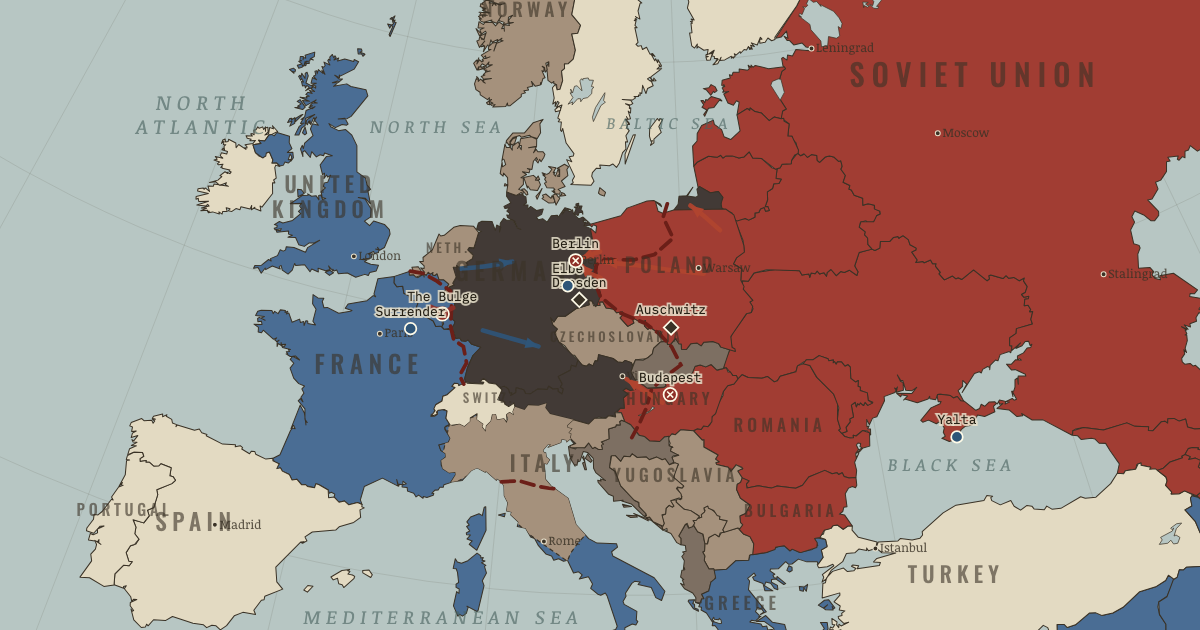
At a schoolhouse in Reims, Germany signs unconditional surrender. The war in Europe is over at one minute past midnight tomorrow.
THE MOMENT IN CONTEXT
Germany’s final offensive in the west opened in the Ardennes in December 1944, when Hitler gambled on splitting the British and American armies, seizing the port of Antwerp, and forcing a political rupture among the Allies. The attack achieved surprise but lacked the fuel, transport, and reserves its objective demanded, so it failed within weeks and consumed forces that Germany desperately needed for its own defence. In January the Soviet Vistula–Oder offensive advanced roughly 500 kilometres in three weeks, carrying the Red Army to the threshold of the German heartland.
From Chapter 13 — Closing the Ring of The War Room — WW2, 1936–1945 (FEB 1945).
OPEN THE INTERACTIVE MAP →TEACH THIS IN 5 MINUTES
- Why it happened — Why fight to annihilation?. No 1918-style armistice was possible: the Allies demanded unconditional surrender (Casablanca, 1943), the regime’s crimes left its leaders nothing…
- The turn — Berlin, 16 April–2 May. Stalin sets his two marshals racing each other into the capital — 2.5 million men against a garrison of old men, boys and broken divisions. It costs…
- What it changed — The Holocaust enters the world’s conscience. The camps’ liberation makes the crime undeniable and demands new words and new law: “genocide” (coined 1944), the Nuremberg trials’ “crimes against…
Then ask the room: Could the Western Allies have taken Berlin first — and should they have? The argued answer is on the chapter page →
THE ATLAS THAT SHOWS IT
THE DISPATCH
One short letter when a new atlas opens — and the printable study guide for WW2 is yours now, free.
NO TRACKING · YOUR ADDRESS IS USED FOR THE DISPATCH AND NOTHING ELSE · UNSUBSCRIBE ANYTIME