ON THIS DAY ·
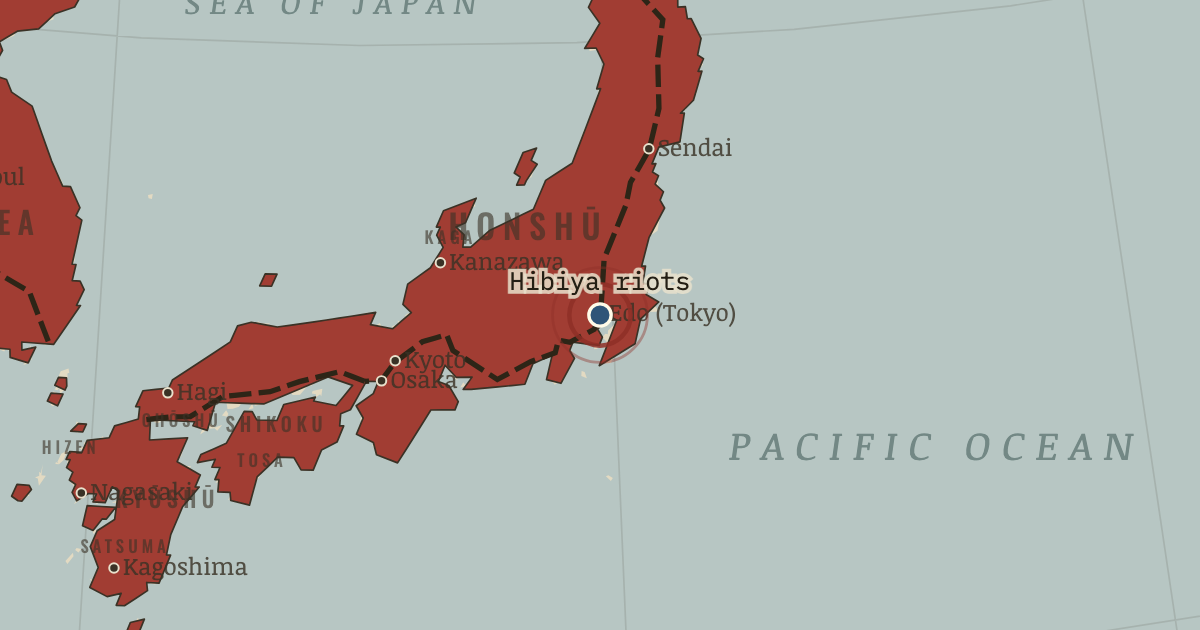
Hibiya riots
5–7 Sep 1905 — The peace signed at Portsmouth brought Japan no indemnity, although taxpayers had borne a war costing several times the government’s annual budget. Crowds in Tokyo burned police boxes and attacked pro-government newspapers. Seventeen people died, and martial law was declared.
WW2 is free in full, and chapter 1 of every atlas is free. A free account opens 3 more chapters a day. Starter, at $9 a month, opens all 21 with no daily limit — see the plans.
Free printable Meiji Japan and post-Soviet Russia study guide, sent by email ↓
The moment in context
Japanese leaders saw Korea as a question of security. A rival established on the peninsula would be close enough to threaten Japan itself; the image of Korea as a dagger pointed at Japan was later attributed to the Prussian adviser Jakob Meckel. In 1894 a peasant rebellion led by the Donghak religious movement prompted Korea to ask China for troops. Japan sent a larger force, seized the royal palace in Seoul and declared war on Qing China in August.
From Sino-Japanese and Russo-Japanese wars, chapter 6 of Remaking the State: Meiji Japan 1600–1912 and Post-Soviet Russia 1964–2000 (1910).
The place: Hibiya riots — map and full story →
Teach this in 5 minutes
- Why it happened — Korea sat between three empires. Korea’s kingdom was weak and divided at court, and had traditionally been a tributary of China. Russia approached from the north; Japanese…
- The turn — Tsushima, 27–28 May 1905. At Tsushima on 27–28 May 1905, Japan destroyed Russia’s Baltic fleet and decided the war. The victory demonstrated that the new state could defeat a…
- What it changed — Japan joined the great powers. The last clauses of the 1858 treaties had been undone by 1911, when Japan regained full control of tariffs and renewed its alliance with Britain. It…
Then ask the room: To what extent was Japan’s transition a success by 1912, and for whom? The argued answer is on the chapter page →
The atlas that shows it
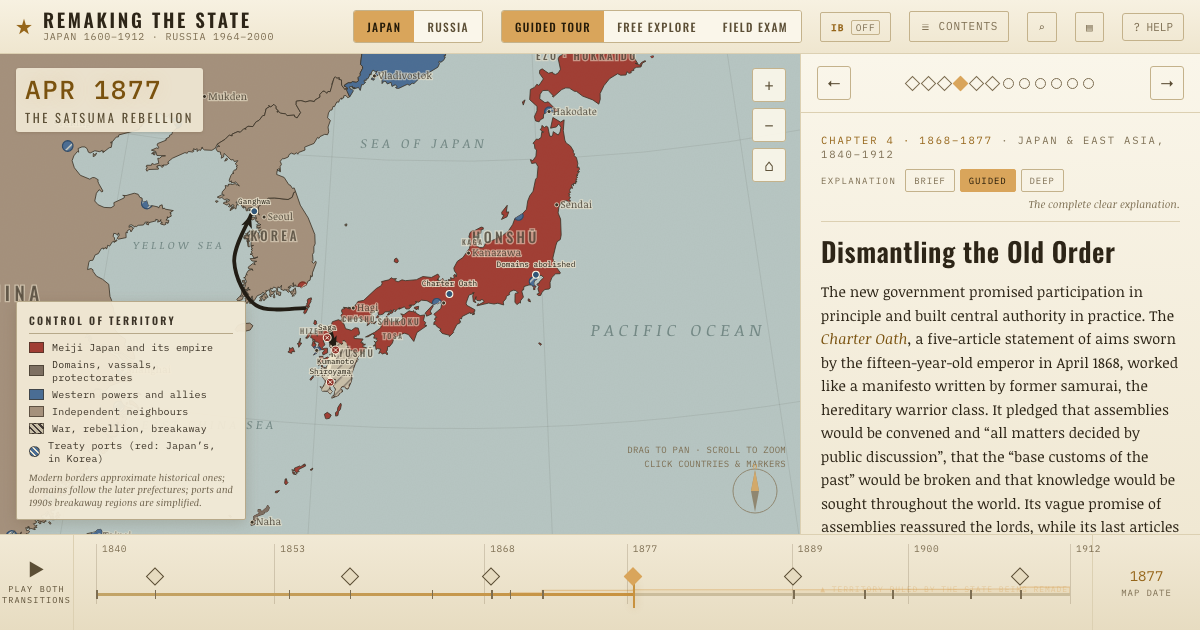
THE FREE PRINTABLE STUDY GUIDE
Get the printable study guide for Remaking the State free. I’ll send you a few short letters, then one when a new atlas opens. That’s all. — Paul
NO TRACKING · YOUR ADDRESS IS USED FOR THE DISPATCH AND NOTHING ELSE · UNSUBSCRIBE ANYTIME