Meiji Japan and post-Soviet Russia · 1910
How successful was Meiji Japan by 1912, and for whom?
The seminar question: “To what extent was Japan’s transition a success by 1912, and for whom?”
Japan used war to become a great power. It defeated Qing China in 1894–95 and gained Taiwan by the Treaty of Shimonoseki, then, allied with Britain from 1902, fought Russia and won the naval battle of Tsushima in May 1905. Korea and Taiwan stayed under Japanese colonial rule until 1945.
Chapter 6 is included with every paid plan. WW2 is free in full, and chapter 1 of every atlas is free. A free account opens 3 more chapters a day. Starter, at $9 a month, opens all 21 with no daily limit — see the plans.
Free printable Meiji Japan and post-Soviet Russia study guide, sent by email ↓
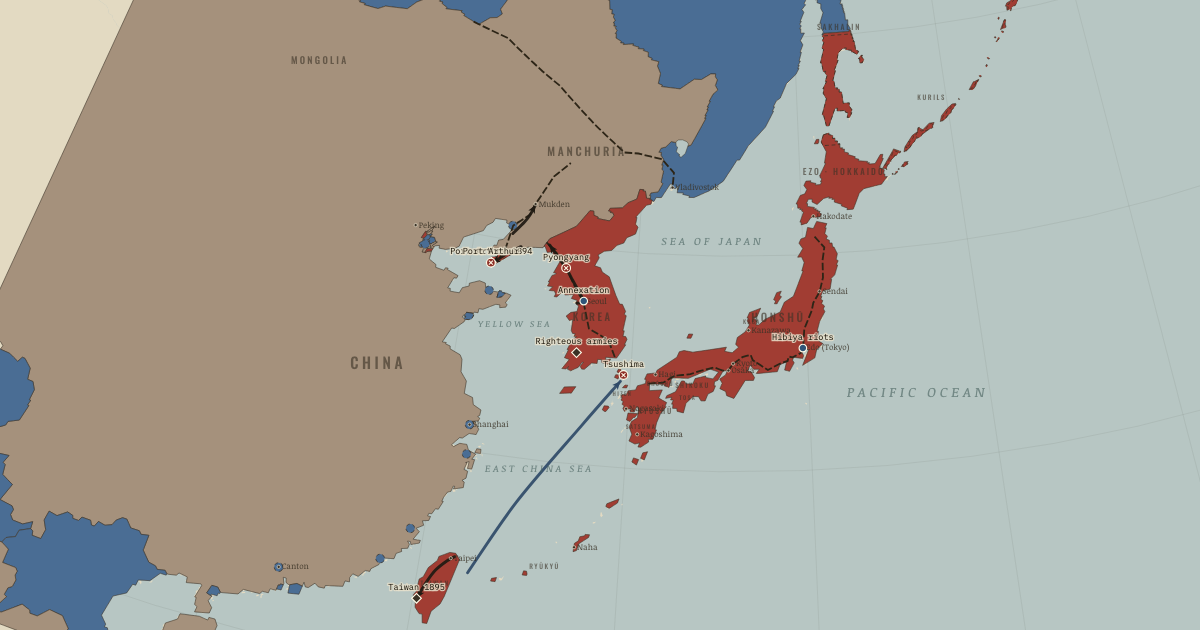
Japanese leaders saw Korea as a question of security. A rival established on the peninsula would be close enough to threaten Japan itself; the image of Korea as a dagger pointed at Japan was later attributed to the Prussian adviser Jakob Meckel. In 1894 a peasant rebellion led by the Donghak religious movement prompted Korea to ask China for troops. Japan sent a larger force, seized the royal palace in Seoul and declared war on Qing China in August.
The short answer
- Korea sat between three empires. Korea’s kingdom was weak and divided at court, and had traditionally been a tributary of China. Russia approached from the north; Japanese strategists feared that control of the peninsula by a rival would threaten Japan. Japanese merchants and officials had built influence there since the 1876 Treaty of Ganghwa. The competing ambitions of China, Russia and Japan around Korea produced two wars within ten years.
- A modern state earned treaty revision. Britain demanded institutional changes before revising the treaties. Japan’s 1880s constitution, cabinet and legal codes supplied them, and on 16 July 1894 Britain agreed to end extraterritoriality from 1899. The agreement came days before war with China. Its negotiator, foreign minister Mutsu Munemitsu, saw proof that reform at home brought respect abroad. Equality with the West and expansion in Asia advanced together, each strengthening the other.
- The Triple Intervention taught that only power counted. Russia, Germany and France advised Japan in April 1895 to return Liaodong. Japan could not fight all three and complied in exchange for an extra indemnity. In 1898 Russia leased the peninsula’s tip, including Port Arthur, itself. Japanese leaders and the public drew a lesson about international law: the strong could make the rules serve them. The episode encouraged rearmament and an alliance capable of matching Russia.
- Russia’s railways and Britain’s alliance set the timing. The Trans-Siberian Railway and its Manchurian branch to Port Arthur threatened to bring Russian armies close to Korea within a few years. Japan’s January 1902 alliance with Britain guaranteed that no third power would join Russia against it. Japanese leaders saw an opportunity to fight before the railway was finished, and struck first in February 1904.
THE TURNING POINT
Tsushima, 27–28 May 1905. At Tsushima on 27–28 May 1905, Japan destroyed Russia’s Baltic fleet and decided the war. The victory demonstrated that the new state could defeat a European great power. Russia accepted mediation, the powers recognized Japan’s control of Korea, and Japan entered the circle of empires on equal terms. From Turkey to India, observers saw evidence that Europe could be beaten. Many Japanese also took empire to be the reward for their transition, a belief that led toward the wars of the twentieth century.
What it changed
Japan joined the great powers. The last clauses of the 1858 treaties had been undone by 1911, when Japan regained full control of tariffs and renewed its alliance with Britain. It negotiated with Western powers as an equal and held colonies like theirs. Within a lifetime it had reached the goal set in 1868: a nation “standing with the nations of the world”.
Korea and Taiwan under colonial rule until 1945. Governors-general, usually generals or admirals, ruled Taiwan from 1895 and Korea from 1910. Railways, ports and schools served Japan’s purposes. Land surveys transferred land to the state and Japanese owners, while police controlled populations and suppressed resistance. Japan held both colonies until its defeat in 1945.
An expensive empire and a restless public. The bills for empire remained: war debts, special taxes and a large standing army became permanent demands on the budget. At Hibiya, crowds had demanded both imperial strength and political influence. Urban protests helped bring down cabinets in 1913 and 1918. The Meiji state’s success had created pressures its successors would struggle to control.
The full answer, argued
By the founders’ own goals, the transition succeeded. Japan kept its independence, ended the unequal treaties, built industry, railways and schools, adopted a constitution and defeated China and Russia. In the 1960s modernization theorists such as Edwin Reischauer presented it as a peaceful, well-managed model. Later historians including John Dower and Carol Gluck asked who bore the costs: indebted farmers, girls in textile mills, the Ainu and Ryukyuans, and above all Taiwanese and Koreans whose lands were taken by force. Some also trace the military’s later independence and the wars of the 1930s to choices of this period. Both sides of the judgment need evidence. The state became strong, while much of the cost fell on people with no voice in it.
An interesting fact
Admiral Tōgō Heihachirō had trained as a young officer in Britain in the 1870s aboard HMS Worcester. Before Tsushima he hoisted a signal echoing Nelson’s at Trafalgar: the empire’s fate depended on the day, and every man must do his utmost. His flagship Mikasa had been built by Vickers at Barrow-in-Furness in England and launched in 1900. Weeks after the war a magazine explosion sank her at her moorings, killing hundreds of crew. Raised and repaired, she later became a memorial ship. She remains preserved in concrete at Yokosuka, south of Tokyo, one of the last surviving battleships of her era.
This is the study layer of Sino-Japanese and Russo-Japanese wars, chapter 6 of Remaking the State: Meiji Japan 1600–1912 and Post-Soviet Russia 1964–2000; the full index of the atlas is here.
Related questions
THE FREE PRINTABLE STUDY GUIDE
Get the printable study guide for Remaking the State free. I’ll send you a few short letters, then one when a new atlas opens. That’s all. — Paul
NO TRACKING · YOUR ADDRESS IS USED FOR THE DISPATCH AND NOTHING ELSE · UNSUBSCRIBE ANYTIME