Stalin’s Soviet Union · 1936
Was the Gulag mainly economic or an instrument of terror?
The seminar question: “Was the Gulag primarily an economic institution or an instrument of political terror?”
From 1930 the Gulag, run by the political police, held prisoners in forced-labour camps, colonies and special settlements across the USSR. About 18 million people passed through the camps and colonies between 1930 and 1953, many sent to remote regions such as Kolyma to work the resources the plans needed.
Chapter 5 is included with every paid plan. WW2 is free in full, and chapter 1 of every atlas is free. A free account opens 3 more chapters a day. Starter, at $9 a month, opens all 21 with no daily limit — see the plans.
Free printable Stalin’s Soviet Union study guide, sent by email ↓
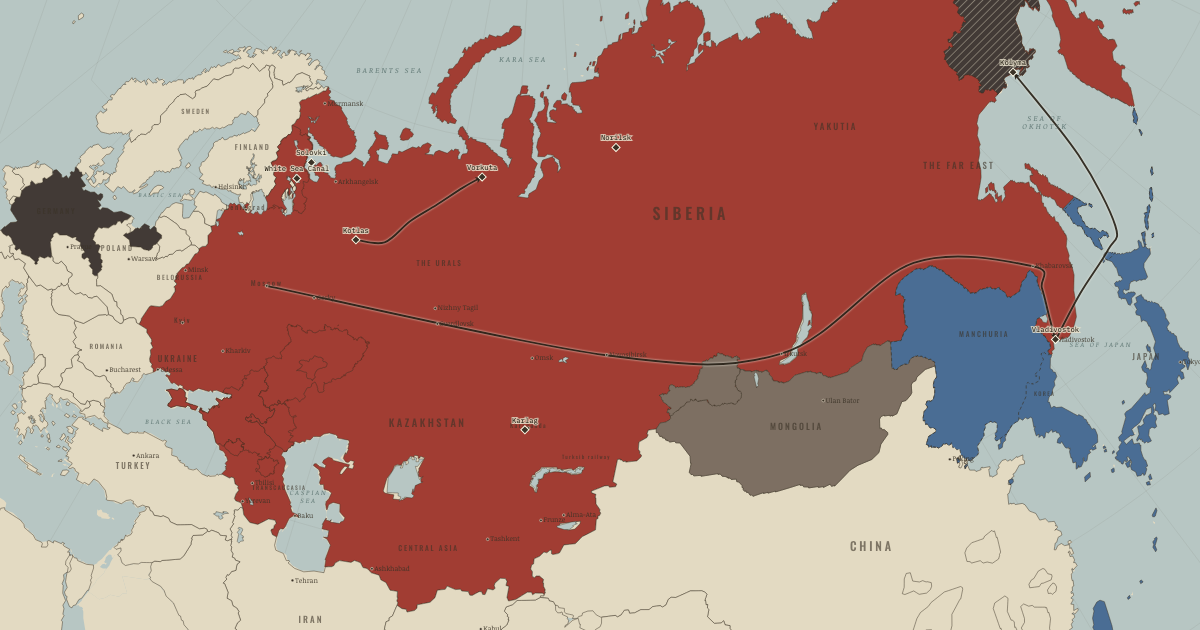
In June 1929 the Soviet leadership joined two ambitions: punishing prisoners and exploiting distant resources. On 27 June the Politburo, the party’s small ruling committee, which worked like a cabinet, assigned prisoners serving three years or more to camps run by the OGPU, the political police and a forerunner of the KGB. A July decree called for camps in remote areas ‘for the purpose of colonising these regions and exploiting their natural resources’. The people sent there would work to sustain their own imprisonment and help open up the empire’s empty regions.
The short answer
- Punishment was redefined as productive labour. Bolsheviks saw labour as a way to reform criminals and objected to the state paying to keep prisoners idle. At Solovki, opened in a former White Sea monastery in 1923, police tied food to prisoners’ work. The June 1929 resolution extended this approach nationally: long-term prisoners would work in remote camps. The punishment itself became a means of carrying out economic plans.
- The plans needed labour in empty places. Industrialisation needed gold, coal, nickel and timber from the Arctic, Siberia and the Far East, where few free workers wanted to live. The state could order prisoners and deportees there, guard them and pay them almost nothing. Camps multiplied alongside the Five-Year Plans; by 1940 prisoners mined most of the Union’s gold. The camps’ distribution follows much of the geography of the resources the plans demanded.
- Collectivisation produced a forced-labour population. In 1930–31 about 1.8 million ‘kulaks’ were deported, creating the first mass forced-labour population outside prisons. The OGPU had to house, feed and employ hundreds of thousands in special settlements. Barracks, transit points and convoys, together with the experience of managing this population, could later be used for convicted prisoners. Dekulakisation supplied methods and infrastructure for the camps.
- New laws turned everyday life into crime. The Law of 7 August 1932 on socialist property, internal passport rules of 1932 and labour laws of 1940 made petty theft, unauthorised travel and lateness crimes carrying long sentences. Most Gulag prisoners were convicted under such laws; political enemies were a minority. Courts could consequently feed prisoners into the camps between campaigns as well as during the Terror, and the camp population kept rising in quieter years.
THE TURNING POINT
The White Sea Canal, 1931–1933. The White Sea–Baltic Canal gave the regime an impressive demonstration, though its usefulness was another matter. Prisoners dug the first great project built entirely by their labour: some 227 kilometres, mostly by hand, in twenty months during 1931–33. Officially about 12,000 died; other estimates are higher. Stalin sailed along the canal in July 1933. A book by thirty-six writers, edited by Maxim Gorky, celebrated the ‘reforging’ of criminals. The canal was too shallow for most ships, but the regime took rapid construction as proof of police capacity and gave the NKVD larger projects.
What it changed
A police empire with its own territory. Dalstroi governed Kolyma from 1931 to 1953, in the territory marked by dark hatching. There the NKVD was government, employer and jailer at once. Camp complexes at Vorkuta, Norilsk and Karaganda built entire cities, and the NKVD became one of the Union’s largest economic ministries. Its authority over territory and people survived the Terror and lasted until after Stalin’s death.
A channel that the Terror could fill. The Terror of 1937–38 encountered a system already equipped to move and employ prisoners. Convoys, transit camps and work sites sent hundreds of thousands to Kolyma, the north and Kazakhstan within months; the Gulag population nearly doubled. In Kolyma, new arrivals were driven to meet gold plans through the Arctic winter of 1938, when deaths rose steeply. The camp network enabled arrests on this scale to be absorbed, while the Terror supplied its largest workforce yet.
Forced labour built the wartime and postwar economy. Prisoner labour remained useful to the state during war and peace. In 1941–45 prisoners made munitions, built railways and mined coal; about a million were released into the Red Army. After 1945 returning soldiers, people from annexed lands and prisoners convicted under harsh new theft laws enlarged the Gulag to its greatest size. Its fastest growth in peacetime shows how deeply forced labour had entered the regime’s routine.
A memory that still divides. After 1953 survivors returned to a society reluctant to hear their accounts. Khrushchev’s government acknowledged the camps only partially. Solzhenitsyn’s One Day in the Life of Ivan Denisovich appeared in 1962, then was banned again. The memory remains contested in Russia, where Memorial, which documented the Gulag, was dissolved by court order in 2021.
The full answer, argued
The Gulag was a political institution given an economic job, and the two purposes helped it grow. The 1929 resolution sent prisoners to colonise remote regions; camps followed resources needed by the plans, and the NKVD built major projects and produced most Soviet gold. But laws disciplining everyday behaviour sent millions into the system, and the Terror of 1937–38 filled it regardless of labour needs. The conditions killed people at rates no rational employer would accept. Khlevniuk’s account of forced labour’s inefficiency suggests that economic arguments also justified a system whose deeper purpose was control. Steven Barnes adds another purpose: labour was treated as a test of who could be redeemed. None of these aims operated alone.
An interesting fact
The Soviet aviation designer Andrei Tupolev worked on the Tu-2 bomber while imprisoned in a Moscow design bureau. Arrested in 1937, he worked in one of the special camps for scientists that prisoners called sharashki. Sergei Korolev, arrested in 1938, spent months in a Kolyma gold mine in 1939 before being moved to Tupolev’s bureau. Korolev later became chief designer of the rocket that launched Sputnik and Yuri Gagarin. Both were released during the war; their imprisonment remained publicly unacknowledged in the Soviet Union for decades.
This is the study layer of Gulag forced-labour camps, chapter 5 of The Soviet Union under Stalin, 1924–1953; the full index of the atlas is here.
Related questions
THE FREE PRINTABLE STUDY GUIDE
Get the printable study guide for The Soviet Union under Stalin free. I’ll send you a few short letters, then one when a new atlas opens. That’s all. — Paul
NO TRACKING · YOUR ADDRESS IS USED FOR THE DISPATCH AND NOTHING ELSE · UNSUBSCRIBE ANYTIME