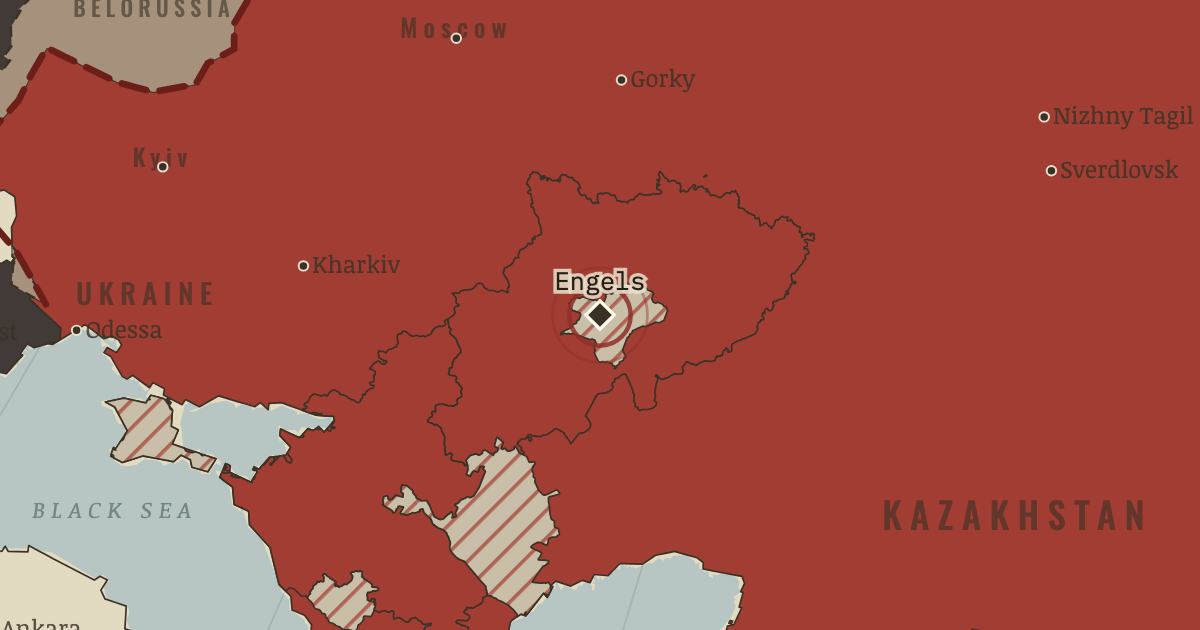
28 Aug 1941 — A decree abolished the Volga German republic and accused its people of hiding “thousands and tens of thousands of saboteurs and spies”. About 440,000 people were deported east from the Volga and the republic’s capital, Engels. They were among some 900,000 Soviet Germans moved by 1942.
WW2 is free in full, and chapter 1 of every atlas is free. A free account opens 3 more chapters a day. Starter, at $9 a month, opens all 21 with no daily limit — see the plans.
28 AUGUST 1941 · THE SOVIET UNION UNDER STALIN, 1924–1953
The moment in context
Soviet leaders first acted against minorities along borders they feared they might have to defend. Poles, Germans, Finns and Koreans had homelands or connections beyond the Soviet Union, and planners imagined that they might help an invading power. In 1936 tens of thousands of Poles and Germans were moved from Ukraine’s western border zone to Kazakhstan. Their residence and ancestry made them suspect before any invasion had occurred.
Why it happened — Fear of foreign enemies on the borders. Japan occupied Manchuria from 1931, Nazi Germany rose to power in 1933, and the two signed the Anti-Comintern Pact against communism in 1936. Soviet…
The turn — The Korean deportation, September 1937. About 172,000 Koreans were removed from the Far East in autumn 1937. Earlier operations had targeted social classes, such as kulaks, or people…
What it changed — Homelands abolished and resettled. The deportations changed the political map as well as the population. The Volga German, Kalmyk and Chechen-Ingush republics and the Karachay region…
Get the printable study guide for The Soviet Union under Stalin free. I’ll send you a few short letters, then one when a new atlas opens. That’s all. — Paul
NO TRACKING · YOUR ADDRESS IS USED FOR THE DISPATCH AND NOTHING ELSE ·
UNSUBSCRIBE ANYTIME