Russian Revolution · CHAPTER 2 ·
Counter-reforms of Alexander III
Chapter 2 of The Russian Revolution, 1855–1924: “Reaction and the Railway”
After the People’s Will assassinated Alexander II in St Petersburg in March 1881, Alexander III and Pobedonostsev concluded that reform had bred revolution. Emergency powers, curbs on universities, land captains over the peasants and the anti-Jewish May Laws of 1882 treated whole groups as suspect.
WW2 is free in full, and chapter 1 of every atlas is free. A free account opens 3 more chapters a day. Starter, at $9 a month, opens all 21 with no daily limit — see the plans.
Free printable Russian Revolution study guide, sent by email ↓
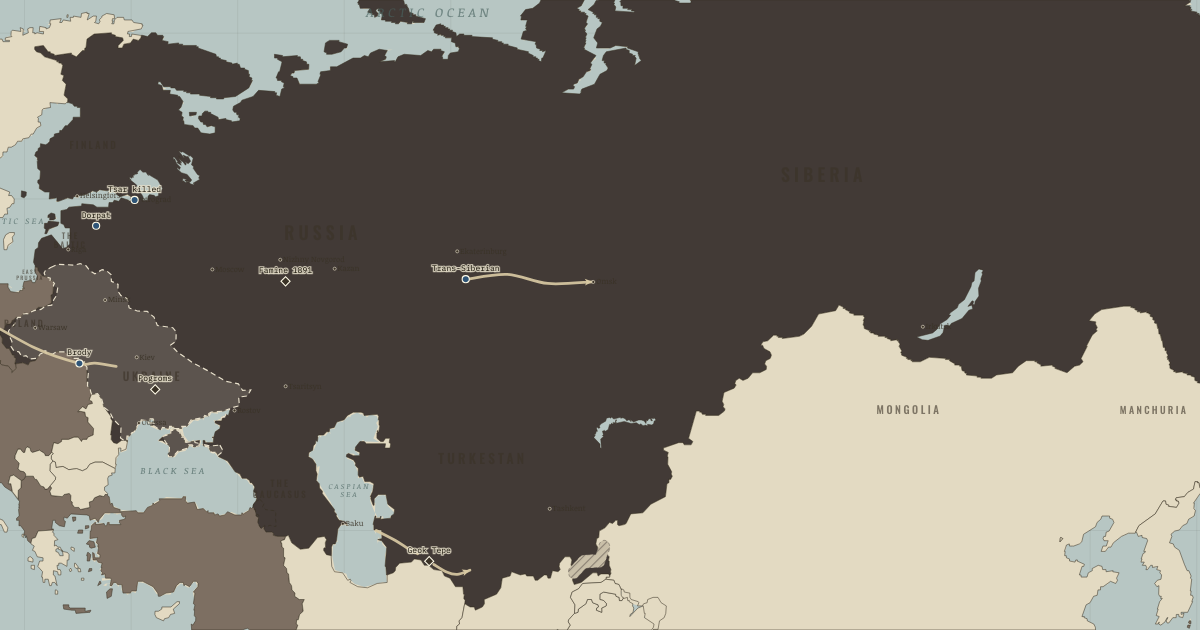
The map above is the world of The Russian Empire, May 1891 — The Trans-Siberian begun.
Every state on the map that year: The world in 1900 · Europe in 1900.
Part of IB History: The Russian Revolution →
SHORT EXPLANATION
Alexander II had approved a plan for elected delegates to advise on new laws only hours before bombs killed him beside the Catherine Canal in St Petersburg in March 1881. His killers belonged to the People’s Will, a small party that murdered officials to frighten the government into concessions. His son Alexander III and former tutor Konstantin Pobedonostsev, the layman who ran the Orthodox Church for the government, drew a lesson: reform had bred revolution. They shelved the plan. Autocracy—the Tsar’s unlimited personal rule without a parliament, elections or a limiting constitution—entered a period of reaction, an attempt to roll political change back. A “temporary” emergency statute lasted until 1917. After anti-Jewish pogroms began at Elisavetgrad, the government blamed Jews and tightened their confinement in the Pale of Settlement, the vast legal ghetto outlined on the map. The institutions of the previous reign remained, but the government’s trust in society had receded.
The same government wanted a stronger industrial economy. Finance ministers Ivan Vyshnegradsky and Sergei Witte raised tariffs on imports to protect domestic industry, promoted grain exports to earn gold for foreign debts, and borrowed in Paris to build railways. In 1891 the heir Nicholas began the Trans-Siberian railway to the Pacific; on the map its arrows start at Chelyabinsk and Vladivostok. Drought that year brought famine, killing several hundred thousand. Critics blamed taxes that forced peasants to sell grain they needed. Nicholas II would inherit a modernizing economy governed by a state deeply suspicious of its people.
The full story
The murder of Alexander II gave his successor a reason to distrust concessions. If reforms had failed to protect the reforming Tsar, Alexander III believed, demands for further change had to be resisted. Pobedonostsev drafted the April 1881 manifesto proclaiming unlimited autocracy, and reforming ministers resigned. The August emergency statute let governors ban meetings, close newspapers and exile suspects without trial. It was renewed until 1917. Suspicion reached beyond the assassins. University self-government ended in 1884; in 1887 schools were urged to turn away cooks’ children. In 1889 noble land captains were appointed to administer and judge peasants, much like colonial district officers. Each measure placed a larger group under control because the government feared what some of its members might do.
The government also treated differences among its subjects as dangers to unity. Pogroms, anti-Jewish riots beginning at Elisavetgrad, spread through about two hundred places in Ukraine in 1881–82. John Klier counts around fifty deaths, about half of them rioters; historians find no evidence that the central government organized the violence. Its response nevertheless restricted the victims. The May Laws of 1882 barred new Jewish settlement in villages even inside the Pale of Settlement, the western provinces where most of the empire’s five million Jews lived. Limits on Jewish pupils in 1887 and expulsions from Moscow in 1891 followed. Hundreds of thousands emigrated, their route marked by the arrow west through Brody into Austria. Russification imposed Russian language and officials in Poland and the Baltic, making the German-speaking university of Dorpat Russian. Farther east, the arrows run from Geok Tepe, stormed in Alexander II’s last weeks, to Merv in 1884; hatching marks the disputed Pamirs. Measures intended to secure the empire encouraged many inhabitants to look beyond it.
Economic policy offered a different route to strength. Nikolai Bunge’s Peasant Land Bank lent peasants money to buy land. Vyshnegradsky collected taxes after harvest, pushing peasants to sell grain for export; Witte, minister from 1892, used import taxes, French loans and state railways to encourage industry. The Trans-Siberian became the policy’s emblem, a public investment meant to support growth. The famine of 1891–92 exposed the cost of a system dependent on grain and the state’s difficulty responding to crisis. Hunger and cholera killed several hundred thousand, while the government was slow to act. Zemstvos, elected local councils, and volunteers supplied much early relief. Leo Tolstoy and Vladimir Korolenko were among the volunteers; Korolenko reported from Lukoyanov district. Educated Russians could see both the state’s ambitions and its failure to protect hungry people.
FULL EXPLANATION
Counter-reform or continuity?
The label “counter-reform” captures an important part of Alexander III’s reign, but does it describe the whole? Pyotr Zaionchkovsky used ministry papers to make the classic Soviet case for reversal, tracing policy to Pobedonostsev, newspaper editor Mikhail Katkov and Interior Minister Count Dmitry Tolstoy, not the novelist. Later historians found continuity in the machinery of government. Thomas Pearson showed that land captains and the 1890 zemstvo law, which increased noble representation and governors’ control, grew partly out of a long effort to order rural administration. Francis Wcislo argued that officials under both emperors sought to extend state authority into villages. Courts survived, zemstvos expanded schools and clinics, and the army and railways modernized. The change was clearest in political trust: Alexander II had justified reform as a means of winning society’s loyalty; Alexander III’s government treated society itself as suspect. That shift mattered more than any single repeal.
The pogroms and the state
For decades Jewish organizations, foreign observers and many historians attributed the pogroms of 1881–84 to a government plot to divert anger from the regime. I. Michael Aronson and John Klier’s Russian archival research found no evidence of central planning. Violence spread along railway lines and river routes with migrant workers at Easter. Local authorities who failed to stop it were usually slow or confused, though some were complicit. The rejection of a central plot does not settle the question of state responsibility. The May Laws, issued as “temporary rules”, remained until 1917. In 1888 a high commission under Count Konstantin Pahlen recommended widening Jewish rights gradually; the government set its report aside. Many Russian Jews concluded that the state would neither protect nor accept them. Their conviction fed emigration, socialism and Zionism, the movement for a Jewish homeland in Palestine.
The famine and the birth of a public
Educated Russians remembered the famine of 1891–92 as a loss of faith in government. Richard Robbins’s standard study gives the state a better record once it acted: it spent about 150 million roubles, much of it lent as grain through zemstvos, and relief prevented starvation in many districts. Robbins counted about 406,000 excess deaths, above the normal rate, including at least 100,000 from cholera. Orlando Figes gives about half a million; some Russian historians argue that few died of starvation itself. Hunger and disease are difficult to separate. The political experience had its own consequences. A government appeal for private help in November 1891 brought doctors, students and writers into relief on an unprecedented scale. In Lukoyanov Korolenko found officials insisting all was well while peasants went hungry. Volunteers witnessed the initial failure. Liberalism, seeking a constitution and elected parliament, and socialism, seeking common ownership of land and factories, both grew from what they saw.
Key places on the map
On this day
Why it happened
The assassination of 1881. The People’s Will pursued Alexander II for two years. Its Winter Palace bomb killed eleven guards in February 1880, and in March 1881 it killed the Tsar just after he approved Interior Minister Mikhail Loris-Melikov’s plan for elected advisers. To Alexander III and the new court, the sequence made concessions look like an invitation to terror. Opponents of reform gained the argument.
Pobedonostsev’s creed. Pobedonostsev, Alexander III’s tutor and the government’s lay head of the Orthodox Church, believed parliaments, elections and a free press were a lie that divided nations. In his view Orthodoxy, autocracy and the Russian people held Russia together. His position at the center of power throughout the reign turned distrust of society into a governing principle.
The needs of a great power. Crimea and disappointment at the Congress of Berlin in 1878 convinced rulers that Russia needed railways, industry and money to remain a great power able, like Britain, France and Germany, to shape Europe’s affairs. Grain exports helped pay for foreign loans; French banks lent heavily from 1888, and the Franco-Russian alliance of 1891–94 sealed the relationship. Strategic strength required economic change, but the rulers saw no need to share power with the classes it created.
Fear of the borderlands. Officials saw the Polish rising of 1863 and national movements among Ukrainians, Baltic peoples and Finns as threats to unity. These movements sought language, schools and rights for their peoples. Russification aimed to make loyal Russians of subjects through a common language and faith; officials also suspected Jews as disloyal outsiders. More than half the population spoke a mother tongue other than Russian. Defining loyalty through sameness made much of the empire a problem for its own government.
THE TURNING POINT
The Catherine Canal, 1/13 March 1881. On the morning of 1/13 March 1881 Alexander II approved Loris-Melikov’s plan to bring elected zemstvo and city delegates into the drafting of laws. They would advise rather than legislate, but the step might have led to a consultative assembly. The bombs on the Catherine Canal ended that path. Alexander III instead sought modernization without consulting society. The killing hardened both sides: for the next twenty-four years reformers and revolutionaries faced a regime inclined to see demands for a voice as the first step toward another bomb.
What it changed
A state of permanent emergency. The 1881 emergency statute became an ordinary instrument of government, placing a large share of the empire under emergency rule for a generation. Political police answering to the interior minister put informers in revolutionary circles; arrest and exile without trial became routine. Peaceful opponents had no legal channel, and being pushed underground encouraged the belief that only force would move the regime.
Industry without a voice for workers. In the industrial boom of the 1890s output grew by around eight percent a year. Workers crowded into St Petersburg, Moscow, Ukraine’s Donbas coalfield and the oil city of Baku. Strikes and unions were illegal, so workers could not use them to bargain over wages and conditions. A strike brought workers into conflict with the state as well as employers, helping explain the rapid politicization of strikes in the 1890s and 1905.
Emigration and new Jewish politics. Estimates place Jewish emigration from the empire between 1881 and 1914 at two to three million, including about 1.6 million to the United States. Poverty drove migration as much as pogroms did. Those who stayed pursued new politics: early Zionist groups of the 1880s sought a Jewish homeland in Palestine, and the Bund, founded in 1897, organized Jewish socialist workers. Many young Jews joined revolutionary parties. Suspicion had helped create some of the opposition the regime feared.
A generation turned against the state. The People’s Will was crushed, but revolution drew a new generation. In 1887 police foiled a student plot against Alexander III and hanged its five leaders at Shlisselburg. One was Alexander Ulyanov; his younger brother Vladimir, later Lenin, turned to revolution. Marxist circles spread among students and workers, studying Karl Marx’s prediction that industrial workers would overthrow their employers. The defeat of the bombers did not end revolutionary ideas.
DISCUSSION QUESTION — Did Alexander III’s policies strengthen the autocracy or prepare its collapse?
By 1894 Alexander III had made the autocracy stronger in several respects. The People’s Will was destroyed, Russia had fought no major war for thirteen years, industry was growing quickly, and the French alliance ended isolation. Yet the society governed by that stronger machinery was changing. Workers and professionals created by growth, and national movements provoked by Russification, found no legal place in the state; famine discredited government among educated Russians. Zaionchkovsky stressed reaction, while other historians emphasize continuity and economic achievement. Each account fits part of the record: the machinery grew stronger while its hold over those it governed weakened. Much depended on the successor, for a system requiring a strong and capable autocrat passed to one who was neither.
An interesting fact
Nicholas laid the first stone of the Trans-Siberian at Vladivostok on 19/31 May 1891 while recovering from an attack. Three weeks earlier at Ōtsu in Japan, Tsuda Sanzō, a policeman assigned to guard him, had struck him with a sabre, leaving a nine-centimeter wound on the right side of his forehead. Nicholas had reached the Pacific by sea at the end of a grand Asian tour. The railway he opened was intended to make Russia a Pacific power; thirteen years later it carried his armies to war with Japan.
Related
THE FREE PRINTABLE STUDY GUIDE
Get the printable study guide for The Russian Revolution free. I’ll send you a few short letters, then one when a new atlas opens. That’s all. — Paul
NO TRACKING · YOUR ADDRESS IS USED FOR THE DISPATCH AND NOTHING ELSE · UNSUBSCRIBE ANYTIME