Russian Revolution · MAY 1891
Did Alexander III strengthen or undermine the autocracy?
The seminar question: “Did Alexander III’s policies strengthen the autocracy or prepare its collapse?”
After the People’s Will assassinated Alexander II in St Petersburg in March 1881, Alexander III and Pobedonostsev concluded that reform had bred revolution. Emergency powers, curbs on universities, land captains over the peasants and the anti-Jewish May Laws of 1882 treated whole groups as suspect.
WW2 is free in full, and chapter 1 of every atlas is free. A free account opens 3 more chapters a day. Starter, at $9 a month, opens all 21 with no daily limit — see the plans.
Free printable Russian Revolution study guide, sent by email ↓
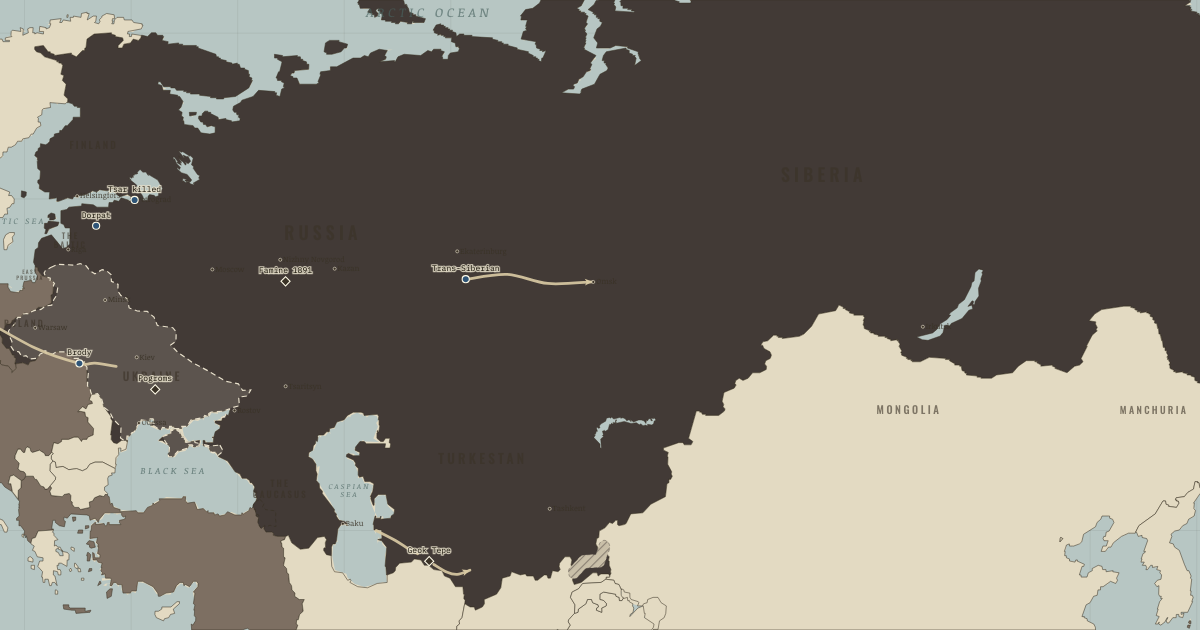
The murder of Alexander II gave his successor a reason to distrust concessions. If reforms had failed to protect the reforming Tsar, Alexander III believed, demands for further change had to be resisted. Pobedonostsev drafted the April 1881 manifesto proclaiming unlimited autocracy, and reforming ministers resigned. The August emergency statute let governors ban meetings, close newspapers and exile suspects without trial. It was renewed until 1917. Suspicion reached beyond the assassins. University self-government ended in 1884; in 1887 schools were urged to turn away cooks’ children. In 1889 noble land captains were appointed to administer and judge peasants, much like colonial district officers. Each measure placed a larger group under control because the government feared what some of its members might do.
The short answer
- The assassination of 1881. The People’s Will pursued Alexander II for two years. Its Winter Palace bomb killed eleven guards in February 1880, and in March 1881 it killed the Tsar just after he approved Interior Minister Mikhail Loris-Melikov’s plan for elected advisers. To Alexander III and the new court, the sequence made concessions look like an invitation to terror. Opponents of reform gained the argument.
- Pobedonostsev’s creed. Pobedonostsev, Alexander III’s tutor and the government’s lay head of the Orthodox Church, believed parliaments, elections and a free press were a lie that divided nations. In his view Orthodoxy, autocracy and the Russian people held Russia together. His position at the center of power throughout the reign turned distrust of society into a governing principle.
- The needs of a great power. Crimea and disappointment at the Congress of Berlin in 1878 convinced rulers that Russia needed railways, industry and money to remain a great power able, like Britain, France and Germany, to shape Europe’s affairs. Grain exports helped pay for foreign loans; French banks lent heavily from 1888, and the Franco-Russian alliance of 1891–94 sealed the relationship. Strategic strength required economic change, but the rulers saw no need to share power with the classes it created.
- Fear of the borderlands. Officials saw the Polish rising of 1863 and national movements among Ukrainians, Baltic peoples and Finns as threats to unity. These movements sought language, schools and rights for their peoples. Russification aimed to make loyal Russians of subjects through a common language and faith; officials also suspected Jews as disloyal outsiders. More than half the population spoke a mother tongue other than Russian. Defining loyalty through sameness made much of the empire a problem for its own government.
THE TURNING POINT
The Catherine Canal, 1/13 March 1881. On the morning of 1/13 March 1881 Alexander II approved Loris-Melikov’s plan to bring elected zemstvo and city delegates into the drafting of laws. They would advise rather than legislate, but the step might have led to a consultative assembly. The bombs on the Catherine Canal ended that path. Alexander III instead sought modernization without consulting society. The killing hardened both sides: for the next twenty-four years reformers and revolutionaries faced a regime inclined to see demands for a voice as the first step toward another bomb.
What it changed
A state of permanent emergency. The 1881 emergency statute became an ordinary instrument of government, placing a large share of the empire under emergency rule for a generation. Political police answering to the interior minister put informers in revolutionary circles; arrest and exile without trial became routine. Peaceful opponents had no legal channel, and being pushed underground encouraged the belief that only force would move the regime.
Industry without a voice for workers. In the industrial boom of the 1890s output grew by around eight percent a year. Workers crowded into St Petersburg, Moscow, Ukraine’s Donbas coalfield and the oil city of Baku. Strikes and unions were illegal, so workers could not use them to bargain over wages and conditions. A strike brought workers into conflict with the state as well as employers, helping explain the rapid politicization of strikes in the 1890s and 1905.
Emigration and new Jewish politics. Estimates place Jewish emigration from the empire between 1881 and 1914 at two to three million, including about 1.6 million to the United States. Poverty drove migration as much as pogroms did. Those who stayed pursued new politics: early Zionist groups of the 1880s sought a Jewish homeland in Palestine, and the Bund, founded in 1897, organized Jewish socialist workers. Many young Jews joined revolutionary parties. Suspicion had helped create some of the opposition the regime feared.
A generation turned against the state. The People’s Will was crushed, but revolution drew a new generation. In 1887 police foiled a student plot against Alexander III and hanged its five leaders at Shlisselburg. One was Alexander Ulyanov; his younger brother Vladimir, later Lenin, turned to revolution. Marxist circles spread among students and workers, studying Karl Marx’s prediction that industrial workers would overthrow their employers. The defeat of the bombers did not end revolutionary ideas.
The full answer, argued
By 1894 Alexander III had made the autocracy stronger in several respects. The People’s Will was destroyed, Russia had fought no major war for thirteen years, industry was growing quickly, and the French alliance ended isolation. Yet the society governed by that stronger machinery was changing. Workers and professionals created by growth, and national movements provoked by Russification, found no legal place in the state; famine discredited government among educated Russians. Zaionchkovsky stressed reaction, while other historians emphasize continuity and economic achievement. Each account fits part of the record: the machinery grew stronger while its hold over those it governed weakened. Much depended on the successor, for a system requiring a strong and capable autocrat passed to one who was neither.
An interesting fact
Nicholas laid the first stone of the Trans-Siberian at Vladivostok on 19/31 May 1891 while recovering from an attack. Three weeks earlier at Ōtsu in Japan, Tsuda Sanzō, a policeman assigned to guard him, had struck him with a sabre, leaving a nine-centimeter wound on the right side of his forehead. Nicholas had reached the Pacific by sea at the end of a grand Asian tour. The railway he opened was intended to make Russia a Pacific power; thirteen years later it carried his armies to war with Japan.
This is the study layer of Counter-reforms of Alexander III, chapter 2 of The Russian Revolution, 1855–1924; the full index of the atlas is here.
Related questions
THE FREE PRINTABLE STUDY GUIDE
Get the printable study guide for The Russian Revolution free. I’ll send you a few short letters, then one when a new atlas opens. That’s all. — Paul
NO TRACKING · YOUR ADDRESS IS USED FOR THE DISPATCH AND NOTHING ELSE · UNSUBSCRIBE ANYTIME