ON THIS DAY ·
US Senate passes the Equal Rights Amendment
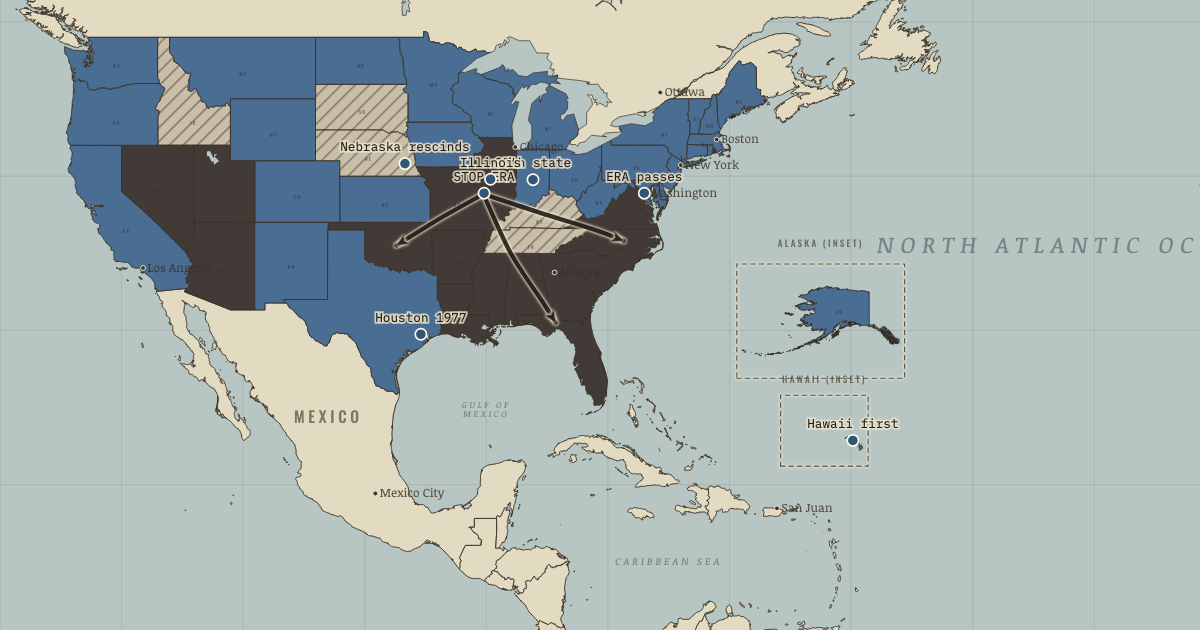
The US Senate passes the Equal Rights Amendment by 84 votes to 8, and Hawaii ratifies it within hours. Ten years later it falls three states short.
WW2 is free in full, and chapter 1 of every atlas is free. A free account opens 3 more chapters a day. Starter, at $9 a month, opens all 21 with no daily limit — see the plans.
Free printable Feminism and the Tunisian Revolution study guide, sent by email ↓
The moment in context
The ERA had been waiting a long time for the reception it received in 1972. Alice Paul of the National Woman’s Party first drafted an amendment in 1923, and both major parties had endorsed it in their platforms for decades. President Nixon, a growing number of trade unions and new women’s organizations now supported it. The Senate approved it by 84 votes to 8.
From Equal Rights Amendment, chapter 5 of Protest and Change: Second-Wave Feminism and Tunisia, 1945–2015 (1982).
Teach this in 5 minutes
- Why it happened — A supermajority rule. The requirement of 38 ratifications gave opponents a smaller task: hold 13 states, by persuading one chamber in each. Support spread widely across…
- The turn — STOP ERA, autumn 1972. In 1972, 22 states ratified; in 1973, eight did. The number fell to three in 1974, one in 1975, none in 1976 and one in 1977. Nebraska’s attempted…
- What it changed — Equality by other routes. Legal change continued without the amendment. In Reed v. Reed (1971) and Craig v. Boren (1976), the Supreme Court applied stricter review to sex…
Then ask the room: Did the ERA fail because of Phyllis Schlafly, or because of the rules for amending the Constitution? The argued answer is on the chapter page →
The atlas that shows it
THE FREE PRINTABLE STUDY GUIDE
Get the printable study guide for Protest and Change free. I’ll send you a few short letters, then one when a new atlas opens. That’s all. — Paul
NO TRACKING · YOUR ADDRESS IS USED FOR THE DISPATCH AND NOTHING ELSE · UNSUBSCRIBE ANYTIME