Norse and Aztecs · CHAPTER 2 ·
Viking expansion and the longship
Chapter 2 of Climate and Innovation: The Norse and the Aztecs, c. 790–1521: “The Ship and the Sea Road”
Viking expansion from about 790 rested on the longship, whose keel and clinker-built hull could ride ocean swells and land on any beach, and on the farms that built it: a warship’s sail needed over 1.5 tonnes of wool. Scarce farmland, Islamic silver and unguarded wealth drew raiders west, as at Lindisfarne in 793.
WW2 is free in full, and chapter 1 of every atlas is free. A free account opens 3 more chapters a day. Starter, at $9 a month, opens all 21 with no daily limit — see the plans.
Free printable Norse and Aztecs study guide, sent by email ↓
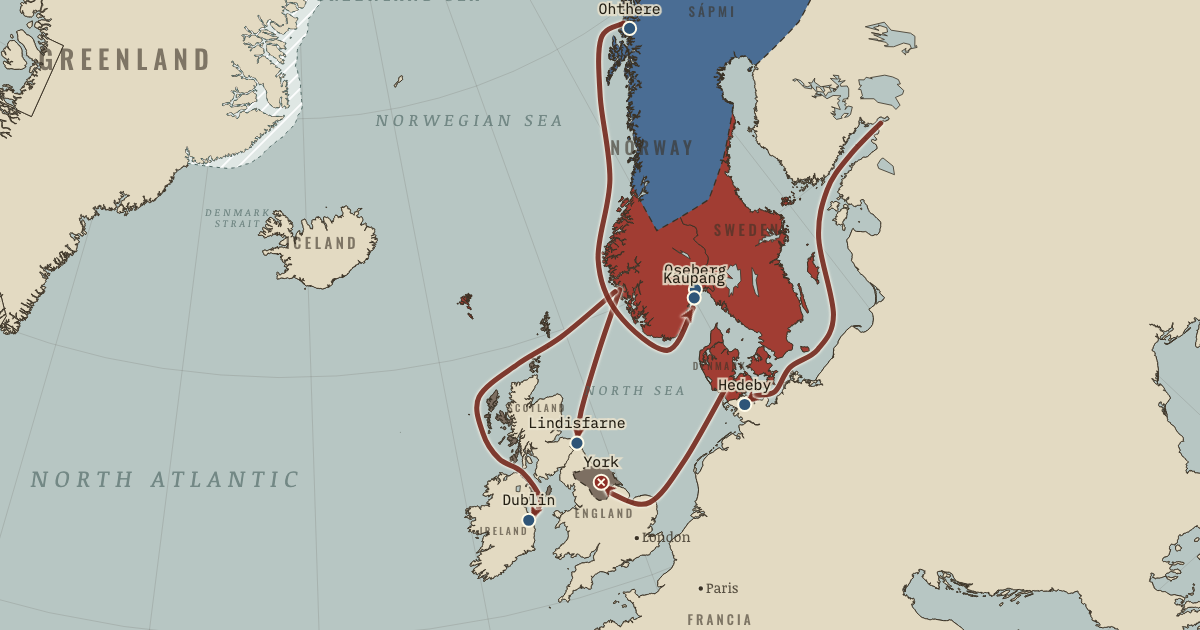
The map above is the world of The Norse North Atlantic, 866 — Raiders become settlers: York, Dublin and the isles.
Part of IB History: The Norse and the Aztecs →
SHORT EXPLANATION
The vessel that carried Scandinavians across the North Sea could also be rowed along a river or brought close to a beach. Its keel, a strong spine along the bottom, helped it hold course under sail; its overlapping, iron-riveted planks formed a light, flexible clinker-built hull. A ship could make the crossing because a farming society had supplied it. A warship's wool sail alone required more than 1.5 tonnes of wool and decades of spinning and weaving by women.
There were reasons to put that costly vessel to use. Only about 3 percent of Norway could be ploughed, power was concentrating in fewer hands, and young men sought wealth for marriage and status. Islamic silver came north through the Baltic; monasteries and towns in Britain and Francia, the Frankish empire covering modern France and western Germany, offered further rewards. The attack on Lindisfarne off northern England in 793 shocked its victims, but trade and raiding belonged to the same economy. Red arrows trace both on the map. By 866 Norse rule extended to York, Dublin and the Scottish isles, and vessels used by raiders were also carrying settlers.
The full story
A ship able to cross open water and land without a deep harbor gave its crew choices that defenders could not easily anticipate. Scandinavian ships had a keel to help hold course under sail, and overlapping planks that flexed with the waves. Their shallow draft—the depth of hull below the waterline—let them approach shore. A fleet could choose a landing place and arrive before a defending army had gathered.
Buried ships and vessels sunk as barriers show how this was done. Oseberg, built around 820 and buried in 834, measured 21.5 metres and had fifteen pairs of oars. Gokstad, built from timber felled around 890, had thirty-two oar positions and a draft of about a metre, roughly an adult's waist height. A later warship, Skuldelev 2, was built near Dublin around 1042. At 30 metres long, it could carry some 65–70 people. These vessels differed in size, but their ability to combine sea passage with access to shore helped make the ship an instrument of power.
The ship's materials lead us back to the farms. Oak grew in forests that took a century to mature; iron for rivets came from bog ore smelted in charcoal furnaces. The sail demanded a still more visible investment of labor. Lise Bender Jørgensen calculates that a cargo sail needed well over 200 kilograms of wool and about ten years of work. A warship's sail required more than 1.5 tonnes and fifty to sixty years of labor, almost all performed by women. Chieftains able to draw on many farms could gather the resources embodied in a fleet.
A seaworthy ship made travel possible; it did not by itself give a crew a reason to leave. James Barrett argues that young unmarried men sought wealth, including payment due to a bride's family. Ben Raffield, Neil Price and Mark Collard connect such pressure to polygyny, in which some powerful men had several wives. The search for wealth could take men to market as well as to a raid. Hundreds of thousands of Islamic silver coins, known as dirhams, have been found in Scandinavia, and Kaupang and Hedeby were thriving trading towns.
The attack on Lindisfarne in 793 brought the danger of the sea home to its victims: monks were killed or carried off, and Alcuin wrote from Charlemagne's court of the shock of such a voyage. Other records show the commercial reach of the same world. Around 890 the Norwegian chieftain Ohthere told King Alfred of Wessex that he hunted walrus for tusks and hides and collected fur tribute from the Sámi, the herding and hunting people of the far north. Dublin became a Norse town from 841, and a great army took York in 866. Routes used for exchange and attack also became routes to places where Scandinavians settled and ruled.
FULL EXPLANATION
Reading the ships: graves, wrecks and replicas
A ship buried with a wealthy person tells us what its builders could make, though it may also have been chosen for display. Tree rings date the Oseberg and Gokstad burials to 834 and the first decade of the tenth century. A different collection comes from Roskilde, Denmark, where five Skuldelev ships were scuttled around 1070 to block a channel and raised in 1962. Their range includes a 16-metre ocean-going cargo vessel of western Norwegian pine built around 1030 and a 30-metre warship of Irish oak. Replicas add another kind of evidence: modern crews can test handling, speed and crew requirements at sea. In 2007 the Sea Stallion, a copy of Skuldelev 2, sailed from Roskilde to Dublin. Such a voyage shows what the design can accomplish; evidence from farms and towns helps explain how ships were equipped and why their owners used them.
What caused the Viking Age?
Overpopulation, a warmer climate and the ship itself have each been offered as an explanation of the Viking Age. Historians have largely moved away from single causes because none alone explains the timing. James Barrett argued in 2008 that several factors were necessary but none sufficient. He proposed that young men who lacked wealth to marry had reason to take the risks of raiding; selective killing of baby girls may have intensified the pressure. In 2017 Ben Raffield, Neil Price and Mark Collard used evolutionary anthropology to argue that polygyny and concubinage created a similar shortage of brides. Political competition offers another emphasis: chieftains needed silver and fame to attract followers, and Steven Ashby has stressed status gained through travel and display. Hundreds of silver hoards on Gotland alone attest to wealth in circulation. They do not settle which desire or institution mattered most, but they show the resources over which people could compete.
Lindisfarne in the sources
The surviving accounts of Lindisfarne come from churchmen for whom an attack by pagans on a holy island had a moral meaning. The northern version of the Anglo-Saxon Chronicle places the raid among fiery dragons and famine and dates it to the sixth day before the ides of January. Historians usually correct the date to 8 June, since a midwinter North Sea voyage would have been unlikely. Alcuin of York wrote to King Æthelred of Northumbria that the attack was God's punishment for the sins of king and people; in another letter he offered Bishop Higbald consolation. Archaeology adds a history these texts do not supply: Scandinavians had traded around the North Sea for decades before 793. Lindisfarne changed English perceptions, while the people who attacked it probably traveled along routes and within patterns of exchange already familiar to them.
Key places on the map
On this day
Why it happened
A scarcity of farmland at home. Norway's mountains, forests and rock left only about 3 percent of its land available for cultivation. Good farms along the fjords were limited and passed to eldest sons. Younger sons and landless men had reason to seek wealth elsewhere. Ships could take them abroad to trade or raid, and later carry families west to clear and defend land for farms.
Silver from the Islamic world. Silver minted by the Abbasid caliphate and its neighbors traveled north in the ninth and tenth centuries, through Russian rivers and across the Baltic, in exchange for furs and enslaved people. Scandinavian finds include hundreds of thousands of these dirhams. Silver enriched towns such as Hedeby and enabled chieftains to reward followers; places where wealth accumulated could also attract raiders.
Unguarded wealth across the North Sea. Coastal monasteries in Britain and Ireland held gold, silver and books, sometimes on islands chosen for solitude. They were exposed to crews arriving by sea. Political divisions offered other opportunities: Northumbria had civil wars, and the Frankish empire of Charlemagne's heirs split after 840. A ship gave its crew the mobility to strike a weak point and leave before an army could gather.
A society organised for voyages. A voyage depended on ties established at home. Chieftains drew followers through gifts and oaths, farms supplied wool, and women did much of the spinning and weaving needed for sails. Crews also needed iron and timber, while assemblies helped settle disputes that might keep men at home. These resources and institutions made it possible to send people abroad in the hope of returning richer.
THE TURNING POINT
Lindisfarne, 793. The 793 raid on the monastery at Lindisfarne, off Northumbria, conventionally begins the Viking Age. Scandinavians had probably traded with Britain for decades, and later attacks killed more people. But the surviving accounts reveal the shock to learned churchmen when attackers reached a holy place across a sea that had helped shelter it. Coastal Europe began reorganizing its defenses to meet danger arriving by water.
What it changed
Settlement follows the raiders west. Routes first used by raiders could also bring families looking for farms. Norse settlers took the Northern Isles, Hebrides and Faroe Islands in the ninth century. In the 870s they crossed about 500 kilometres of open sea to Iceland, a volcanic island without a king or native people. Chapter 3 follows the society they established, including enslaved people brought from Gaelic lands.
Norse towns and kingdoms in Britain and Ireland. Some raiders acquired territory and governed it. Dublin became a Norse trading town from 841; after 866 York became the capital of a Norse kingdom. In the 870s and 880s the Danelaw placed eastern England under Scandinavian law. Markets and churches in these centers connected the Norse world to western Europe and later colonies depended on those connections.
Walrus ivory enters the story. In the 890s Ohthere described a trade in walrus tusks and hide ropes from the far north to southern markets. Greenland's Norse later hunted walrus far up the west coast, and ivory became an economic engine for their colony. Chapter 4 follows the trade and the dependence that could grow around a single export.
DISCUSSION QUESTION — Was the Viking expansion driven more by the ship or by the society that built it?
Both belong in the explanation. Without a seaworthy, shallow-drafted ship, ambition could not have carried crews to Lindisfarne, Dublin or Iceland. Yet similar vessels existed in Scandinavia for a century before 793. Why were they then used for expansion? Historians point to scarce land, young men's need for marriage wealth, competition among chieftains and incoming Islamic silver, while disagreeing about their relative importance. Written accounts often come from victims and say little directly about Scandinavian motives. The ship itself also depended on social organization: Lise Bender Jørgensen's estimate of decades of women's labor for a warship sail shows what farming communities had to supply. A motive to sail and the capacity to equip a voyage worked together.
An interesting fact
In 834 the Oseberg ship was hauled ashore beside the Oslo fjord and buried beneath a turf mound with two women, one probably in her seventies or eighties and the other about fifty. A carved wagon, three sledges, beds, tapestries and kitchen tools accompanied them, along with the bodies of horses and oxen. Clay helped seal air out of the mound, preserving the ship until excavation in 1904. The grandest Viking ship burial yet found shows the extraordinary honor that could be given to women in Viking-age society.
Related
THE FREE PRINTABLE STUDY GUIDE
Get the printable study guide for Climate and Innovation free. I’ll send you a few short letters, then one when a new atlas opens. That’s all. — Paul
NO TRACKING · YOUR ADDRESS IS USED FOR THE DISPATCH AND NOTHING ELSE · UNSUBSCRIBE ANYTIME