Haiti and Kenya independence · 1950
Why did constitutional nationalism fail in Kenya by 1952?
The seminar question: “Why did constitutional nationalism fail to contain the oath between 1946 and 1952?”
Between 1939 and 1952 Kenyan politics turned from petitions to a secret oath of loyalty to the land and freedom movement officials called Mau Mau. Nearly 100,000 Kenyan Africans served in the Second World War, while settler-run councils cut squatters’ plots and herds and pushed thousands back to the reserves.
Chapter 8 is included with every paid plan. WW2 is free in full, and chapter 1 of every atlas is free. A free account opens 3 more chapters a day. Starter, at $9 a month, opens all 21 with no daily limit — see the plans.
Free printable Haiti and Kenya independence study guide, sent by email ↓
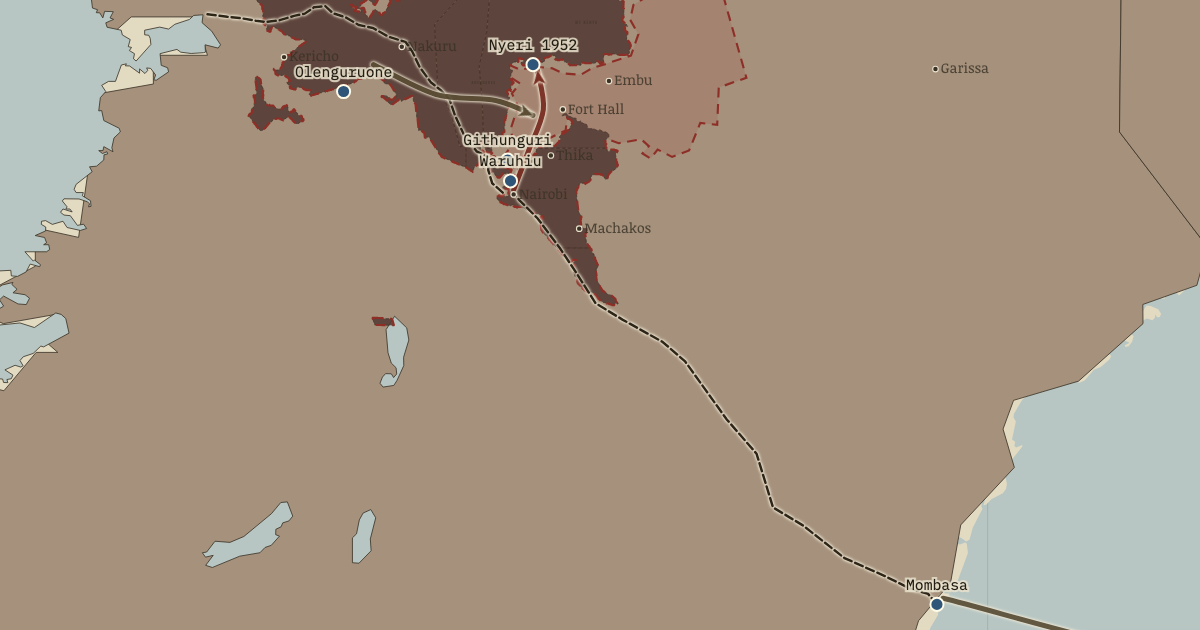
The Second World War took Kenyan soldiers far beyond the colony. About 98,000 Kenyan Africans enlisted, most in the King’s African Rifles, Britain’s East African regiment. The 11th (East Africa) Division fought into Burma in 1944–45, following the route shown by the arrow leaving Mombasa, Kenya’s main port. Waruhiu Itote, later the forest commander known as “General China”, fought beside British soldiers. Veterans had seen their colonizers frightened and beaten; the claim that Europeans were naturally invincible had become harder to sustain.
The short answer
- Petitions that won nothing. KAU asked for elected African seats and the return of alienated land—the colonial term for African land taken for European settlement. Its ability to show results was limited. Settlers dominated the Legislative Council, African elections did not come until 1957, and a petition taken to London in 1951 was rebuffed. A landless family asked to wait could see little reward for patience. Younger men began looking elsewhere for a way to change their position.
- The squatters’ bargain broke. For thirty years squatters had exchanged labor for land on settler farms. After 1945 councils reduced their cattle and cultivation, and settlers evicted those who resisted; thousands went to reserves where they held nothing. Even families already displaced to Olenguruone were evicted again in 1948–50. Their experience came to symbolize a government that could move people at will. With no secure land in sight, rebellion carried less to lose.
- Crowded reserves and compulsory work. Returning squatters found little room in the reserves, where Kikuyu farms had been divided into ever smaller plots. Officials trying to combat erosion imposed terracing—earth steps across hillsides—and other rules. Women often performed the required work without pay. In Fort Hall and Kiambu conservation became a source of resentment, and chiefs who enforced the rules and often prospered became targets. Families whose sons had gone to war now faced closer policing in the countryside.
- A generation that had seen the world. Nearly 100,000 Kenyan Africans served in Ethiopia, Madagascar, Ceylon and Burma. Abroad they saw that their rulers could be frightened and defeated; at home they encountered the same pass and land laws. Most veterans stayed out of politics. Some, including Waruhiu Itote, brought organizing skills to Nairobi militant groups, contributing confidence and discipline that officials had not expected.
THE TURNING POINT
The Kiambu road, 7 October 1952. On 7 October 1952 Senior Chief Waruhiu was killed in his car near Gachie, seven miles from Nairobi. He was the government’s most prominent Kikuyu ally. Sir Evelyn Baring, who had arrived as governor only on 30 September, took the killing as evidence that rebellion was under way. He declared a State of Emergency on 20 October; that night Operation Jock Scott began arresting Kenyatta and some 180 suspected leaders on a list. The killing pushed both sides toward violence and revealed a division within Kikuyu society itself. Loyal chiefs and oath-takers would confront one another in a civil war within the wider conflict.
What it changed
The Emergency begins. The Emergency of 20 October 1952 gave the government powers resembling martial law: it could detain people without trial, ban meetings and, later, shoot on sight in forest areas. British troops arrived by air within days. Officials expected the emergency to last weeks; it continued until January 1960. The resulting counter-insurgency—a war against a guerrilla movement—became the largest in Britain’s African empire. The next chapter follows it.
Kenyatta becomes a prisoner and a symbol. The government arrested Kenyatta on the first night and tried him at Kapenguria for managing Mau Mau. He always denied the charge, which historians now doubt. Prison removed him from the movement’s decisions, but gave Kenya’s factions a leader each could claim. Nine years later the man presented by the government as the rebellion’s organizer emerged as the only figure able to unite the nationalists and negotiate an end to colonial rule.
Kikuyu turned against Kikuyu. The oath had already divided Kikuyu communities: those who swore, willingly or under force, stood against chiefs, Christians and landholders who refused. After October 1952 these divisions hardened into armed opposition between forest fighters and the Home Guard. Daniel Branch’s account of a Kikuyu civil war within a colonial war has shaped historians’ understanding of the Emergency.
The full answer, argued
KAU asked people to pursue change through constitutional politics, but had little success to show them. Settlers dominated the Legislative Council, London moved slowly, and petitions for land and elected seats returned empty. Officials treated the oath as a crime without addressing the land crisis that fed it. Evicted squatters, families in crowded reserves and unemployed young men in Nairobi formed a constituency with little to lose. Kenyatta faced a further difficulty inside KAU: he needed militant energy and could not afford a break. His denunciations of Mau Mau at Nyeri and Kiambu were too guarded for the government and too hostile for the movement. Historians emphasize different parts of this story: Throup stresses colonial misgovernment, Kanogo the squatters’ crisis, and Branch divisions within Kikuyu society. Together they show why men promising to take change could gain support when moderate leaders could not deliver it.
An interesting fact
Kikuyu parents invested in schools as well as land claims. Their independent schools grew from the quarrel with missions over female circumcision in 1929–31. In 1939 the American-educated Peter Mbiyu Koinange founded the Kenya Teachers College at Githunguri to train their teachers; Kenyatta later ran it. That year 63 schools taught 12,964 pupils. By 1952 parents were paying for more than 400 schools. The government closed every one when the Emergency began.
This is the study layer of Origins of the Mau Mau uprising, chapter 8 of Two Roads to Independence: Haiti 1789–1838 and Kenya 1895–1978; the full index of the atlas is here.
Related questions
THE FREE PRINTABLE STUDY GUIDE
Get the printable study guide for Two Roads to Independence free. I’ll send you a few short letters, then one when a new atlas opens. That’s all. — Paul
NO TRACKING · YOUR ADDRESS IS USED FOR THE DISPATCH AND NOTHING ELSE · UNSUBSCRIBE ANYTIME