Haiti and Kenya independence · 1789
Was Saint-Domingue’s wealth the main cause of revolution?
The seminar question: “Was Saint-Domingue’s wealth the main reason it erupted into revolution?”
In 1789 Saint-Domingue, the western third of Hispaniola and today Haiti, produced roughly two-fifths of the sugar and three-fifths of the coffee consumed in Europe. That wealth was made by about half a million enslaved Africans and their children, who outnumbered the free by about eight to one, under the Code Noir of 1685.
WW2 is free in full, and chapter 1 of every atlas is free. A free account opens 3 more chapters a day. Starter, at $9 a month, opens all 21 with no daily limit — see the plans.
Free printable Haiti and Kenya independence study guide, sent by email ↓
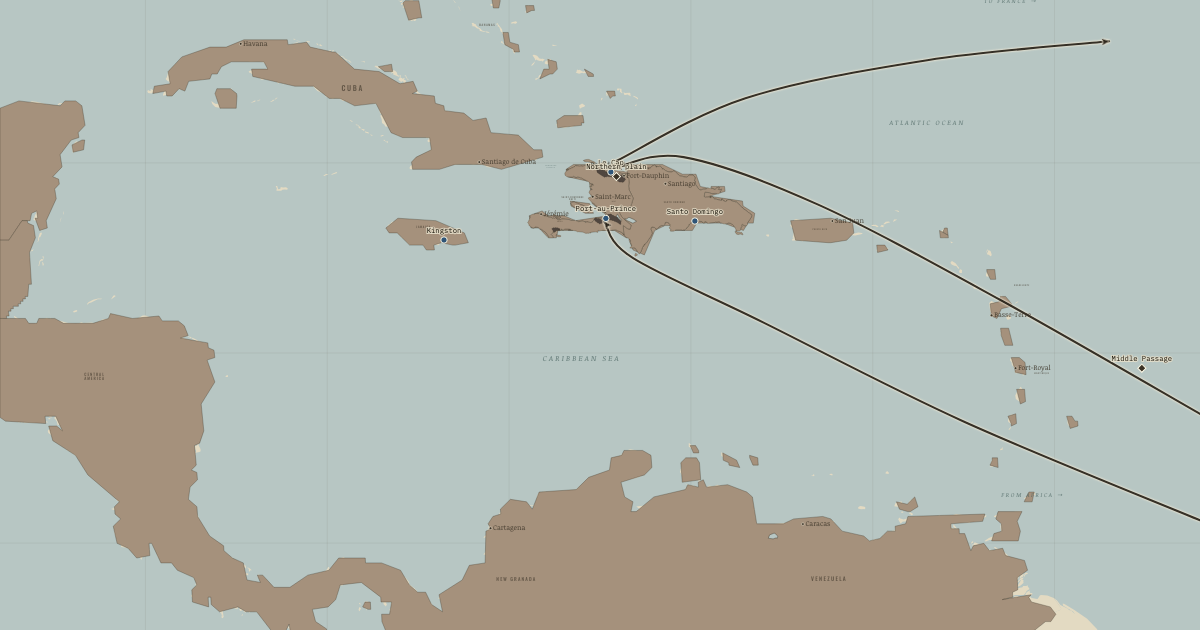
The sugar on European tables passed through a system that joined French ports, African coasts and Caribbean plantations. Ships left Nantes, Bordeaux and Le Havre carrying French goods, bought captives in Africa and landed nearly 30,000 people a year in Saint-Domingue in the late 1780s. Most came from West Central Africa, the region of the Kongo kingdom, and the Bight of Benin, on the coast of present-day Togo, Benin and southwestern Nigeria. From roughly 800 sugar estates and more than 3,000 coffee farms, produce went back to France for refining and re-export across Europe. The arrows trace this traffic. Cap-Français, the main port, known to everyone as Le Cap, had a theater, newspapers and a scientific society. Its prosperity was inseparable from the violence that supplied its labor.
The short answer
- Sugar demanded an unending supply of labour. Cane had to be cut and milled within hours before it spoiled. That made sugar, the eighteenth century's most profitable crop, exceptionally demanding of labor. After the 1760s Saint-Domingue's planters expanded sugar and added mountain coffee estates, each new estate requiring hundreds of workers. The work killed faster than families could grow. More production consequently meant buying more Africans: the colony's prosperity and the slave trade expanded together.
- Death kept the plantations African. Overwork, inadequate food and disease made deaths exceed births on the sugar estates. Planters replenished their labor force through purchases, bringing in adults who had been born free in Africa; many had been soldiers, and fewer had grown up knowing only slavery. Terror was intended to keep them working. Yet the same system assembled a majority with memories of freedom and, in many cases, military skills.
- A free society divided by colour. Free people of colour were nearly as numerous as whites by 1789, and many were prosperous planters. Their wealth did not secure equal standing. Since the 1760s laws had barred them from offices and professions and even regulated their clothing. Rich and poor whites defended restrictions on which their own racial privileges rested. A crisis arriving from France would find the free population divided over who should exercise power.
- Colonists who resented their mother country. Under the exclusif, Saint-Domingue had to trade mainly with French merchants and ships, rather like a company town obliged to buy from the company store. Wealthy planters resented the restriction and looked toward self-government after the recent independence of Britain's North American colonies. In 1789 they challenged royal officials to gain more control. Once the rich had challenged authority, people beneath them could make claims of their own.
THE TURNING POINT
Cap-Français, autumn 1789. News from France reached Le Cap in autumn 1789 with several groups ready to draw different lessons from it. The Estates-General, the king's long-unused assembly of clergy, nobles and commoners, had declared itself a National Assembly speaking for the nation. Parisians had stormed the Bastille, and the Assembly had issued the Declaration of the Rights of Man. Wealthy planters sent deputies to Paris in pursuit of self-government; poorer whites formed militias and demanded power; free people of colour, led in Paris by Julien Raimond and Vincent Ogé, claimed the equality the Declaration seemed to promise. Each group appealed to France against the others. Their quarrel divided the colony's rulers while the enslaved majority listened, with consequences none of those free claimants imagined.
What it changed
The colonists demand power. The planters created colonial assemblies to pursue autonomy against the royal governor. At Saint-Marc in 1790, the most radical assembly insisted that colonists alone should decide questions of slavery and race. But defiance could be learned by others: poorer whites and free people of colour pressed claims of their own. The next chapter follows that struggle.
Free people of colour claim equality. A claim made in Paris became a conflict in the colony. Free men of colour sought citizens' rights from the National Assembly, while white militias met their demands with violence. Vincent Ogé took up arms to enforce those rights in October 1790; his defeat and public execution turned the legal claim into a war. Free people of colour would remain a decisive force throughout the revolution.
An African-born majority with its own aims. The enslaved had reasons of their own to follow their masters' quarrels. African experience and life on the estates shaped demands to end the whip, obtain free time for their plots and, for many, gain land. Their August 1791 rising pursued those aims. Independent purpose would help define Haiti.
Plantation land, then settler land. Land connects the charcoal sugar plains to the atlas's second case. In Kenya's White Highlands, European settlers held the best land and African labor worked it. Ownership would be central to both independence struggles, yet the arrangements after independence disappointed many who had fought in them.
The full answer, argued
The sugar boom helps explain why Saint-Domingue was vulnerable. It concentrated hundreds of thousands of people around Le Cap and brought in a largely African-born workforce, including people with military experience. But Jamaica was also rich, dependent on sugar and slavery, and had no successful revolution. Wealth alone cannot explain the outcome. The French Revolution divided planters, poorer whites and free people of colour, weakening the forces that controlled the enslaved. That division opened a possibility; it did not itself organize a rising. Historians such as Fick and Thornton therefore stress the ideas and organization of the enslaved, whose agency—their capacity to plan and act—made use of the opening. In this account wealth was a necessary condition, conflict among the free created an opportunity, and the enslaved made the revolution. A coercive system becomes particularly fragile when its rulers fall out.
An interesting fact
Science and slavery met in the Cercle des Philadelphes at Cap-Français. Founded in 1784 and granted royal status in 1789, it was one of the first scientific societies in the Americas. Its members published research in France on tropical medicine, botany, natural history and weather. Much of their work served plantations: improving sugar cultivation and milling, fighting epidemics among soldiers and, in the language of the time, keeping enslaved workers alive long enough to repay their purchase. Historian James McClellan described the colony as a place where Enlightenment science served the slave economy.
This is the study layer of Slavery in colonial Saint-Domingue, chapter 1 of Two Roads to Independence: Haiti 1789–1838 and Kenya 1895–1978; the full index of the atlas is here.
Related questions
THE FREE PRINTABLE STUDY GUIDE
Get the printable study guide for Two Roads to Independence free. I’ll send you a few short letters, then one when a new atlas opens. That’s all. — Paul
NO TRACKING · YOUR ADDRESS IS USED FOR THE DISPATCH AND NOTHING ELSE · UNSUBSCRIBE ANYTIME