Haiti and Kenya independence · 1825
How far did the 1825 indemnity shape Haiti’s history?
The seminar question: “How far did the indemnity shape Haiti’s history after 1825?”
In April 1825 Charles X recognised Haiti’s independence if it halved duties on French goods and paid 150 million francs to former colonists for lost property that had included enslaved people. President Boyer accepted in July 1825, and Haiti borrowed in Paris to pay, creating a double debt that lasted a century.
Chapter 6 is included with every paid plan. WW2 is free in full, and chapter 1 of every atlas is free. A free account opens 3 more chapters a day. Starter, at $9 a month, opens all 21 with no daily limit — see the plans.
Free printable Haiti and Kenya independence study guide, sent by email ↓
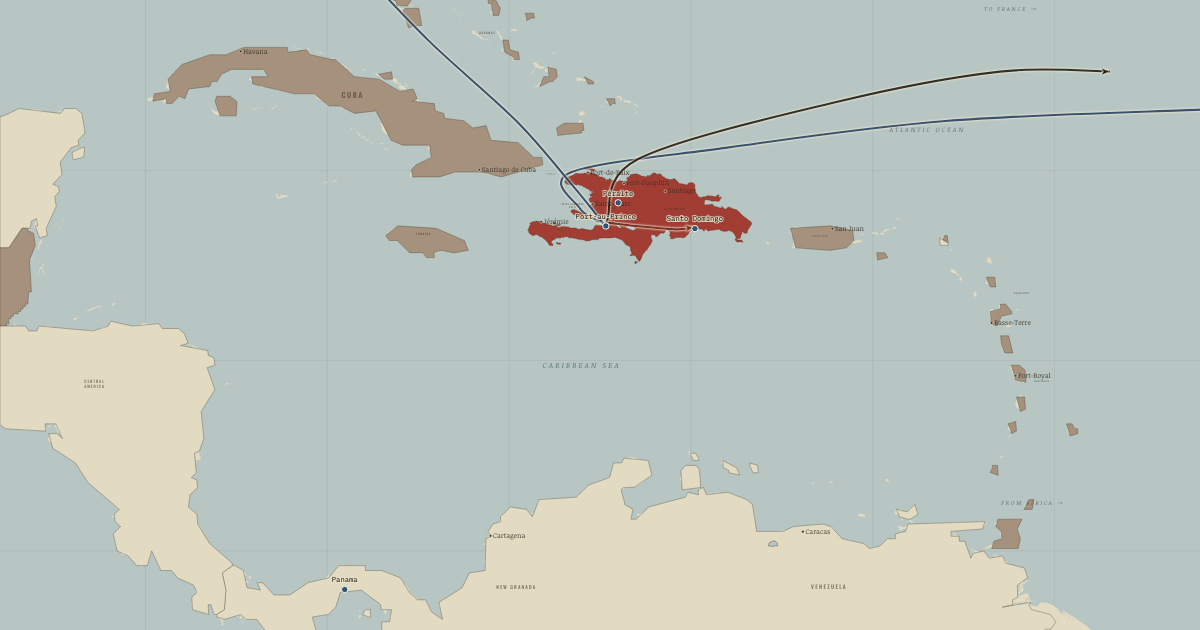
Haiti had defeated France, but the victory did not secure acceptance by other powers. Since 1804 no great power had formally recognised it as a sovereign state with which treaties could be signed, much as governments today decide whether to recognise a breakaway region. The United States banned trade in 1806, and France continued to claim the colony. President Jean-Pierre Boyer sought secure borders and open trade. He had reunited the north in 1820 and marched into Santo Domingo in 1822, along the arrow crossing the island.
The short answer
- Isolation after 1804. Haiti’s independence left it isolated. No great power recognised it after 1804; under pressure from slaveholders the United States banned trade in 1806, Spain retained Cuba and Puerto Rico, and Britain dealt with Haiti informally. Recognition would make treaties and credit easier to obtain while leaders feared invasion. By the 1820s Boyer considered it worth almost any price.
- A claim France never abandoned. Former colonists pressed Paris for compensation or reconquest after France’s defeat in 1803. French ministers sent envoys in 1814 and 1816 to negotiate the colony’s return. The Bourbon kings, restored after Napoleon’s fall in 1814–15, faced the planters’ lobby and could satisfy it through an indemnity without a war France could not afford. The 1825 ordinance turned the lost colony into a source of revenue.
- Boyer’s need for security and trade. After 1822 Boyer governed the whole island. He had to maintain a large army against France while relying on coffee exports. A settlement promised trade revenue and the possibility of reducing the army. He believed the alternative to harsh terms was a war Haiti might not survive, and made his decision under the guns of Mackau’s squadron.
- Money borrowed on others’ terms. Paris was Haiti’s only source of credit, giving bankers control over the terms. The 1825 loan yielded 24 million francs but left 30 million owed; fees also consumed a large share of the 1874–75 loans. Each refinancing paid an earlier obligation while adding interest and charges, extending the chain of debt.
THE TURNING POINT
Port-au-Prince, July 1825. In July 1825 Mackau arrived at Port-au-Prince with warships in the bay and an ordinance already written in Paris. Boyer accepted within five days, believing refusal meant war. Recognition ended the threat of French reconquest and opened trade, but the demand required borrowing and committed state finances for generations. France had treated Haitian freedom as something it could sell. Disputes from the 1838 treaty to the 2025 commission began with that week.
What it changed
A double debt for a century. The indemnity and its loans drew on Haitian revenue from the 1820s until 1947, with creditors changing from French bankers to American ones. Historians debate the burden’s effect on schools, roads and investment, while agreeing that it narrowed Haiti’s choices. The epilogue places it beside Kenya’s burden of land bought back from settlers for independence.
The east breaks away. Boyer’s whole island bore the indemnity’s cost. In the east, taxes and conscription fed resentment; Boyer was overthrown in 1843. On 27 February 1844 Santo Domingo declared itself the Dominican Republic, and the map changes the eastern half’s colour. The Dominican nation won independence from Haiti, with which it would share Hispaniola.
From French bankers to American Marines. Foreign financial control preceded the US occupation. In 1910–11 a consortium including New York’s National City Bank took over the national bank, and US Marines removed its gold in 1914. During the occupation of 1915–34, the United States controlled customs and finances and suppressed peasant resistance led by Charlemagne Péralte. The Marines departed in 1934, but American control of customs continued until the last debts were paid in 1947: another thirteen years of foreign financial management.
The full answer, argued
The indemnity placed a substantial weight on Haiti. Payments and the loans behind them drained revenue for more than a century, encouraged taxes on coffee peasants and imports, made customs houses targets in every coup and opened the way to American financial control and occupation. The New York Times estimate of 21 to 115 billion dollars in lost growth expresses that weight in a model. But political instability, elite rivalries, environmental decline and the occupation itself also shaped Haiti; counterfactual models cannot separate their effects cleanly. Historians such as Dubois treat the indemnity as a structural burden interacting with internal choices. The fiscal drain followed directly from the debt, while dependence and instability were outcomes it made more likely. Recognition’s terms bound Haiti long after the ceremony.
An interesting fact
A French print issued in 1825 celebrated the ordinance with an image of King Charles X giving freedom to a kneeling Black figure. Now held by the Bibliothèque nationale de France, it presents independence as the king’s gift to Saint-Domingue and Haitians as supplicants. Yet they had won that freedom at Vertières, the November 1803 battle that ended French rule. The print transformed a forced payment into a picture of royal generosity, showing how France told the story to itself.
This is the study layer of Haiti’s independence debt, chapter 6 of Two Roads to Independence: Haiti 1789–1838 and Kenya 1895–1978; the full index of the atlas is here.
Related questions
THE FREE PRINTABLE STUDY GUIDE
Get the printable study guide for Two Roads to Independence free. I’ll send you a few short letters, then one when a new atlas opens. That’s all. — Paul
NO TRACKING · YOUR ADDRESS IS USED FOR THE DISPATCH AND NOTHING ELSE · UNSUBSCRIBE ANYTIME