Haiti and Kenya independence · 1803
Why did Napoleon’s expedition to Saint-Domingue fail?
In 1801 Napoleon sent General Leclerc to restore French control of Saint-Domingue; some 31,000 soldiers landed over two years. Toussaint’s generals submitted in spring 1802 and he was seized and shipped to France, but yellow fever and renewed unity against a feared return of slavery destroyed the expedition by November 1803.
Chapter 4 is included with every paid plan. WW2 is free in full, and chapter 1 of every atlas is free. A free account opens 3 more chapters a day. Starter, at $9 a month, opens all 21 with no daily limit — see the plans.
Free printable Haiti and Kenya independence study guide, sent by email ↓
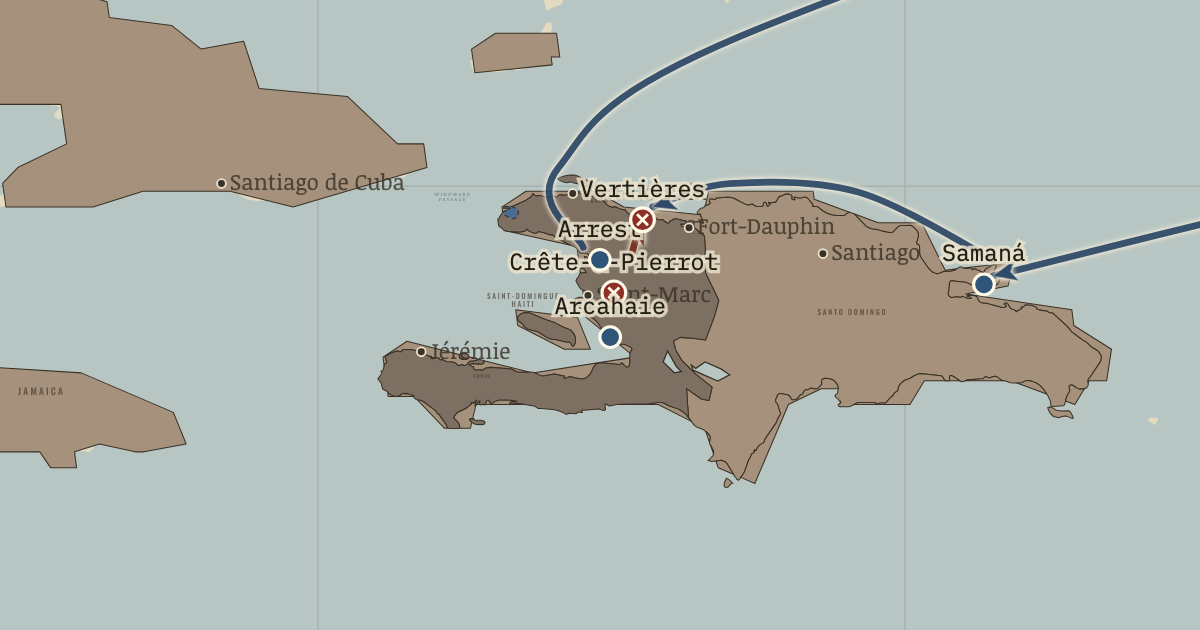
Napoleon publicly promised the people of Saint-Domingue that their freedom would be respected. His orders to General Leclerc, who sailed from Brest on 14 December 1801, had another purpose as well: disarm the colony’s Black generals and send them to France. The expedition would restore French control over a colony that had come to govern itself.
The short answer
- A constitution that alarmed Paris. By 1801 Toussaint had given the colony a constitution, governed the whole island and traded with Britain and the United States. Napoleon feared losing France’s richest colony and wanted its plantation economy restored to finance his ambitions. Planters in Paris pressed him to act. Saint-Domingue’s self-government had become a challenge to French rule.
- Peace in Europe freed France to act. Preliminary peace with Britain in October 1801 opened an Atlantic crossing without British interception. Napoleon used the pause to send one of France’s largest overseas fleets. The position reversed when war resumed in May 1803: Britain blockaded the French garrisons and deprived them of men and supplies.
- A plan to disarm the colony. Submission placed officers in French hands, but Leclerc’s orders called for their Black army to be disarmed and its leaders deported. They saw soldiers disarmed and, in June 1802, Toussaint seized after making peace. The guarantees offered at submission had failed. Distrust helped turn the defeated army into a revolutionary force again.
- Divisions inside Saint-Domingue. France found allies because Saint-Domingue was divided. André Rigaud and Alexandre Pétion, defeated in the 1799–1800 War of Knives against Toussaint, sailed with Leclerc. Many cultivators resented Toussaint’s labor code, and some officers expected France to win. French policy later threatened the freedom of these groups alike. Their reunion at Arcahaie in May 1803 closed the division that had helped the expedition gain its opening.
THE TURNING POINT
Vertières, 18 November 1803. Le Cap’s defenses stood at Vertières. On 18 November 1803 Dessalines’ army attacked the forts; Haitian tradition celebrates François Capois, Capois-la-Mort, charging under fire. Within two days Rochambeau agreed to evacuate, sailing with some 6,000 men into the hands of the British squadron offshore. The Môle’s last French garrison left in early December. Former slaves had defeated Europe’s strongest military power, ending French rule; six weeks later their leaders declared independence.
What it changed
Independence is declared. The generals gathered at Gonaïves on 1 January 1804 and declared independence. Their country took the name Haiti from the Taíno, the island’s first Indigenous inhabitants, and Dessalines became governor-general for life. The name marked the end of the colony. Defining citizenship and protecting the new state against a French return remained to be settled in the next chapter.
Napoleon abandons the Americas. Napoleon’s failing expedition helped persuade him to abandon his American empire. In April 1803 he sold Louisiana to the United States for 15 million dollars, more than doubling the young republic’s size. The revolution thus reshaped North America, although the United States refused to recognize Haiti for almost sixty years. The country whose victory helped enlarge it was shunned.
A war remembered as extermination. The drownings, dogs and other killings under Rochambeau left a memory of extermination. Haitian leaders feared France would return to finish the work. That fear, rooted in the war of 1802–03, influenced their treatment of the French who remained, including the killings of 1804 discussed as a memorial in the next chapter. The war’s memory shaped Haitian politics for generations.
The full answer, argued
French policy helped produce the resistance that defeated the expedition. By May 1802 France held most of the colony and might have survived the fever season had it remained quiet. But Toussaint’s arrest and the restoration of slavery in Guadeloupe convinced former slaves and free people of color that France meant to re-enslave them. They united under Dessalines, whose leadership sustained the fight. Yellow fever killed Leclerc and most of his soldiers; McNeill’s differential immunity helps explain why Europeans died while local fighters survived. Renewed war with Britain in 1803 cut French supply lines. The political rupture, disease and blockade worked together against an army whose promises had lost credibility.
An interesting fact
Roughly 5,000 Polish legionaries served among Napoleon’s troops in Saint-Domingue. They had joined France hoping it would restore Poland’s independence. Some deserted or refused to fight people they saw as fellow victims of oppression, and a few hundred remained in Haiti. Dessalines’ 1805 constitution recognized “Germans and Poles naturalised by the government” as Haitians, making an exception for them. Cazale still claims descent from the legionaries. Polish painter January Suchodolski depicted them in Saint-Domingue in a canvas now at the National Museum in Warsaw.
This is the study layer of Napoleon’s Saint-Domingue expedition, chapter 4 of Two Roads to Independence: Haiti 1789–1838 and Kenya 1895–1978; the full index of the atlas is here.
Related questions
THE FREE PRINTABLE STUDY GUIDE
Get the printable study guide for Two Roads to Independence free. I’ll send you a few short letters, then one when a new atlas opens. That’s all. — Paul
NO TRACKING · YOUR ADDRESS IS USED FOR THE DISPATCH AND NOTHING ELSE · UNSUBSCRIBE ANYTIME