Haiti and Kenya independence · 1801
Was Toussaint Louverture a liberator or a new master?
Toussaint Louverture, born enslaved around 1743, joined the insurgents in 1791 and by 1793 led an army serving Spain. After Sonthonax abolished slavery in the North in August 1793 and the Convention ended it in all French colonies in February 1794, Toussaint joined the Republic; by 1801 he governed under his own constitution.
Chapter 3 is included with every paid plan. WW2 is free in full, and chapter 1 of every atlas is free. A free account opens 3 more chapters a day. Starter, at $9 a month, opens all 21 with no daily limit — see the plans.
Free printable Haiti and Kenya independence study guide, sent by email ↓
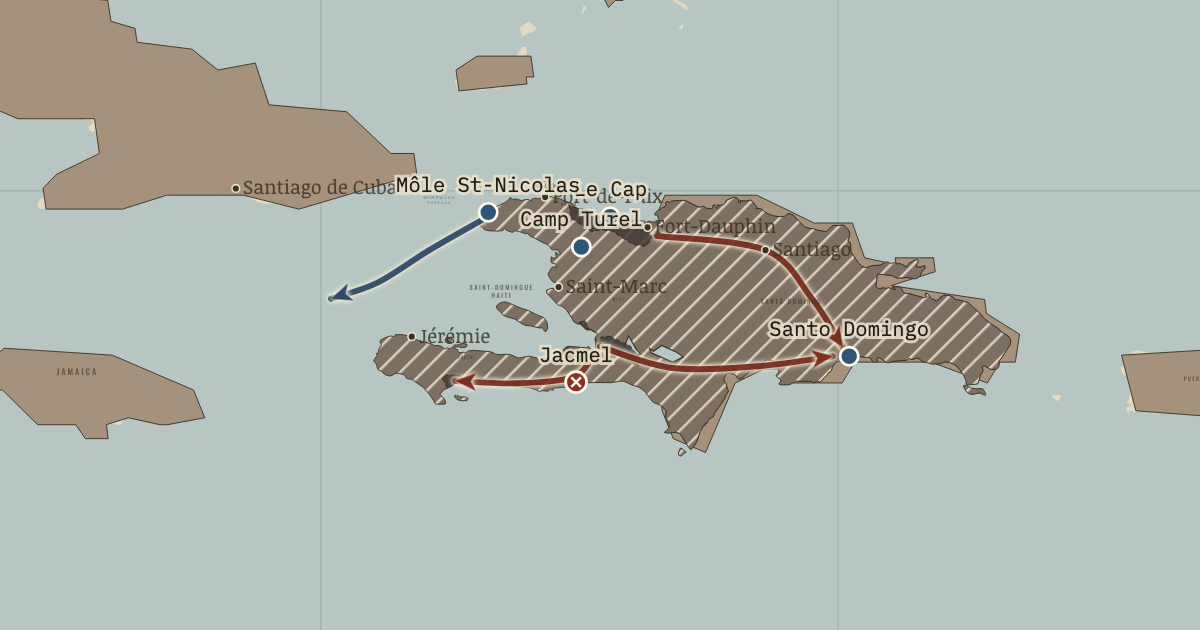
The struggle for Saint-Domingue put the meaning of freedom into the hands of rival powers. In 1793 Spain paid northern insurgent leaders as auxiliaries, or allied fighters on a salary. Planters in the West and South invited British troops to Jérémie and the Môle, hoping to preserve slavery. France’s commissioner Sonthonax, holding Le Cap with too few soldiers, sought fighters by offering them freedom. On 29 August he proclaimed general emancipation in the North, invoking the words “men are born and remain free and equal in rights”.
The short answer
- Imperial war made freedom a weapon. France’s commissioners lacked the soldiers to hold Saint-Domingue against Spain and Britain in 1793. The insurgents offered a large army, and Sonthonax offered its members freedom: first to those who fought and then to all. Britain and Spain kept slavery and could not match that promise. France made emancipation policy while fighting for a colony whose enslaved people it needed.
- An army of the formerly enslaved. Former slaves and free people of color filled the disciplined army Toussaint built. It learned European drill and guerrilla tactics, and its officers, including Jean-Jacques Dessalines and Henry Christophe, owed their rank to him. Personally loyal to Toussaint, the army defeated rivals and made him indispensable to France. His authority over the colony rested on that force.
- Disease fought for Saint-Domingue. Britain sent about 20,000 troops to Saint-Domingue; more than half died, most of disease within months of landing. Mosquito-borne yellow fever was particularly deadly to newly arrived European soldiers. Toussaint’s troops, born or long settled in the Caribbean, had much greater resistance. Napoleon’s expedition would face the same disease environment in 1802.
- France was far away and divided. The Atlantic separated Paris from its colony, and the British navy controlled the crossing. From 1795 to 1799 the Directory, France’s weak five-man executive, was also fighting wars across Europe. It could send commissioners and generals more readily than the soldiers needed to enforce their authority. Toussaint used the space this left him to expel officials he distrusted, negotiate with Britain and the United States, and govern as he chose.
THE TURNING POINT
The Constitution of 1801. The constitution adopted on 9 May 1801 and proclaimed in July gave Toussaint’s military rule a legal form. A law drafted in Saint-Domingue defined its people, for the first time, as free and equal citizens regardless of color, while giving him power for life. France now had to decide whether to accept a colony that wrote its own constitution. Napoleon, newly at peace with Britain, saw his authority slipping away and an opportunity to restore the plantation empire. Within six months one of the largest fleets France had sent across the Atlantic sailed to regain control.
What it changed
Napoleon decides to reconquer. Napoleon saw Toussaint’s constitution, occupation of Santo Domingo and independent diplomacy as grounds for restoring French control. The preliminary peace with Britain in October 1801 freed the navy to carry an army; General Leclerc’s expedition sailed in December. Seven years of accumulated autonomy now faced a French invasion.
Freedom defined as plantation work. The Moyse rising revealed resistance to the labor code’s military discipline on the estates. Later rulers faced the same dispute over export plantations and family land. Christophe retained estates in the north; Pétion began dividing them in the south, a contrast visible on the 1807 map. The argument over land became Haiti’s longest political quarrel.
One island, two memories. Toussaint’s 1801 occupation abolished slavery in Santo Domingo and put all Hispaniola under one ruler for the first time. For many Dominicans it also began a memory of Haitian rule, renewed in 1805 and from 1822 to 1844. That history continues to shape relations between the two nations sharing the island.
The full answer, argued
Toussaint made emancipation effective against European rivals, defeated Spain and Britain, abolished slavery in Santo Domingo and wrote freedom and racial equality into law. He also made himself governor for life, forced cultivators to work plantations, had his nephew Moyse shot for leading their protest and provided for workers from abroad. Fick and Casimir emphasize the distance between ruler and ruled; Hazareesingh sees a statesman trying to finance the defense of a free society. Toussaint believed control of labor was needed to preserve freedom. His government joined the two, carrying methods of war into the society the war had liberated.
An interesting fact
The name Louverture began appearing on Toussaint’s signatures in 1793. Before then he was known as Toussaint Bréda, after the estate where he was born. The August proclamation at Camp Turel is among the first documents bearing the new name, French for “the opening”. Its meaning remains debated: it may have celebrated his ability to find a way through enemy lines or announced a road to freedom. A man once registered as property had chosen a name for what he meant to do.
This is the study layer of Toussaint Louverture, chapter 3 of Two Roads to Independence: Haiti 1789–1838 and Kenya 1895–1978; the full index of the atlas is here.
Related questions
THE FREE PRINTABLE STUDY GUIDE
Get the printable study guide for Two Roads to Independence free. I’ll send you a few short letters, then one when a new atlas opens. That’s all. — Paul
NO TRACKING · YOUR ADDRESS IS USED FOR THE DISPATCH AND NOTHING ELSE · UNSUBSCRIBE ANYTIME